Z Pulley Mechanical Advantage Calculator
Estimate the real mechanical advantage of a Z-pulley or Z-rig after pulley efficiency, progress-capture drag, rope bend friction, edge friction, slope angle, hauler count, and anchor safety margin.
🪢Z-Pulley Haul Presets
⚙Pulley, Friction, Load, and Anchor Inputs
This calculator is a planning and training aid for understanding force, friction, and rope travel. It is not rigging instruction. Use rated equipment, manufacturer instructions, formal rescue training, redundant anchors where required, and local judgment before loading a system.
📐Four Formula Cards
Effective Load
W x sin(angle) + dragThe load is adjusted for slope angle, then surface or edge friction is added.
Z-Rig Efficiency
1 + P + P x R x CA 3:1 Z-pulley loses force through the moving pulley, redirect, and progress capture.
Haul Force
effective load / real MAThe required haul-line pull falls as real mechanical advantage rises.
Anchor Margin
rating / anchor loadEstimated anchor load is compared with the selected anchor rating and target factor.
🪢Rope and Pulley Specification Grid
📊Mechanical Advantage Reference Tables
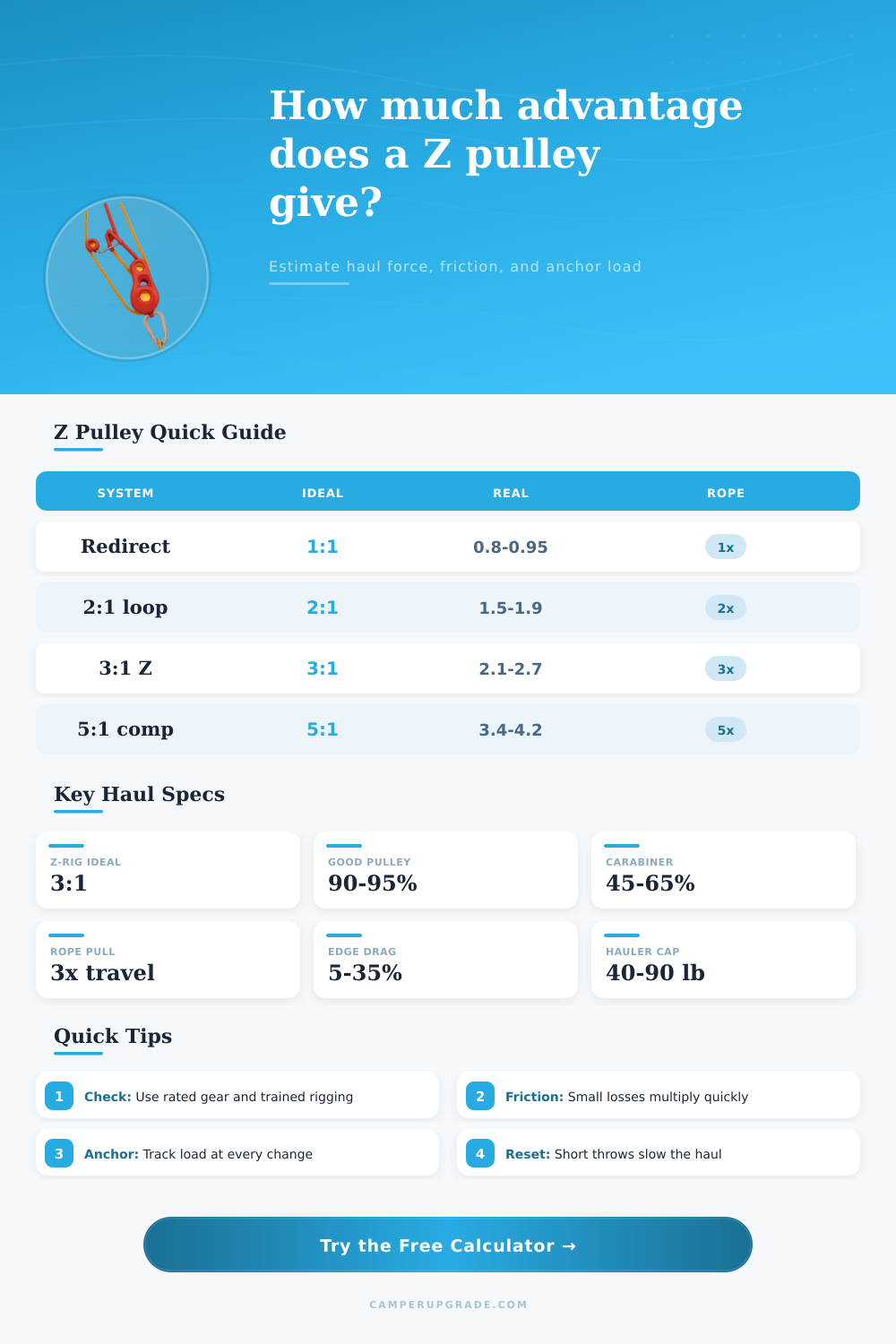
| System | Ideal MA | Real Range | Rope Pulled |
|---|---|---|---|
| Change of direction | 1:1 | 0.75-0.95 | 1x movement |
| 2:1 drop loop | 2:1 | 1.45-1.90 | 2x movement |
| 3:1 Z-pulley | 3:1 | 2.10-2.70 | 3x movement |
| 5:1 compound | 5:1 | 3.40-4.25 | 5x movement |
| 9:1 double Z | 9:1 | 5.50-7.20 | 9x movement |
| Pulley Type | Efficiency | Z-Rig Effect | Use Note |
|---|---|---|---|
| Sealed rescue pulley | 92-96% | high | best haul |
| Small climbing pulley | 85-92% | good | compact |
| Pulley carabiner | 75-85% | moderate | fast setup |
| Round carabiner | 55-70% | poor | emergency |
| Sharp bend or knot | 35-55% | very poor | avoid load |
| Load | Ideal 3:1 | Real 2.5:1 | Real 2.1:1 |
|---|---|---|---|
| 100 lb | 33 lb | 40 lb | 48 lb |
| 200 lb | 67 lb | 80 lb | 95 lb |
| 300 lb | 100 lb | 120 lb | 143 lb |
| 500 lb | 167 lb | 200 lb | 238 lb |
| 1000 lb | 333 lb | 400 lb | 476 lb |
| Lift Needed | 2:1 Pull | 3:1 Pull | 5:1 Pull |
|---|---|---|---|
| 3 ft | 6 ft | 9 ft | 15 ft |
| 6 ft | 12 ft | 18 ft | 30 ft |
| 10 ft | 20 ft | 30 ft | 50 ft |
| 15 ft | 30 ft | 45 ft | 75 ft |
| 25 ft | 50 ft | 75 ft | 125 ft |
💡Z-Pulley Calculation Tips
A Z-rig use a 3:1 ratio to make it easier for a persons to move a load. With a perfect 3:1 Z-rig, a person only have to apply one-third of the load’s weight. However, friction in a Z-rig make it imposible for it to maintain such a perfect 3:1 ratio.
There are multiple type of friction in a Z-rig. The rope rub against the hardware causes one type of friction. Another type of friction is caused by the load rubbing against the ground.
How friction and anchors change a Z-rig
Additionally, whenever the rope passes over a carabiner, friction are created at that point of contact. Because friction reduce the mechanical advantage of the system, a 3:1 Z-rig will not always work as a 3:1 system; it may work more like a 2:1 system, or one with even less mechanical advantage than that. To manage a Z-rig correctly, a person must understand the concept of effective load.
The effective load are the total load that a person must fight to move the object. If a person lift an object, they are fighting the force of gravity. However, if a person pull a load across the ground, they are fighting both gravity and the friction between the object and the ground’s surface.
The force of friction between the load and the ground is called surface friction. Therefore, the effective load will always be more greater than the actual weight of the object being moved. This is due to the fact that the effective load includes the force of gravity and the force of surface friction.
The efficiency of the hardware used in the Z-rig can also impact the mechanical advantage of the system. A professional rescue pulley are created to minimize friction within the system. However, a carabiner isnt create to minimize friction.
Therefore, if a person incorporates many carabiners into a Z-rig, there will be many instances of friction in the system. These instance of friction will increase the force that a person must apply to move the load. Many people may think that adding more pulleys to increase the mechanical advantage to a 5:1 or even 9:1 system will make it easier to pull the load.
However, if the efficiency of the hardware is low, the force lost due to friction may even cancel the mechanical advantage provided by the increase in the number of pulley. A Z-rig also involve a trade-off between force and distance. A 3:1 Z-rig will require a person to pull three times the distance of the distance that the load will be moved.
A person will not have thirty foot of rope to pull. Therefore, the load will have to be reset. To reset the Z-rig, a person pulls the rope until the rope run out of movement.
The person then hold the object with a progress-capture device and slide the pulley down the rope. Resets are inefficient at best because a person must start over every time to continue to move the load. Each reset will break the persons momentum and may even increase their fatigue.
Finally, another factor to consider with a Z-rig is the anchor. The anchor must be able to hold the load of the object being move. However, it must also be able to withstand the force applied to the rope.
If a person pulls on the rope to overcome the friction in the system, they will add more force to the anchor. If a marginal anchor is used, such as a small tree or snow picket, this extra force could easily result in the anchor failing. The margin of the anchor must be checked to make sure that it is able to handle the force of the load and the force that the person place upon the rope.
Finally, by being able to calculate the mechanical advantage of a system, a person can plan the task. If a person knows the real mechanical advantage of a Z-rig, a person can decide if more people is needed to move the rope, or if the carsabiner is too inefficient and should of been replaced. By accounting for all of the factors mentioned, a person is able to manage a Z-rig effective.