Wood Stove Flue Diameter Calculator
Compare stove collar size, liner shape, chimney exposure, height, elbows, and altitude to estimate a practical flue diameter and draft risk.
Flue Diameter Results
| Component | Where It Is Used | Sizing Effect | Planning Note |
|---|---|---|---|
| Single-wall connector | Room-side stove pipe before chimney | Usually same diameter as collar | Loses heat faster; needs listed clearances. |
| Double-wall connector | Connector where draft or clearance matters | Same nominal diameter, warmer gases | Often helps short or marginal draft systems. |
| Class A chimney | Through ceiling, attic, roof, or outside wall | Listed insulated chimney section | Use matching brand/system parts and supports. |
| Stainless round liner | Masonry chimney relining | Best match for round stove collars | Insulation improves draft and creosote resistance. |
| Oval stainless liner | Narrow masonry flues or inserts | Area must still match required round area | Check actual inside area, not just nominal label. |
| Clay tile masonry flue | Existing masonry chimney | Can be oversized for modern stoves | Large cold tiles often need a listed liner. |
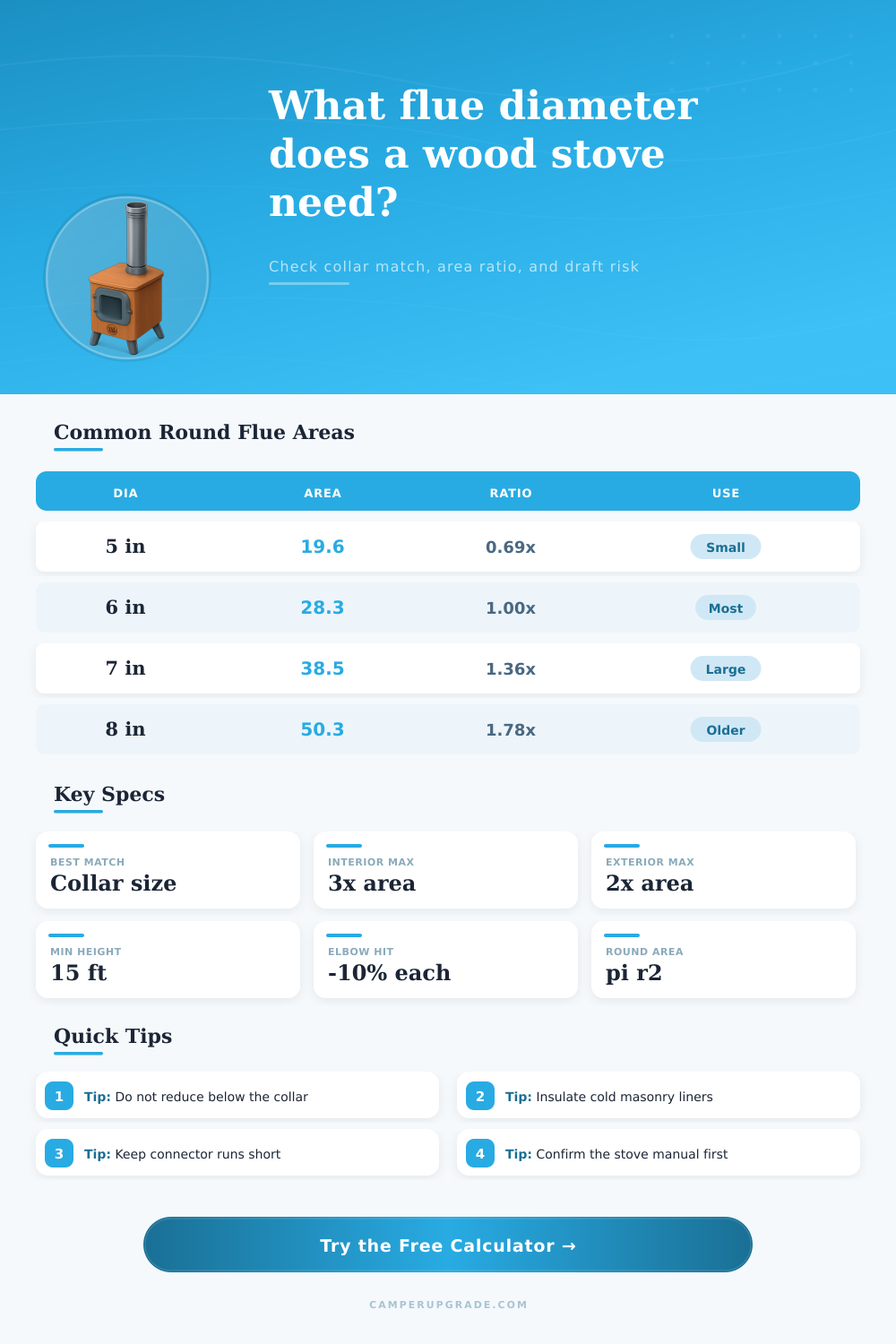
| Round Diameter | Area | Metric Area | Common Wood Stove Use |
|---|---|---|---|
| 5 in | 19.6 sq in | 126.7 cm² | Compact listed stoves only when manual allows. |
| 5.5 in | 23.8 sq in | 153.3 cm² | Uncommon adapter size; check listing carefully. |
| 6 in | 28.3 sq in | 182.4 cm² | Most current residential wood stoves. |
| 7 in | 38.5 sq in | 248.3 cm² | Some larger or older appliances. |
| 8 in | 50.3 sq in | 324.3 cm² | Large stoves, older units, or some inserts. |
| 10 in | 78.5 sq in | 506.7 cm² | Usually too large for a 6 in modern stove. |
| Stove Collar | Minimum Flue Area | Interior Chimney Max | Exterior Chimney Max |
|---|---|---|---|
| 5 in round | 19.6 sq in | 58.9 sq in | 39.3 sq in |
| 6 in round | 28.3 sq in | 84.8 sq in | 56.5 sq in |
| 7 in round | 38.5 sq in | 115.5 sq in | 77.0 sq in |
| 8 in round | 50.3 sq in | 150.8 sq in | 100.5 sq in |
| Liner Or Tile Inside Size | Approx Area | Equivalent Round | Fit Against 6 in Collar |
|---|---|---|---|
| 4.5 x 7.5 in oval | 26.5 sq in | 5.8 in round | Below a 6 in collar unless listed. |
| 5 x 8 in oval | 31.4 sq in | 6.3 in round | Usually near a 6 in round liner. |
| 6 x 10 in oval | 47.1 sq in | 7.7 in round | May be oversized for exterior masonry. |
| 8 x 8 in tile | 64.0 sq in | 9.0 in round | Often large for a 6 in stove. |
| 8 x 12 in tile | 96.0 sq in | 11.1 in round | Oversized for most 6 in stoves. |
| Condition | Calculator Penalty | Why It Matters | Better Direction |
|---|---|---|---|
| Chimney under 15 ft | Up to 18 points | Less warm vertical column to create draft. | Add listed height if the manual allows. |
| Each 90° elbow | 10 points | Turns add friction and slow flue gases. | Use straighter connector routing. |
| Long horizontal run | 3 points per ft over 2 ft | Horizontal pipe cools and resists draft. | Keep upward slope and shorten the run. |
| Cold exterior masonry | 18 points | Cold flue walls reduce buoyancy and increase deposits. | Use an insulated listed liner. |
| High altitude over 3000 ft | 4 points per 1000 ft | Thinner air lowers pressure difference. | Favor warm, tall, correctly sized systems. |
Backdrafting is a problem wood stove user know well. It’s cold outside, so you build up the fire and then you smell smoke in your livin room. Perhaps you bought the right chimney pipe, followed the manual and ensured proper clearance but still the fire keeps sputtering out. What gives?
It isn’t typically the stove. Typically, it is how the collar size work with whatever system you constructed around it. For example, a six inch stove require a certain amount of buoyancy to raise those hot gases. Adding too much elbow or changing shape of the pipe robs that buoyant force. After entering your roof height (local) and liner type into the calculator above, it will make those tradeoffs for you. Most homeowners don’t consider these things until it’s too late to do anything about them, but they are all part of equation.
Why Smoke Comes Back Into Your Room
Altitude has more effect then you’d think because thinner air at higher elevations reduces natural draft pressure. A system that operates well in Phoenix may not perform as well in Denver. The calculator takes all of that into account and applies penalties depending on chimney exposure and site elevation. It also accounts for friction losses in each 90 degree elbow; if you’ve got a long horizontal run across your basement ceiling, that adds up fast.
Bigger is not always better. Most people assume that bigger is better, right? That’s how most folks envision it: they think a larger pipe moves air faster, but the reality is actualy the opposite. Nope. If you use a pipe that’s too big, it will allow smoke to cool down rapidly as it rise. And cold smoke isn’t buoyant. It doesn’t shoot out the top; it pools in the chimney.
That poses two obvious issues. First, your draft won’t be steady at start-up. Second, those cool gases will begin to condense into creosote, a very flammable tar that forms on walls of your liner, essentially creating a trap for harmful deposits just outside your home’s framing.
The golden rule of installing is to match the collar size. For example, if your stove’s outlet is six inches, your whole path to the chimney should generaly be about that same size. If you’ve got an exterior, masonry chimney that remains cold, that’s okay too. The added volume will help keep gas warm, provided you pay attention to ratios in the area.
The table on the page spells it all out, maximum square inch allowances for interior versus exterior chimneys, and as long as you’re inside these bounds, you’ll avoid the cooling effects of oversized areas without sacrificing flow space. But surprisingly, shape matter: Round liners perform better than oval or rectangular tiles; they hold heat more efficienty, with less turbulence. Oval liners may be necessary just because they fit physically where a round won’t (fine, provided the cross-sectional area matches what’s required by the stove). The calculator transforms these oddball dimensions into corresponding rounds. This lets you line them up to see at a glance whether that sexy six-by-ten inch tile is realy too small for the job.
Short chimneys, in other words, no thermal column height; simply won’t pull the air up well enough; this is a classic case where a basic geometric mistake causes drafts. The solution: Add height (within listing limits) above the flashing instead of lengthening the connector pipe if that’s what you’ve got.
Insulate, the uninsulated liner in a cold masonry chimney will murder your draft each night in winter. You should of use a double-wall stainless system, or at least a ceramic wrap to keep the gases hot enough to rise naturaly. It’s not about warmth; it’s about clean burning, with clean exhaust removed safely from inside your home.
So height plus number of turns plus collar size equals a consistent rising column of air, which in turn means the stove has plenty of draft, gets hot enough to burn cleanly, and leaves less residue behind. Your calculator will tell you all this by measuring a draft risk score, which you can trust.
But also realize that your physical install needs to match these numbers exactly, since every time there’s smoke, it takes the path of least resistance. That’s gotta be outside your house. Not up your lungs.