Windsurf Sail Size Calculator
Estimate a windsurf sail size from rider weight, steady wind, gusts, board volume, board width, water state, skill level, and sailing style.
🏄Windsurf Session Presets
⚙Rider, Wind, Board, Skill, and Water Inputs
This calculator estimates a rigging range for normal freeride gear. Always choose the smaller size when the launch, current, shore break, or rescue situation demands extra control.
🔢Sail Size Calculation Cards
Wind Power
wind squaredSail force rises quickly as wind builds, so the calculator trims area fast above the mid-teens.
Rider Load
kg ratioHeavier riders usually need more square meters for the same planing threshold and stance pressure.
Board Carry
liters + widthWide, high-volume boards can carry larger rigs; narrow boards cap practical sail leverage.
Control Trim
gust + chopGust spread, water state, skill, and session goal move the final number toward control or power.
🧰Sail and Rig Spec Grid
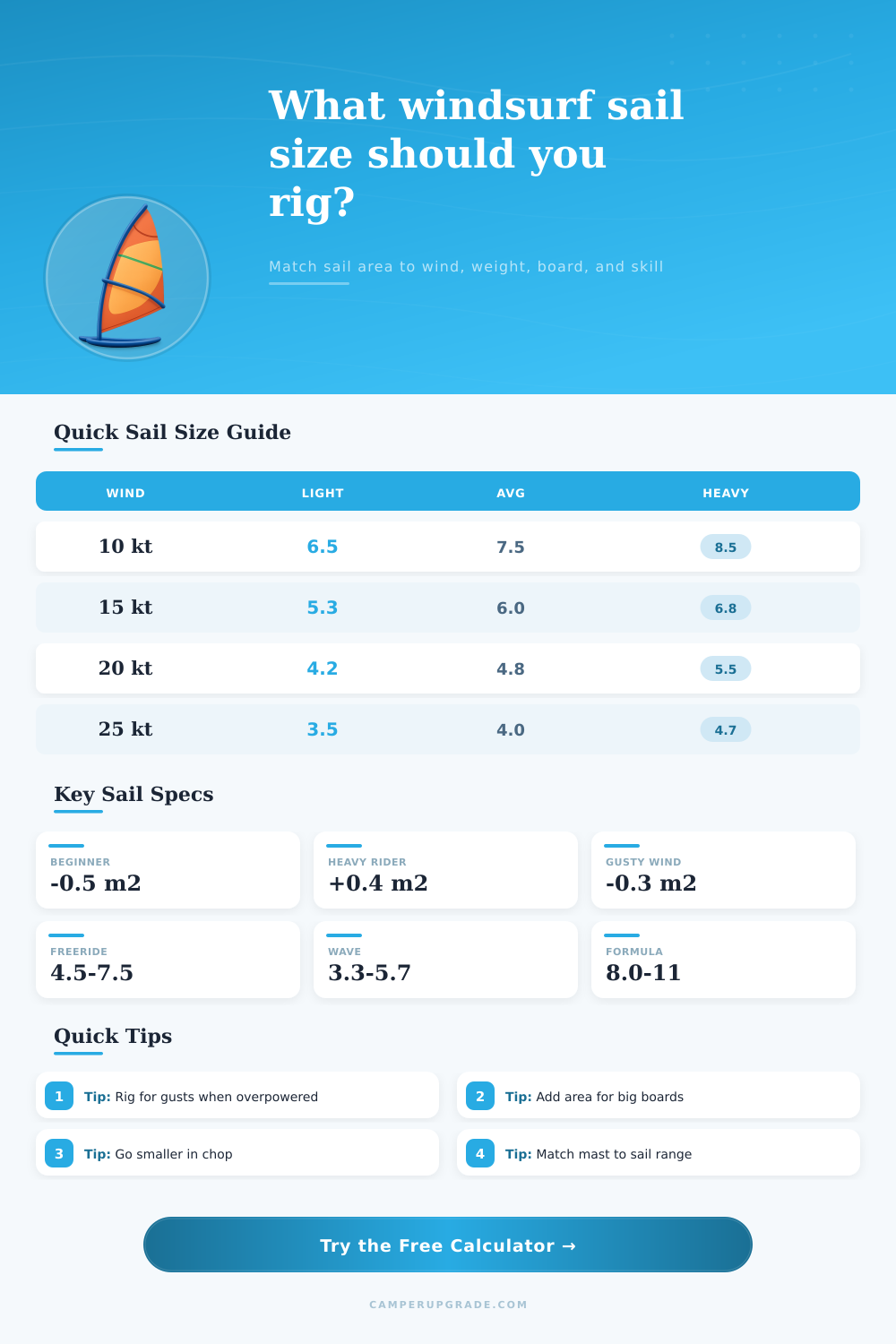
📋Windsurf Sail Size Reference Tables
| Average wind | 60 kg rider | 75 kg rider | 90 kg rider |
|---|---|---|---|
| 10 knots | 6.4-7.2 m² | 7.2-8.0 m² | 8.0-9.0 m² |
| 12 knots | 5.8-6.5 m² | 6.5-7.3 m² | 7.2-8.2 m² |
| 15 knots | 4.9-5.6 m² | 5.6-6.4 m² | 6.2-7.0 m² |
| 18 knots | 4.2-4.8 m² | 4.8-5.5 m² | 5.4-6.1 m² |
| 22 knots | 3.6-4.2 m² | 4.0-4.7 m² | 4.6-5.3 m² |
| 28 knots | 3.0-3.6 m² | 3.4-4.0 m² | 3.8-4.5 m² |
| Sail type | Common sizes | Power feel | Best use |
|---|---|---|---|
| School trainer | 2.5-5.5 m² | Soft, easy | Learning, light handling |
| Freeride no-cam | 4.0-7.8 m² | Balanced | Most recreational sailing |
| Freerace cam | 5.5-8.5 m² | Locked-in | Fast reaches and blasting |
| Wave | 3.0-5.7 m² | Neutral | Waves, jumps, high wind |
| Foil | 4.0-7.5 m² | Efficient | Early lift with smaller area |
| Formula | 8.0-11.0 m² | Deep power | Very wide boards and fins |
| Board width | Board volume | Practical sail range | Rig note |
|---|---|---|---|
| 50-58 cm | 70-95 L | 3.3-5.3 m² | High wind, wave, smaller fin |
| 58-68 cm | 95-125 L | 4.2-6.2 m² | Freestyle-wave or small freeride |
| 68-78 cm | 125-155 L | 5.0-7.5 m² | Freeride sweet spot |
| 78-88 cm | 150-180 L | 6.0-8.8 m² | Light wind and freerace support |
| 88-100 cm | 180-260 L | 7.5-11.0 m² | Formula, raceboard, very large fin |
| Condition | Size adjustment | Reason | Planning cue |
|---|---|---|---|
| Gusts 6-10 kt above average | -0.2 to -0.6 m² | Control in peaks | Rig for the gust line |
| Choppy bay water | -0.2 to -0.4 m² | Board hits slow you down | Prioritize recovery |
| Flat water speed run | +0.2 to +0.5 m² | Stable platform | Use enough fin |
| Foiling | -0.8 to -1.5 m² | Foil creates lift | Downhaul for control |
| New sailor | -0.5 to -1.2 m² | Easier uphaul | Stay below overpowered |
💡Windsurf Sail Size Tips
Choosing an proper size for a windsurfing sail involve several different variables. For these reasons, choosing the proper size for a windsurfing sail isnt always a simple process. A sail size calculator can assist with determining the proper size for the sails that a windsurfer should use.
The calculator take into account several different variables, including the riders weight, the wind speed, the volume of the riders board, the state of the water, and their skill with windsurfing. Using the calculator help to ensure that the sailor does not use a sail that is too large for the wind conditions, which will make it difficult to windsurf, or a sail that is too small for the wind conditions, which will make it difficult to generate enough power while windsurfing. The different variables that a windsurfer can enter into the calculator will determine the proper size for their sails.
How to Choose the Right Windsurfing Sail Size
For instance, the riders weight will impact the amount of area that is required for individuals that weigh more to reach the planing speed that is required for windsurfing. Additionally, the average wind speed that is expected will impact the size of the sail because the force of the sail increases with the speed of the wind. Other factors, such as the gust field will also have an impact on the size of the sail.
Other factors, such as the volume and width of the riders board will determine the amount of area of sail that the board can carry before it loses its grip with the water. Finally, the skill level and the state of the water that is being use for windsurfing will impact the size of the sail because the more skilled the individual is with windsurfing, and the smoother the water, the larger the sail that can be used. Additionally, the goal that the windsurfer wants to accomplish during that particular session with the water will also have an impact on the size of the sail that is chosen.
The calculator will produce several types of outputs. For instance, the size of the sail that is recommended for that rider. Additionally, the calculator will display a usable range for that sail.
The calculator will also display the power of the sail. Additionally, the calculator will also display a rating as to whether that sail is appropriate for the riders board. Even using the calculator, there are still some variables that the individual windsurfer has to use their judgment to determine.
For instance, gust spread is a variable that many individuals does not consider when using the calculator. Gust spread is the number of times that gusts of wind occur during the session. If there are frequent gusts, the calculator may recommend a sail that is too large for that individual.
Finally, the water temperature also has a considerable effect on the size of sail that is used. Cold water can create more dense air in the atmosphere which will result in stronger winds. Hot water, by contrast, will have less dense air in the atmosphere which will result in lighter winds.
The type of board that is used also has a considerable effect on the size of sail that is used. For instance, the size of the fins for that board will impact the amount of area of the sail that can be used. Additionally, the position of the riders mast base and tail rocker will impact the maximum area of sail that is used by that windsurfer.
A sail that is calculated as the proper size according to the calculator may be incorrect if those factors is not matched with that sail size. Due to these potential issues, many windsurfers will purchase multiple sails of similar sizes. Additionally, many windsurfers will choose a sail size on the beach when they see the conditions.
Some of the most common mistakes for windsurfers is to treat the size of the sail as a fixed number. Many individuals will use the same size of sail for every session. This can be problematic for windsurfers because if the winds are strong, they may find themselves overly power by the sails.
If the winds are too light for the size of the sail, they may not be able to generate enough power with their windsurfing board. Other windsurfers will try to use the largest sail that is available to them. This is problematic because it limits their control of the sail and the board on which they are standing.
For these reasons, the result of the calculator will provide a starting point for the decision for the size of the sail that is to be used. The rider can use the recommended size and the usable range to decide whether their desired sail should have more power or more control. The weight of the rider and the wind speed will determine the range of sail sizes that can be used by the rider.
Additionally, the volume and width of the board will determine the maximum size for the sail that is that can be used for control. The skill level, the state of the water, and the gust spread will determine where the rider should place their sail size within the range of sail sizes that is possible according to the weight, wind, and board. Understanding these factors will allow an individual to use the calculator to quickly determine the sail size for the individual windsurfing session.