Windsurf Board Size Calculator
Estimate windsurf board volume, width, range, and board category from rider weight, skill, wind speed, sail size, water state, sailing style, and flotation reserve.
🌊Windsurf Board Presets
⚙Rider, Skill, Wind, Sail, and Water Inputs
📋Your Board Size Estimate
📏Board Spec Grid
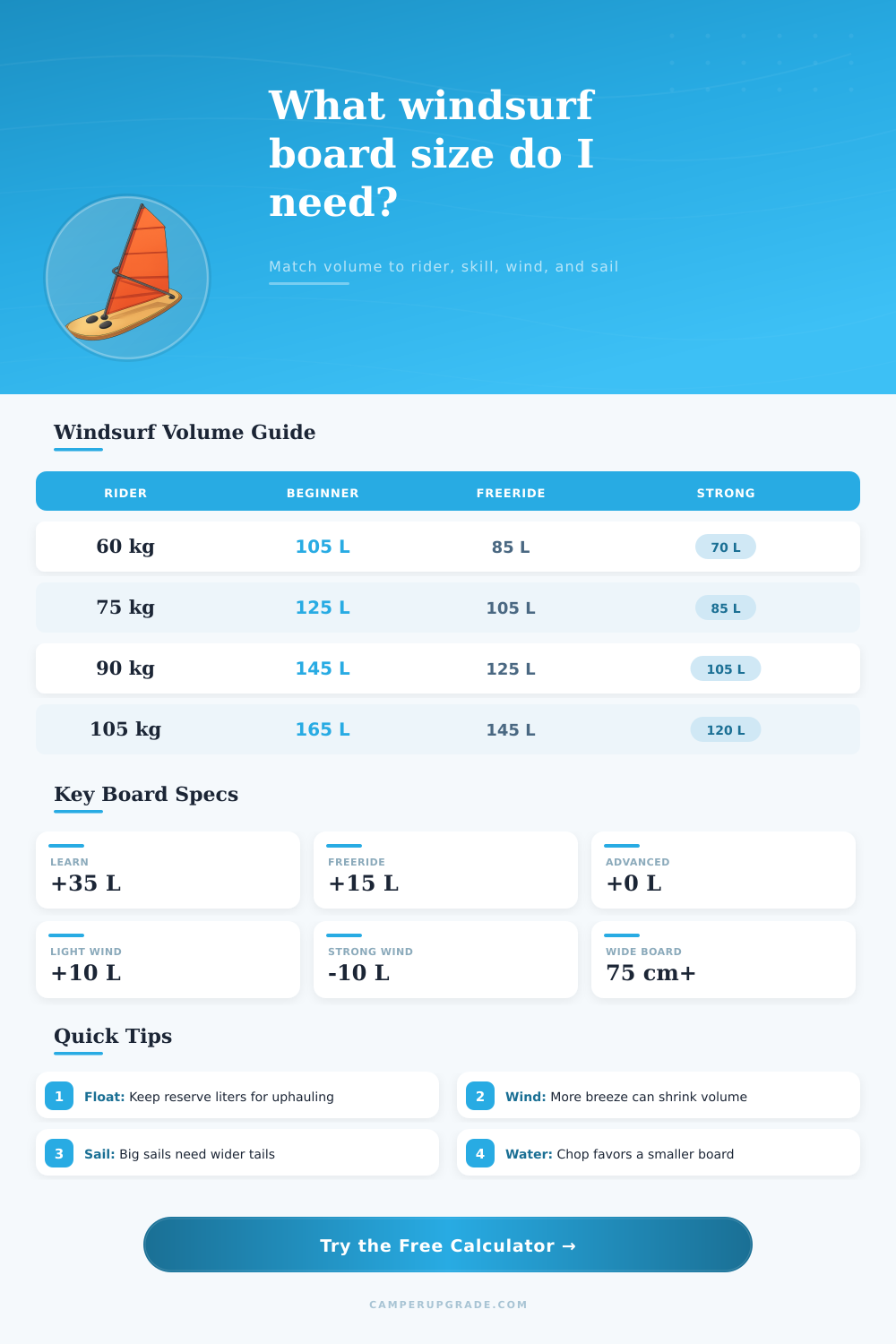
Volume keeps the board floating; width and outline decide how easily it carries sail power, planes early, and stays calm underfoot.
📚Windsurf Board Volume Tables
| Rider Weight | Beginner | Freeride | Advanced |
|---|---|---|---|
| 55 kg / 121 lb | 100-120 L | 85-100 L | 65-80 L |
| 70 kg / 154 lb | 115-140 L | 100-115 L | 80-95 L |
| 85 kg / 187 lb | 135-160 L | 115-135 L | 95-110 L |
| 100 kg / 220 lb | 155-185 L | 135-155 L | 110-130 L |
| Skill Level | Reserve | Width Aim | Notes |
|---|---|---|---|
| First lessons | +45-60 L | 80 cm+ | Stable uphaul |
| Beginner | +30-45 L | 75-85 cm | Easy tacks |
| Intermediate | +10-25 L | 65-78 cm | Planing focus |
| Advanced | -5-10 L | 55-70 cm | Control focus |
| Wind | Sail | Volume Move | Board Feel |
|---|---|---|---|
| 8-12 kt | 7.0-9.5 m² | +10-25 L | Early planing |
| 13-18 kt | 5.5-7.5 m² | +0-12 L | Freeride sweet spot |
| 19-25 kt | 4.5-6.0 m² | -5-12 L | Control and chop |
| 26 kt+ | 3.5-5.0 m² | -10-25 L | Small board trim |
| Board Type | Typical L | Typical Width | Best Use |
|---|---|---|---|
| School | 150-220 L | 80-100 cm | Lessons |
| Freeride | 105-160 L | 65-85 cm | All-round |
| Freemove | 85-115 L | 58-68 cm | Chop and jumps |
| Wave | 65-105 L | 53-62 cm | Swell control |
💡Board Sizing Tips
Windsurf board volume is the amount of volume a windsurf board need. The amount of volume that a windsurf board needs to have is dependent upon many differents variables. For example, the volume that is needed will vary with the weight of the rider, the skill level of the rider, the strength of the winds, the size of the sail that the rider is being use, the state of the water, and the style in which the rider wants to windsurf.
If the amount of volume of the windsurf board is not correctly chosen for these different variable, then the windsurf board may feel too heavy for the rider when trying to turn, or the rider may fall into the water too frequent while windsurfing on that board. Thus, the calculator that is provided on this page gathers all of these different variable into one place, allowing the calculator to determine the appropriate amount of volume that the windsurf board should have. The calculator begins by using the weight of the rider to calculate the amount of displacement that the windsurf board should have.
How to Choose the Right Windsurf Board Volume
In addition to determining the displacement of the board, the calculator also uses the skill level of the rider to determine how many liter of volume should be added to the displacement calculation; the fewer liters of volume that are added to the calculation, the more skilled that the rider is with waterstarts and planing. Furthermore, the calculator consider the strength of the winds and the size of the sail that is to be used to determine how much volume should be allotted to the windsurf board; the stronger the winds and the larger of the sails that are use, the more volume that is required of the windsurf board so that it can reach the necessary speed to begin planing. Additionally, the calculator considers the state of the water; either flat water or choppy water will require adjustment to the length and width of the windsurf board.
Thus, the calculator will provide a volume window for the windsurf board, as well as the width of the board and the category of windsurf board that is recommended. Within this volume window is an important number that will help to ensure that the windsurf board is appropriate for the range of sailing conditions that the rider is likely to be experienced. For instance, the volume calculations are based upon the conditions that are likely to be experienced on a typical day; however, the windsurfing condition may vary from those suggested conditions.
For instance, a windsurf board that may have 120 liters of volume that is calculated as appropriate for a 78-kilogram rider may require an additional five to ten liters of volume if the rider is sailing on a lake that experience gusty winds. Furthermore, if the volume for the windsurf board is too low, the rider may experience difficulty in performing actions like uphauling the sail when there are lulls in the wind; if the volume is too high, it will be difficult for the rider to turn the windsurf board once the winds increase. The skill level of the rider is one of the variable that the calculator gathers.
For instance, beginning rider may require additional liters of volume to provide stability for those that are just beginning to windsurf; intermediate windsurfers may require less of that reserve volume since they are able to plane more of the time; and, finally, the most advanced windsurfers may prefer windsurf boards that have less volume than those of intermediate skills since the most experienced of rider prefers more control of the windsurf board. The other two variable that the calculator gathers are the strength of the winds and the size of the sail. Strong winds and large sails will require more volume for the windsurf board to plane early; weak winds and small sails will require less volume for the windsurf board.
These two variable combine into one adjustment within the calculator so as to avoid purchasing a windsurf board that may be appropriate for the largest sail that the rider owns. Finally, the state of the water is another variable that is gathered by the calculator. For instance, if the water is known to be choppy, the windsurf board will be required to have a shorter length and narrower width than if the water is flat; choppy water create challenges for the rider in that a narrower board can more easily move through the choppy water.
Thus, the calculator applies an adjustment to the volume of the windsurf board to account for the chop in the water. Another of the variable that is gathered by the calculator is the style in which the rider desire to windsurf. For instance, windsurf boards that are of the freeride category will have a moderate width; those that are of the wave category will be more maneuverable, and, therefore, have less volume and width than freeride windsurf boards; and finally, foil windsurf boards will have more volume and width to allow for stability when taking off from the water.
Beyond the calculation of the volume of the windsurf board, the calculator also calculates the width and length of the windsurf board. The width and length of the windsurf board will impact the amount of strength that is required to turn the board, as well as the type of windsurfing that is possible on that board. Thus, the calculator calculates the width of the board based off the volume of the windsurf board, the size of the sail that is to be used, and the state of the water.
Additionally, the calculator calculates the length of the windsurf board based upon the volume of the board and the style of the windsurf board that is chosen. Although the calculator provides a great starting point for windsurfers for the volume of the windsurf board that is appropriate for themselves, there are some mistake that individual windsurfers can make in determining the amount of volume of the windsurf board that should be selected for themselves. For instance, windsurfers may purchase a windsurf board that works for one season but may not be appropriate for the next season; windsurfers increase in skill each season, and the amount of volume in their current windsurf board may no longer provide for the appropriate performance for themselves.
Thus, the calculator can help windsurfers to determine how their skill may change over time, and to provide for a windsurf board that can adapt to those change. Thus, in addition to the volume of the windsurf board, the width of the windsurf board is an additional factor that will impact the ability of the rider to turn the windsurf board in relation to the direction of the wind, as well as the types of maneuver that can be performed on the windsurf board. Windsurf boards with wide tail can carry large sails without sinking into the water due to the strength of the wind, while windsurf boards with narrow tail will require less strength to turn the board but may not be able to handle the same strength of winds without sinking into the water.
The calculator calculates the width of the windsurf board, based upon the volume of the windsurf board, the size of the sail that is to be used, and the state of the water. Additionally, the calculator calculates the length of the windsurf board, based upon the volume of the windsurf board and the type of windsurf board that is to be ridden. The tables that are provided on this page are helpful in understanding how the volume of the windsurf board may need to change with the changes in the skill level of the rider or the weight of the rider.
For instance, the tables may reveal that an intermediate rider that weighs 70 kilogram will require either 100 or 115 liters of volume. However, a beginning rider that weighs 70 kilogram may require between 115 and 140 liters of volume. Thus, these tables allow the rider to understand how the volume of the windsurf board will change in response to changes in the weight of the rider and the skill level of the rider.
In general, the calculator that is provided on this page will help to determine the amount of volume that a windsurf board should have. However, there are other factor that must also be considered in the purchase of a windsurf board. Factors like the water temperature and the requirement of the rider to be able to fit the windsurf board within their airline bag are not accounted for by the calculator.
Additionally, the rider should determine the volume and the width of the windsurf board by looking for actual windsurf boards that match those number calculated by the calculator. Thus, the outline of the windsurf board and its tail shape will also factor into the decision of which windsurf board will be purchased. One habit that can help the rider to determine which windsurf board to purchase is to run the calculator both with and without certain variable set to different values.
For instance, one can perform one run of the calculator to determine the volume of the windsurf board for the average condition of the riders area. Additionally, one can perform another run of the calculator to determine the volume that is required for the conditions that is less common in the riders area. The overlap of these two calculation will provide the rider with a range of volume for their windsurf board that will remain useful in both common and rare conditions of windsurfing.