Windscreen Length for Stove Calculator
Calculate the cut length, finished wrap coverage, panel area, and estimated weight for a camping stove windscreen.
🏕Named Stove Presets
📏Calculator Inputs
Windscreen Sizing Results
⚙Material / Spec Comparison Grid
📚Reference Tables
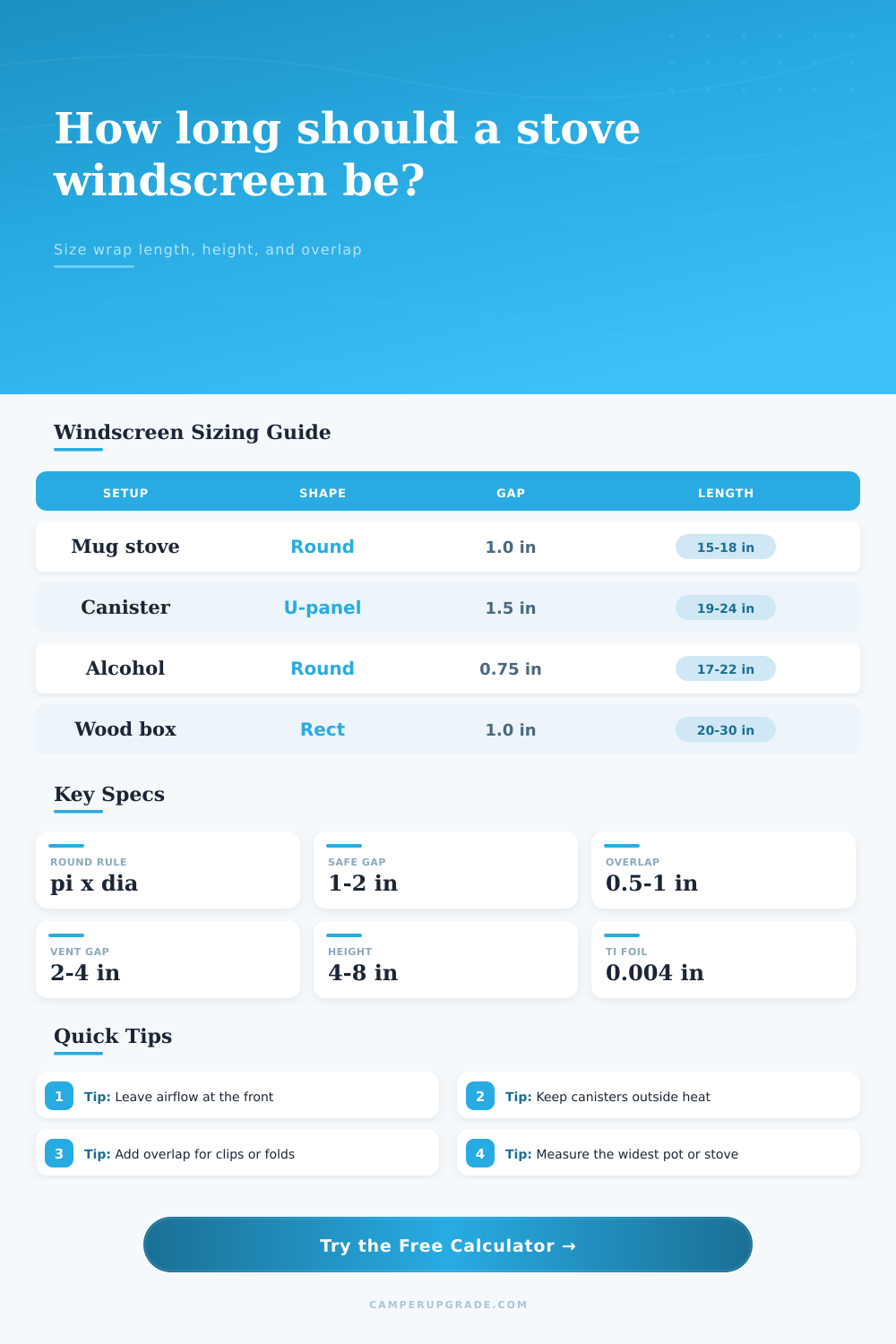
| Common stove setup | Measured envelope | Suggested clearance | Typical cut length |
|---|---|---|---|
| Pocket canister with 750 ml mug | 4.0-4.5 in diameter | 1.0-1.5 in | 15-19 in |
| Upright canister with 1 L pot | 5.0-5.8 in diameter | 1.5-2.0 in | 20-25 in |
| Remote canister with 2 L pot | 7.0-8.0 in diameter | 1.0-1.5 in | 27-34 in |
| Alcohol stove with pot stand | 5.0-6.0 in diameter | 0.75-1.25 in | 19-25 in |
| Solid fuel tablet stove | 4.0 x 3.0 in base | 0.75-1.0 in | 12-17 in |
| Folding twig stove box | 5.0 x 5.0 in base | 1.0-1.5 in | 20-27 in |
| Material | Typical thickness | Approx density | Best use in sizing |
|---|---|---|---|
| Heavy folded aluminum foil | 0.003 in / 0.08 mm | 0.098 lb/in³ | Very light short screens |
| Disposable oven liner aluminum | 0.005 in / 0.13 mm | 0.098 lb/in³ | Backpacking wrap screens |
| Titanium foil sheet | 0.004 in / 0.10 mm | 0.163 lb/in³ | Durable compact screens |
| Stainless steel shim | 0.005 in / 0.13 mm | 0.289 lb/in³ | Small hot solid-fuel shields |
| Hard aluminum flashing | 0.012 in / 0.30 mm | 0.098 lb/in³ | Van galley and base-camp panels |
| Carbon felt heat skirt | 0.125 in / 3.18 mm | 0.020 lb/in³ | Heat buffering, not rigid wrap |
| Coverage choice | Opening / vent gap | Useful for | Calculator effect |
|---|---|---|---|
| Loose round wrap | 3-5 in front opening | Upright canister stoves | Reduces trap heat and length |
| Tight alcohol wrap | 1.5-3 in front opening | Alcohol burners with pot stands | More wind blocking around flame |
| Three-sided U-panel | Full open front | Canisters, skillets, griddles | Uses back plus two side lengths |
| Rectangular full wrap | 2-4 in front opening | Wood boxes and tablet stoves | Perimeter minus opening |
| High-airflow punched screen | 14-22% hole area | Combustion hungry burners | Lowers material weight estimate |
| Height target | Imperial range | Metric range | Practical note |
|---|---|---|---|
| Minimal mug shield | 3.5-4.5 in | 9-11 cm | Good for tiny pots and low burners |
| Backpacking pot shield | 5-6 in | 13-15 cm | Common size for 750 ml to 1 L pots |
| Alcohol stove surround | 5.5-7 in | 14-18 cm | Often reaches near lower pot wall |
| Base-camp skillet panel | 7-9 in | 18-23 cm | Useful for wide pans and side gusts |
| Wood stove spark side | 8-12 in | 20-30 cm | Use only with suitable heat material |
💡Calculation Tips
The trick with sizing a windscreen is striking this balance of air flow and still having some distance for heat transfer, i.e., heat distance from the flame itself. You don’t want it so loose that it just blows off or that it traps heat against your fuel canister in an unsafe manner. A good windscreen are not something you simply wrap loosely around your burner, but rather a tool of function that requires planning and proper execution.
After entering in the size of your stove, the calculator will do the math for you and you won’t have to guess at conversion factors and numbers anymore. Begin by measuring largest dimension of whatever your setup is: the burner head, the pot stand, or maybe some bulky valve sticking out the side of an upright canister. That’s your base measurement.
How to Choose the Right Windscreen Size and Shape
Next, add space for clearance. Generally, adding one to two inches provide a safe margin while still keeping the hot air away from any delicate fuel line or valve part made of plastic. With a remote stove (meaning the fuel bottle isn’t near the heat), you can get a bit closer with less worry about thermal damage.
Wood gasifiers and alcohol stoves is completely different. They produce different types of burns that release heat differrently and more quick.
Almost as important as size is shape. To block out the most wind, a panel need to be a full round wrap. But if it’s wrapping something like a heat source, then this shape means it will fit tight and form a good seal around it. That’s why rectangular wraps with front openings for things like canister stoves are popular, and U-shaped panels is even better. Then they’ll allow you to protect three sides yet leave the front opening for getting at your fuel easily and letting some fresh air in.
This tool takes into account those geometry differences so you know how long to cut the thing, not just give yourself a rough guess based off experience. It also accounts for overlap when you fold over (or clip or tape) the end together. Otherwise, your screen will pop open in high winds or fray at its seam without that extra inch or half inch of fabric.
More than any other factor, the material determine the durability and the weight. Aluminum foil is light as a feather but tears like tissue paper in cold gloved hands when you try to set it up. Titanium foil is a little pricier but has greater heat tolerance. Stainless steel shims are indestructible, but if you’re UL backpacking you’ll want the few extra ounces for something else. Once you select material thickness (and optionally punch some vent holes), the calculator will estimate total weight.
It’s easy to overlook ventilation, but it ensures efficient combustion. If a screen covers all available inches of air intake, not only will a gas burner be choked, but an alcohol stove will burn yellow and sooty. Vents breaks the wind’s momentum while allowing oxygen to reach the flame. Small gaps are okay or even beneficial, and you can always punch them.
Consider height next: how tall should the panel be? It should be high enough to shield the flame zone without being so high that it gets in the way of seeing into the pot (or keeps steam trapped below a lid). For most backpacking pots, five to six inches will do. If you’re using a larger skillet, or at base camp, you may want something taller to prevent crosswind from catching side edges. This small detail makes all the difference between watching a dancing flame for two minutes or boiling a quart of water in four.
Some common errors include screens that are too tight against the edge of the pot, which can melt your plastic handles. You might also forget that folding stove boxes gets wider as they open. Always check for deployed dimensions, not packed ones!
And keep in mind that real world conditions is different than the usual ranges listed in the reference tables on the page. What’s effective depends upon wind direction, what sits atop the stove, and even where you’re sitting when you cook. Your starting point is the calculator for basic sizes. Next is trying it in place. If you find the screen running hot, or not stable, adjust the ventilation/overlap.
You want a shield that blends in. It should of worked quietly during your routine so you can concentrate on cooking a meal. A quality windscreen is more than a hunk of sheet metal; it’s the separation between a warm dinner and an annoying evening.