Windbreak Height Calculator
Estimate the windbreak height, useful shelter distance, exposed top gap, and anchor load for camp tarps, mesh screens, vehicle shields, and temporary fence panels.
🏕Windbreak Presets
⚙Wind Speed, Shelter Height, Distance, and Material Inputs
🧱Material and Spec Grid
📊Windbreak Reference Tables
| Height | Best Lee | Outer Lee | Camp Use |
|---|---|---|---|
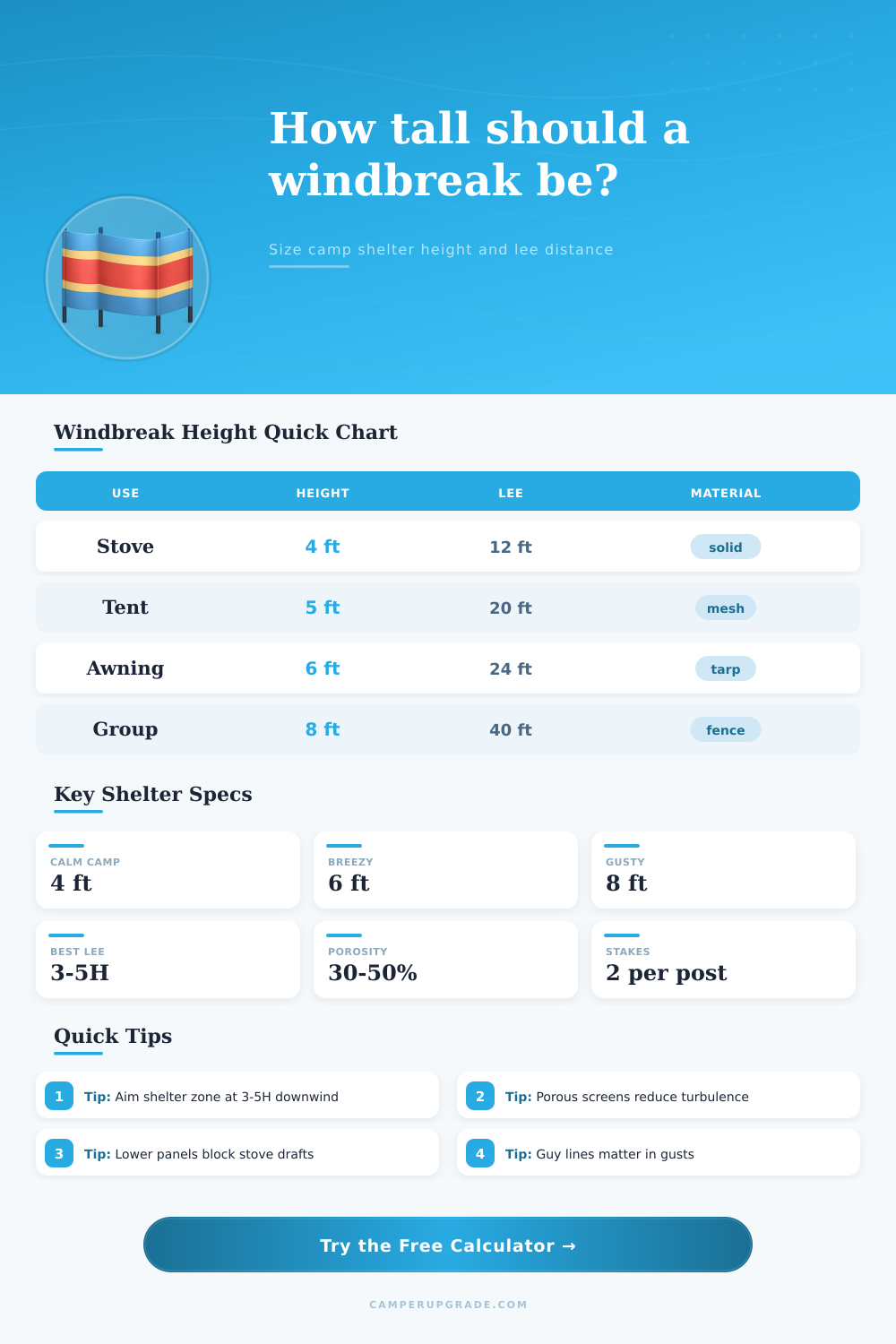
| 3 ft | 9 to 15 ft | 24 ft | Stove or low seat |
| 4 ft | 12 to 20 ft | 32 ft | Table and chairs |
| 5 ft | 15 to 25 ft | 40 ft | Tent door comfort |
| 6 ft | 18 to 30 ft | 48 ft | Awning side wall |
| 8 ft | 24 to 40 ft | 64 ft | Group kitchen edge |
| Wind | Camp Feel | Height Factor | Material Note |
|---|---|---|---|
| 0 to 7 mph | Light drift | 0.95x | Low screen works |
| 8 to 14 mph | Breezy camp | 1.10x | Mesh or tarp |
| 15 to 21 mph | Hard cooking | 1.28x | Porous preferred |
| 22 to 30 mph | Gust control | 1.55x | Lower solid area |
| 30+ mph | Storm force | 1.90x | Avoid tall tarps |
| Material | Porosity | Lee Quality | Anchor Need |
|---|---|---|---|
| Mesh screen | 30-40% | Smooth | Moderate |
| Solid tarp | 0-10% | Short, turbulent | High |
| Canvas screen | 10-25% | Strong | High |
| Snow wall | Solid low wall | Stable low lee | Low |
| Slat fence | 35-50% | Balanced | Moderate |
| Protected Spot | Zone Height | Best Distance | Typical Height |
|---|---|---|---|
| Backpacking stove | 1.5 ft | 2 to 5 ft | 2 to 3 ft |
| Camp chairs | 3.5 ft | 10 to 18 ft | 4 to 5 ft |
| Picnic table | 4 ft | 12 to 22 ft | 5 to 6 ft |
| Tent doorway | 4.5 ft | 15 to 25 ft | 5 to 7 ft |
| Awning kitchen | 5.5 ft | 18 to 30 ft | 6 to 8 ft |
💡Windbreak Sizing Tips
A windbreak is an barrier that is established to block the wind. Windbreaks is especially useful in situations in which the wind may move object, such as stove flames or tarps. In determining the height of a windbreak, there are several different variable that must be considered.
For instance, the height of a windbreak is based off the wind speed, the height of the object that needs to be protect, the distance between the object and the windbreak, and the material that you will use to construct the windbreak. When the wind encounter an obstacle, such as a windbreak, the wind can behave in specific ways. For instance, solid windbreaks will create a calm zone of air behind the solid barrier, but the wind will change the direction of the air over the top of the solid barrier, creating turbulence in that area at a certain distance from the solid barrier.
How to Choose the Right Height for a Windbreak
Porous windbreaks allow some of the air to pass through the barrier. Porous windbreaks will reduce the amount of turbulence created by the wind, allowing the calm zone to continue further in relation to the porous barrier. To determine the height of the windbreak, you can use calculators.
The calculator will require the input of the wind speed, the height of the object that is to be protected, the distance between the object and the windbreak, and the type of material that will be used for the windbreak. Based on these parameters, the calculator will provide the height of the barrier that will create calm air around the object that is to be protected. Thus, the height of the barrier should of be establish based upon the distance between the object and the windbreak.
Many windbreaks that are used in camping settings are between four and six feet in height. The calm zone that is created behind a windbreak is typically three to five times the height of the windbreak. Thus, if the object to be protected is placed between fourteen feet from a five-foot windbreak, the object will be within the calm zone.
Three-foot windbreaks create calm zones that are closer to the windbreak compared than five-foot windbreaks, but eight-foot windbreaks may place additional load on the anchors that holds the windbreak. Taller windbreaks will create more protection for high winds, but the increased height will also place more load on the anchors that hold the windbreak in place. The type of material from which a windbreak is constructed will also impact how the wind move through the barrier.
Solid tarps will block the majority of the wind, but the solid tarp will create swirling air pattern behind the tarp. Mesh or slat panels will allow some air to pass through the panels. Allowing the air to pass through the panels will reduce the number of swirling air patterns behind the tarp.
The porosity of the material will affect the load of the wind on the anchors; porous materials will have less force on the anchors than solid materials. The exposure of the site will also affect the behavior of the wind. If the site to be camped at is sheltered by trees or a hollow in the area, the wind will slow before it reaches the camping area.
If the site to be camped at is exposed, such as a beach or a hilltop, the wind will be stronger. Because of these variables, the exposure of the site will affect the height of the windbreak that is built. The stronger the wind on the site to be camped at, the taller the windbreak that should be established.
The quality of the anchors will not impact the height of the windbreak that is necessary to establish, but will impact whether or not the windbreak remains in place. If the anchors that you utilize for the windbreak are too weak to handle the load of the wind, the windbreak will fail. Therefore, you will need to ensure the strength of the anchors to handle the load of the wind; guy lines or buried anchors may be necessary if the load of the wind is strong.
Lastly, the length of the windbreak will impact the efficiency of the windbreak. If the length of the windbreak is too short for the height of the windbreak, air will leak around the side of the windbreak. As such, the windbreak should be at least twice as long as it is tall; if it is not, a taller windbreak may be necessary to compensate for this.
Common mistakes with the building of a windbreak may occur if the camper is too focused on one variable of the windbreak. For example, the camper may choose the height to be tall enough to cover the stove, but the distance between the windbreak and the camping chairs may not be considered. Similarly, the camper may choose the type of tarp to be solid to create a windbreak, but the resulting turbulence of the wind crossing a solid tarp may not be considered.
Additionally, the camper may choose the type of anchors for a sheltered camping area, but may unnecessarily choose them for an open site like a beach. These types of mistakes may occur due to the fact that the wind reacts to all of these factor at once. The calculator will recommend the height of the windbreak and the zone that will be sheltered from the wind.
The reference tables will illustrate the height of the windbreak necessary to create a certain distance of sheltered zone. These variables will provide a baseline for the construction of the windbreak, but judgment on the ground will be necessary. For instance, if the wind changes direction or if one of the anchors begin to move, the windbreak will need to be adjusted.
Understanding why the height of the windbreak should be a certain measurement will allow the camper to adjust the windbreak or the camping area to ensure that the desired zone of calm is created. Youll see that the windbreak needs care. Its important to get it right.
Actualy, most people dont realize how much the wind affects things. Use a moddern calculator to help.