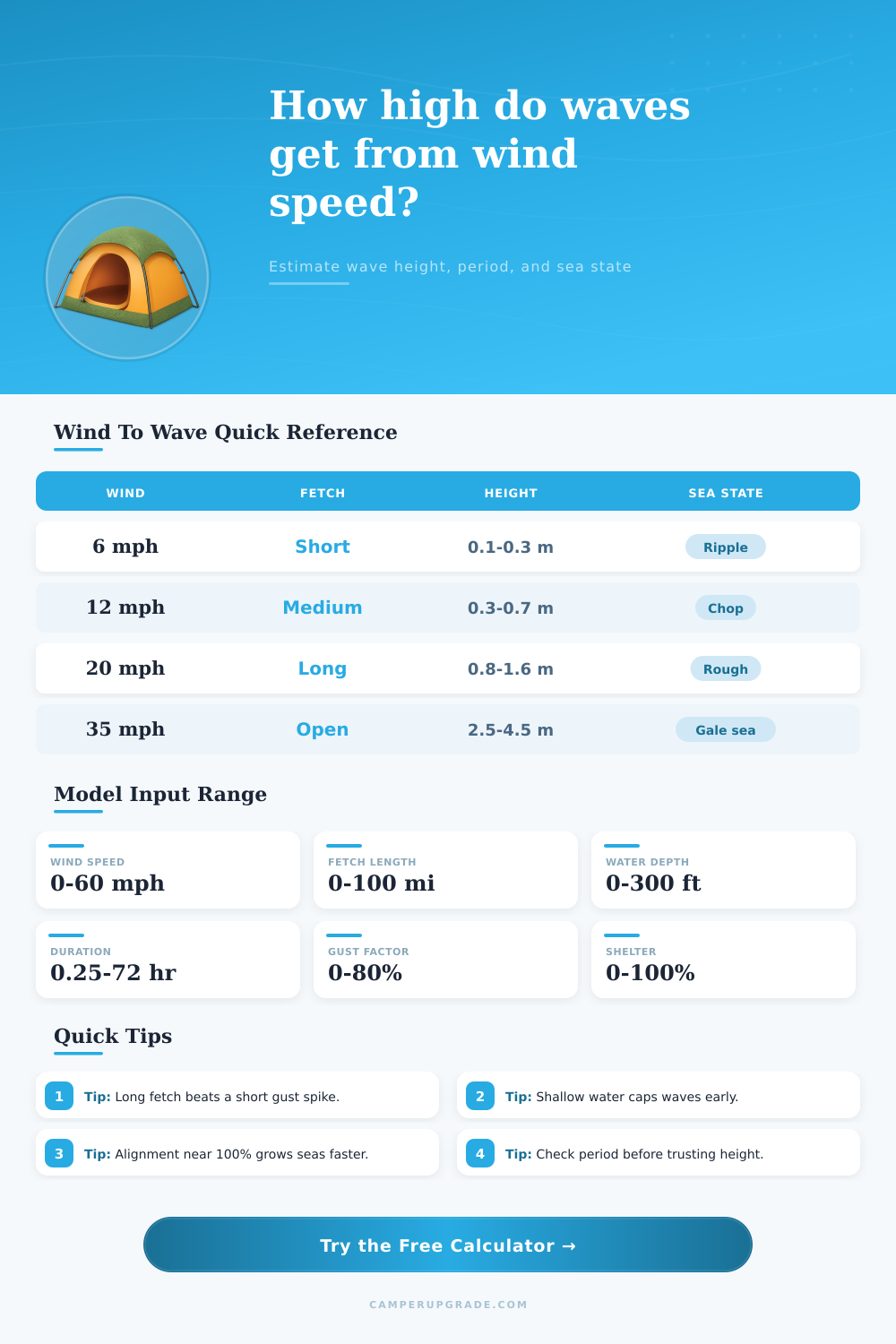
Wind Speed to Wave Height Calculator
Estimate significant wave height, peak period, wavelength, and sea state from wind, fetch, duration, and depth.
🌊Sea State Presets
⚙Wind And Water Inputs
📊Wave Model Spec Grid
📘Wave Growth Reference Tables
| Wind Band | Fetch Need | Typical Height | Typical Period |
|---|---|---|---|
| 5-10 mph | Short bay | 0.1-0.3 ft | 1-2 s |
| 10-18 mph | Few miles | 0.5-1.5 ft | 2-4 s |
| 18-28 mph | Long fetch | 2-5 ft | 4-7 s |
| 28+ mph | Open coast | 6-15 ft | 7-11 s |
| Exposure Pattern | Fetch Band | Duration Band | Growth Pattern |
|---|---|---|---|
| Sheltered cove | Under 1 mi | Under 2 hr | Short chop |
| Small lake | 1-5 mi | 2-4 hr | Wind sea |
| Broad bay | 5-20 mi | 4-8 hr | Steady build |
| Open coast | 20+ mi | 8+ hr | Near full growth |
| Water Depth | Breaker Cap | Safer Class | Note |
|---|---|---|---|
| Under 5 ft | Under 4 ft | Very shallow | Steep break risk |
| 5-15 ft | 4-12 ft | Choppy | Caps sooner |
| 15-40 ft | 12-31 ft | Moderate | More room to grow |
| 40+ ft | 31+ ft | Deep | Wind controls more |
| Sea State | Height Range | Surface Look | Risk Signal |
|---|---|---|---|
| 0-1 | Under 0.3 ft | Mirror to ripple | Low |
| 2-3 | 0.3-4 ft | Chop to rough | Moderate |
| 4-5 | 4-13 ft | Very rough | High |
| 6-7 | 13+ ft | Huge surf | Severe |
Wave formation depend on several specific factor related to the water and the wind. The formation of waves arent dependent on the speed of the wind. In order to understand how waves form on the water, it is important to understand four factors related to the formation of those waves: fetch, duration, depth, and the shape of the waterbody.
Fetch is the distance that the wind travel over the water before it reach a person or boat. If the fetch for a certain point in the water are long, it allows the water to form large waves due to the ability of the wind to accumulate energy over a long distance. If the fetch for a certain location is short, it will result in small and steep waves.
How Waves Form on Water
The wind’s alignment also impact the formation of the waves. If the wind is blowing direct on the path of the water, large waves will form. If the wind is coming from a crosswind angle, the wind will not allow for the formation of organized waves.
Islands and headlands can also impact the fetch for a certain point in the water; they can act as a barrier to the wind. Duration is the length of time that the wind blows over the water. If the wind only blow over the water for a short period of time, short and steep wave will form.
However, if the wind blows over the water for longer period, the waves will become taller. The period of the waves is the length of time between one wave and the next wave in the group of waves. The depth of the water limit the size of the waves that form.
In deep water, waves can grow to they’re full potential due to the strength of the wind. In shallow water, however, the waves have resistance against the shallow water, which limit their growth. In shallow water, the waves become steeper until they reach a height that is 78 percent of the depth of the water.
This is referred to as a breaker cap; this is the reason why the waves in shallow bays can be different than the open ocean. The shape of the waterbody also impact the fetch. Open coasts have an endless fetch for the wind and the water to form their waves to their more maximum potential.
However, lakes and bays has limited fetch due to their edges. Reservoirs may appear to be large areas of water, but they often have many cove along their edges; these coves will limit the fetch of the wind for the water. There is several different outputs from the process of wave formation.
The significant wave height is the average height of the largest one-third of the waves; this is the height that most people experience. The peak period is the length of time between the longest swell in a group of waves. The wavelength is the distance between each wave.
Additionally, the sea state code describe the condition of the water. Other factors related to the water include the steepness of the waves; this determine if the waves will break; and the breaker margin is the distance between the waves and the depth of the water; the breaker margin is the amount of room that the waves have before they are limited in height due to the depth of the water. However, environmental factor also impact the formation of waves.
For instance, wind shadow occur when the land obstruct the wind. These wind shadows will reduce the ability of the wind to form the waves. Additionally, the currents in the water will impact the fetch of the wind; the depth of the water will change due to the movement of the tides; these changing depth will change the limit of the height of the waves.
Thus, understanding these factors will allow a person to make more better decisions about the water and the formation of the waves.