Wind Direction Calculator
Correct wind bearing, compare source and flow direction, and measure how much wind will hit your camper from the side or front.
💨Wind Scenario Presets
⚙Direction And Speed Inputs
📊Wind Direction Spec Grid
📘Wind Direction Reference Tables
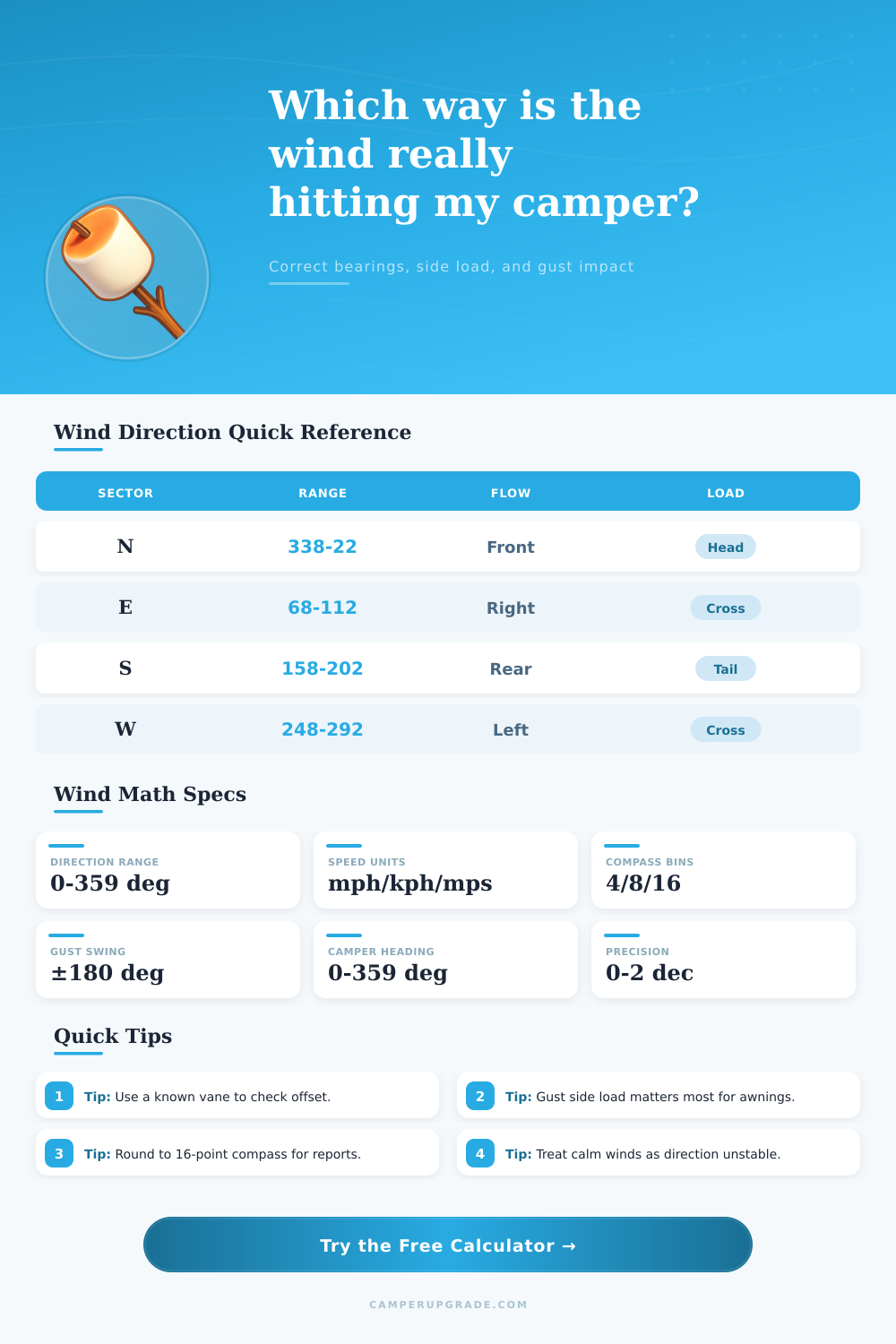
| Compass | Range | Flow | Use |
|---|---|---|---|
| N | 338-22 | Front | Headwind |
| E | 68-112 | Right | Crosswind |
| S | 158-202 | Rear | Tailwind |
| W | 248-292 | Left | Crosswind |
| Angle | Cos | Sin | Meaning |
|---|---|---|---|
| 0° | 1.00 | 0.00 | Full headwind |
| 45° | 0.71 | 0.71 | Front quarter |
| 90° | 0.00 | 1.00 | Pure side load |
| 135° | -0.71 | 0.71 | Rear quarter |
| Speed | mph | kph | knots |
|---|---|---|---|
| 1 m/s | 2.24 | 3.60 | 1.94 |
| 5 m/s | 11.18 | 18.00 | 9.72 |
| 10 m/s | 22.37 | 36.00 | 19.44 |
| 15 m/s | 33.55 | 54.00 | 29.16 |
| Camper Exposure | Crosswind | Gust Factor | Action |
|---|---|---|---|
| Low | 0-5 mph | <1.2x | Open |
| Moderate | 5-12 mph | 1.2-1.5x | Watch |
| High | 12-20 mph | 1.5-1.8x | Secure |
| Severe | 20+ mph | 1.8x+ | Pause |
Understanding teh wind direction is necessary for camper safety, as understanding the wind direction will allow you to protect your camper equipment. When you are camping and park your camper in a campground, the direction from which the wind is moving will impact how the wind lands on your camper. If you dont understand the direction of the wind, you may end up with the wind landing on one of the sides of your camper, which could potentially damage some of your camper equipment such as the awnings or slide outs.
Meteorologists often report the wind direction to travelers, who measure the movement of the wind from where it originates. Additionally, navigators report the direction of the wind from where it is traveling. However, because these two measurement of wind direction are slightly different, campers must ensure they are using the apropriate measurement convention to calculate the load that the wind will exert on their camper.
Protect Your Camper by Understanding Wind Direction
To calculate the load of the wind acting upon the camper, individuals must account for several factor. One factor to account for is magnetic declination. For instance, if the camper is facing north, the magnetic compass may not indicate true north due to magnetic declination.
Additionally, any sensor mounted to the camper may not accurately measure the direction of the wind if they is mounted at an angle to the camper. These small error must be corrected for in order to accurately calculate the load of the wind that will act upon the camper. For instance, incorrectly perceiving the wind direction from these sensors may make an individual think that the crosswind is stronger than it actualy is.
Another important factor to consider is the impact of crosswind. Crosswinds are often more damaging than headwinds. Headwinds are those that hit the camper from the front, while crosswinds are those that hit the camper from the side.
When the wind hits one of the sides of the camper at a 90-degree angle, the wind delivers to the camper the maximum amount of lateral force. Additionally, if the wind hits the camper at a 45-degree angle, the wind will deliver both a headwind and crosswind force. The gusts of wind may change the wind direction, which could change a steady wind into a potentially dangerous crosswind.
Lastly, the terrain that the camper is traveling on can impact the movement of the wind. The effect of the terrain may be different than the wind applications on your smart phone. For example, valleys will channel the wind, causing the wind moving through that valley to be faster than the wind in an open area.
Additionally, the approach of lakes can create offshore winds, which may impact the camper to broadside, despite the wind applications indicating that it is a tailwind for the camper. Finally, the impact of moving over ridge tops may create gusts that change direction, creating potentially dangerous wind gusts on the ridges top that may rotate quick. Due to the changes in the terrain that impact the direction of the wind, people should not solely use the information from the weather application.
People should also observe the direction of the wind. The presets can be used to test the different scenario of the wind, as well as to understand how the offsets and declination of the camper impact the load of the wind. For instance, the scenario can be set up where the camper is facing north while in the desert and exposed to a broadside wind.
The units of the wind can also be adjusted to match the correct unit for the specific location that the camper is traveling to. While the precise degree of the wind is important to understand, the most important degree to understand is the relative angle of the wind to the camper. The grids on the camper can be used to understand the exposure to the wind.
These grids use sector to indicate the different directions from which the wind may come. For instance, the sector for the north includes wind flows between 338 to 22 degrees. Additionally, the sector for the south includes tailwinds.
Each of these sectors can be used to make decision regarding the camper and it’s equipment. For instance, if the wind is in the high range between 12 to 20 miles per hour, the camper should secure its equipment. If the wind is over 20 miles per hour, the camper should hunker down and secure all equipment and awnings.
Many people make mistake when calculating the load of the wind. Often, people make these mistakes when they rush the process. For instance, many people make the assumption that the wind direction that is shown on the weather application is the same as the wind that they will experience.
This is usually not the case. Additionally, people usually do not account for the offsets of the sensors that detect the wind. These offsets may expose the camper to a dangerous wind direction.
Furthermore, people do not account for potential gust shifts in the wind that may expose the camper to dangerous load on the awning. By regularly checking the wind vanes to the known flow of the wind in specific locations (such as campgrounds), people can calibrate the sensors for the offsets. For instance, if the camper is in a campground that features a south wind and the camper is facing south, the camper will experience a tailwind.
If the camper rotates 15 degrees from the south, the crosswind will decrease 30 percent. Winds that are 45 degrees from the intended direction of travel for the camper will create an imbalance in the campers load. Therefore, the camper should respect exposure to pure side wind, as should the tails until gusts appears.
By understanding the different impacts of the various angle to which the camper may be exposed, the camper will be able to better manage the load of the wind and protect its camper.