🥁 Wind Chime Length Calculator
Convert note targets, tube material, and geometry into tuned tube lengths
| Note | Frequency | Pitch Role | Length Trend |
|---|---|---|---|
| A3 | 220.00 Hz | Deep root | Longest |
| C4 | 261.63 Hz | Low bright | Long |
| E4 | 329.63 Hz | Warm mid | Mid |
| G4 | 392.00 Hz | Open chord | Shorter |
| A4 | 440.00 Hz | Standard | Short |
| C5 | 523.25 Hz | Bright top | Shortest |
| D5 | 587.33 Hz | High shimmer | Very short |
| E5 | 659.25 Hz | Chime peak | Very short |
| Scale | Intervals | Tube Fit | Character |
|---|---|---|---|
| Major Pentatonic | 0,2,4,7,9 | 5 tubes | Open |
| Major Diatonic | 0,2,4,5,7,9,11 | 7 tubes | Balanced |
| Minor Pentatonic | 0,3,5,7,10 | 5 tubes | Mellow |
| Whole Tone | 0,2,4,6,8,10 | 6 tubes | Floating |
| Bell Ladder | 0,2,3,5,7,8,10,12 | 8 tubes | Chiming |
| Octave Stack | 0-18 mix | 10 tubes | Wide |
| OD | Wall | Best Use | Tone Note |
|---|---|---|---|
| 0.50 in | 0.03 in | Small chime | Light |
| 0.75 in | 0.05 in | Porch set | Clear |
| 1.00 in | 0.06 in | Deep tone | Rich |
| 25 mm | 1.0 mm | Metric set | Bright |
| 32 mm | 1.5 mm | Windy site | Focused |
| 40 mm | 2.0 mm | Large tube | Strong |
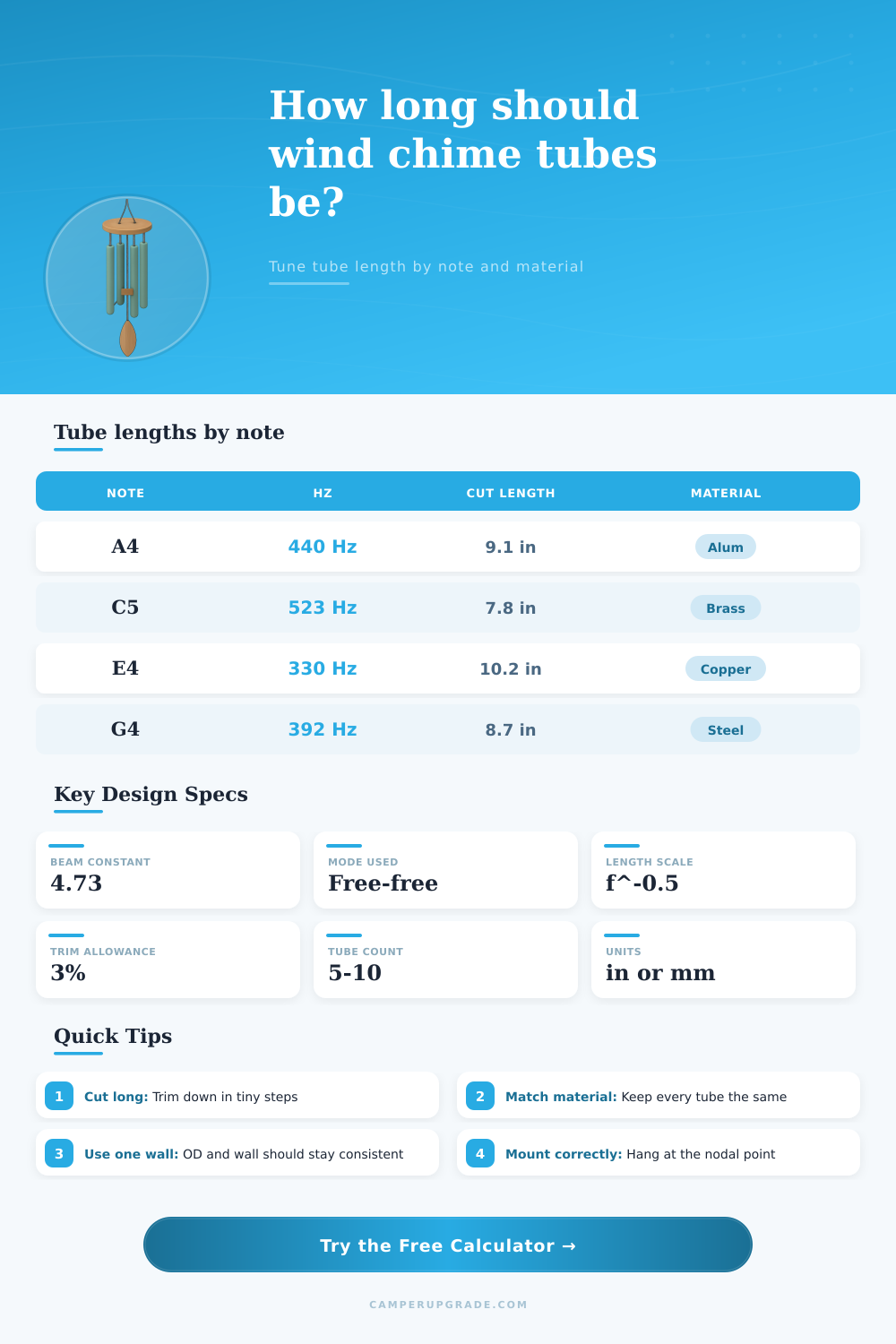
Wind chime produce sound based off the physics of vibration, where the length of the wind chime tube determine the pitch of the wind chime tubes. Wind chime tubes that a person cut to a short length will produce a high pitch from an wind chime tube. Conversely, wind chime tubes that are cut to a long length will produce a low pitch from the wind chime tube.
The relationship between the length of the wind chime tube and the frequency of the sound that is produced can be calculated through a simple mathematicaly calculation. Small changes in the length of the wind chime tubes will have a large impact on the frequency of the sound that is produced by the chime. The material from which the wind chime tubes is made will also impact the sound that the chime makes.
How Wind Chimes Make Sound
Tubes made from brass will produce a long sustained sound. Aluminum chime tubes will produce a brightly sound. Copper chime tubes will produce a warm sound.
Steel chime tubes will produce a crisp sound. Furthmore, the thickness of the wall of the chime tubes and the outer diameter of the tubes should be consistent throughout the chime. Any difference in the dimensions will result in the wind chime tubes producing random sound instead of the scale of musical sounds that is desired from a wind chime.
The scale patterns of the wind chimes will determine the mood of the music that the chime plays. Additionally, the number of the wind chime tubes will determine the type of scale that the chime can play. Major pentatonic scale contain five notes, whereas diatonic major scales contain seven notes.
Minor pentatonic scales are mellower in there sounds. Whole tone scales use even steps in its musical tones. The number of wind chime tubes can range from three to twelve.
However, if you are using more than three wind chime tubes, the musical interval will need to be tightened. The dimensions of the wind chime tubes will have an impact upon the projection of the sound that the chime makes. Three quarters of an inch is the outside diameter of the wind chime tubes for most chimes.
The wall thickness of the tubes should be one twentieth of an inch. Using a diameter of one inch in the size of the wind chime tubes will produce a deeper sound resonating from the chime. Using a thicker wall thickness will make the chime tubes more stiffer.
Chime tubes that are more stiff will require less length of the tubes to reach the desired pitch. A person can use a calculator to calculate the length of the chime tubes by taking into consideration the density and stiffness of the metal chime tubes. The way that the wind chime tubes are mounted to the chime will have an impact upon the length of the chime.
If the chime is hung on a cord loop, the wind chime tubes can swing free. If the wind chime tubes have drilled holes or top caps, they will be more constrained in there movement. These constraints will change the resonant portion of the chime tubes by a small percentage.
In order to account for this change, the wind chime tubes should be cut to a length that is longer than the calculated length by approximately three percent. This allowance for extra length ensure that the wind chime tubes will reach the desired pitch. Some mistakes that should of been avoided in the construction of wind chimes are mixing materials for the chime tubes.
Using different material for the wind chime tubes will fracture the tone of the chime. Another mistake is failing to include nodal suspension for the chime tubes. Nodal suspension is necessary for the chime tubes to have a long sustain in there sounds.
Additionally, the metal chime tubes should be made of a dense metal if the wind chime is to be hung in an area with soft breeze. Dense metals will produce longer decays in their sound. Steel chime tubes are best for areas with high winds.
Steel is a more stoutly metal. Finally, the chime should be hung at a height that allows for the chime tubes to sway and make contact with the clapper.