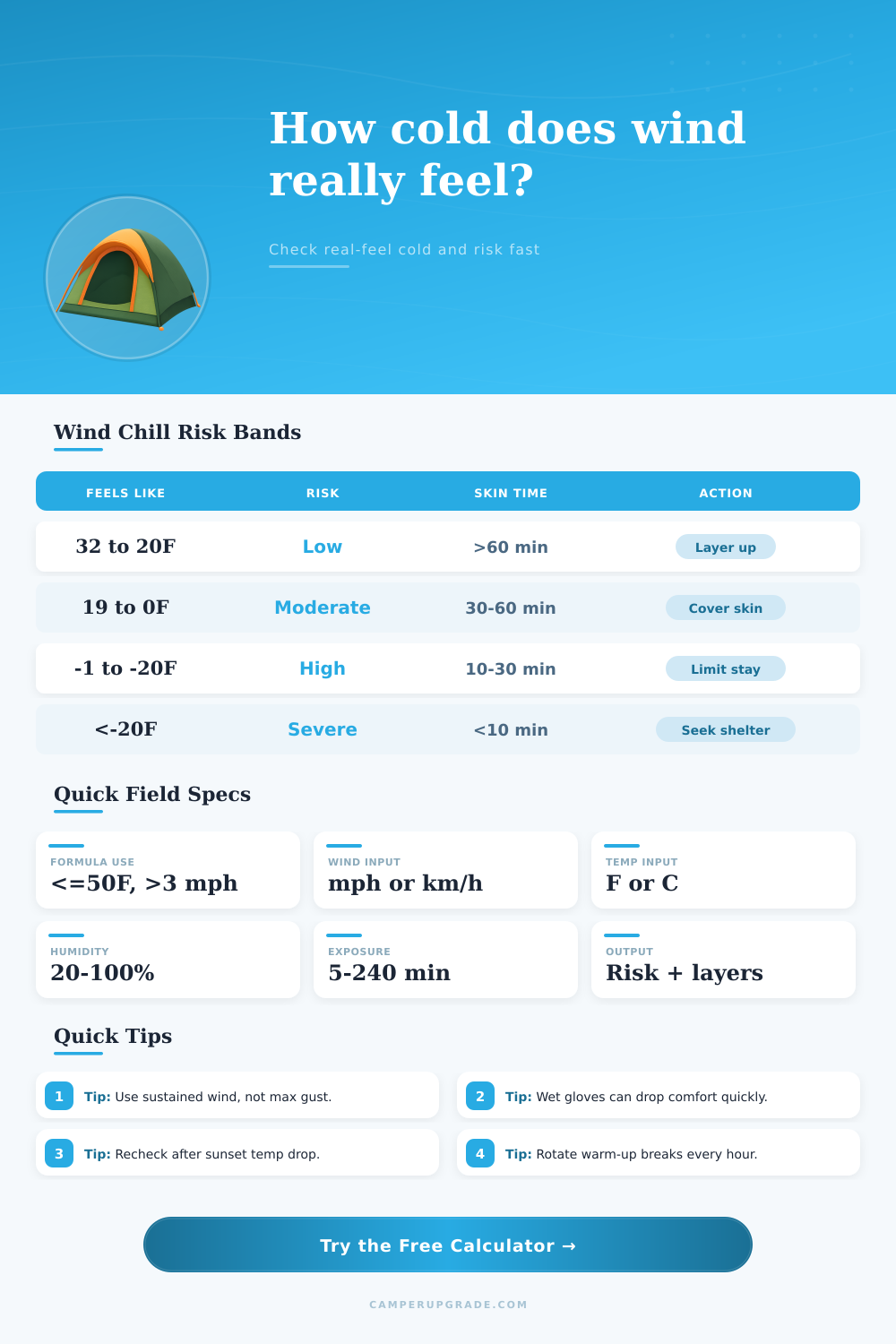
Wind Chill Calculator
Estimate apparent cold, frostbite timeline, and layering needs for RV stops, campsites, and exposed trailhead tasks.
🏕Field Presets
📝Condition Inputs
🧥Cold-Weather Gear Spec Grid
📊Reference Tables
| Adjusted Wind Chill | Risk Level | Approx. Frostbite Time | Operational Guidance |
|---|---|---|---|
| 32 to 20°F | Low | 60+ min | Standard layers, monitor hands. |
| 19 to 0°F | Moderate | 30-60 min | Cover face, tighten wind shell. |
| -1 to -20°F | High | 10-30 min | Limit static work, timed warm-ups. |
| -21 to -35°F | Very High | 5-10 min | No exposed skin, buddy checks. |
| Below -35°F | Extreme | Under 5 min | Emergency conditions, shelter now. |
| Sustained Wind | mph | km/h | Field Effect on Camp Tasks |
|---|---|---|---|
| Light | 4-9 | 6-14 | Minor heat loss increase during setup. |
| Breezy | 10-19 | 16-31 | Noticeable chill through light layers. |
| Windy | 20-29 | 32-47 | Rapid hand cooling and face sting. |
| Strong | 30-39 | 48-63 | Frequent shelter breaks recommended. |
| Near Gale | 40-49 | 64-79 | High convective loss, reduce exposure. |
| Exposure Duration | Suggested Warm Break | Hydration Prompt | Skin Check Interval |
|---|---|---|---|
| Under 20 min | Not required | Before task | Start and end |
| 20-45 min | 5 min warm-up | Every 45 min | Every 20 min |
| 45-90 min | 10 min each hour | Every 30 min | Every 15 min |
| 90-180 min | 15 min each hour | Every 20 min | Every 10 min |
| 180+ min | Split into short blocks | Every 15 min | Every 5-10 min |
| Scenario | Typical Temp / Wind | Expected Wind Chill | Layer Target |
|---|---|---|---|
| Ridge RV Stop | 26°F / 24 mph | 11°F range | 1.8 to 2.2 clo |
| Lake Morning Setup | 30°F / 18 mph | 17°F range | 1.4 to 1.8 clo |
| Open Desert Front | 35°F / 30 mph | 22°F range | 1.6 to 2.0 clo |
| Forest Calm Camp | 28°F / 8 mph | 20°F range | 1.2 to 1.6 clo |
| Frozen Lake Watch | 18°F / 22 mph | -1°F range | 2.1 to 2.6 clo |
The wind chill shows how cold folks and creatures feel outside. It estimates the rate of stripped skin because of wind and cold. When wind increases, it removes heat.
That turns skin temperature and later body heat. Wind does everything feel more cold, than it really is. Matter to know, that wind chill is the feeling of wind in outside temperature on skin.
What Wind Chill Is and How It Affects Camping
Always the values of wind chill is lower than the air temperature.
Wind chill does not alter the real temperature. It does not touch the air itself. Also it does not work on dead objects, that has the same temperature as the outside.
Wind chill does not affect metal neither pipes. It only attains living creatures as folks and creatures. It will not freeze water neither will melt it.
Also it does not inhibit or help start cars. Wind forces heat to flow more quickly of warm bodies, as folk, to cold, as air. If you stand outside with bare skin, the physical impacts describe the wind chill.
Basically it shows, as far more cold you feel you during wind blow.
Wind chill matters especially for winter campers. Temperatures sharply sink, and with wind they create dangerously low felt values. That makes sleep uncomfortable and expand frostbite risk.
For hammock camping, use the wind chill temperature as target. In tent it can alter everything. Tents give only a bit of heat during winter sleep, unless wind blows.
Then it helps a lot, because protect against wind chill. A 4-season tent expands the temperature in around 5 until 10 degrees in calm weather.
Strong winds complicate cook. If you plan to use camp stove, take windscreen. In windy conditions start campfires are difficult.
For keep fire during gusts requires to carefully choose place and learn techniques for ignition. In gusty winds, a campfire can become dangerous, because flaming tinder can fly away. In campfire the fuel is limited.
When gale strikes, the flame pushes away of the timbers to a space and disappear.