Wet Bulb Dry Bulb Dew Point Calculator
Convert field psychrometer readings into dew point, relative humidity, vapor pressure, and humidity ratio for moisture control and condensation checks.
🌡️ Observation Presets
⚙ Dry Bulb, Wet Bulb, And Pressure Inputs
🧪 Psychrometric Constant Grid
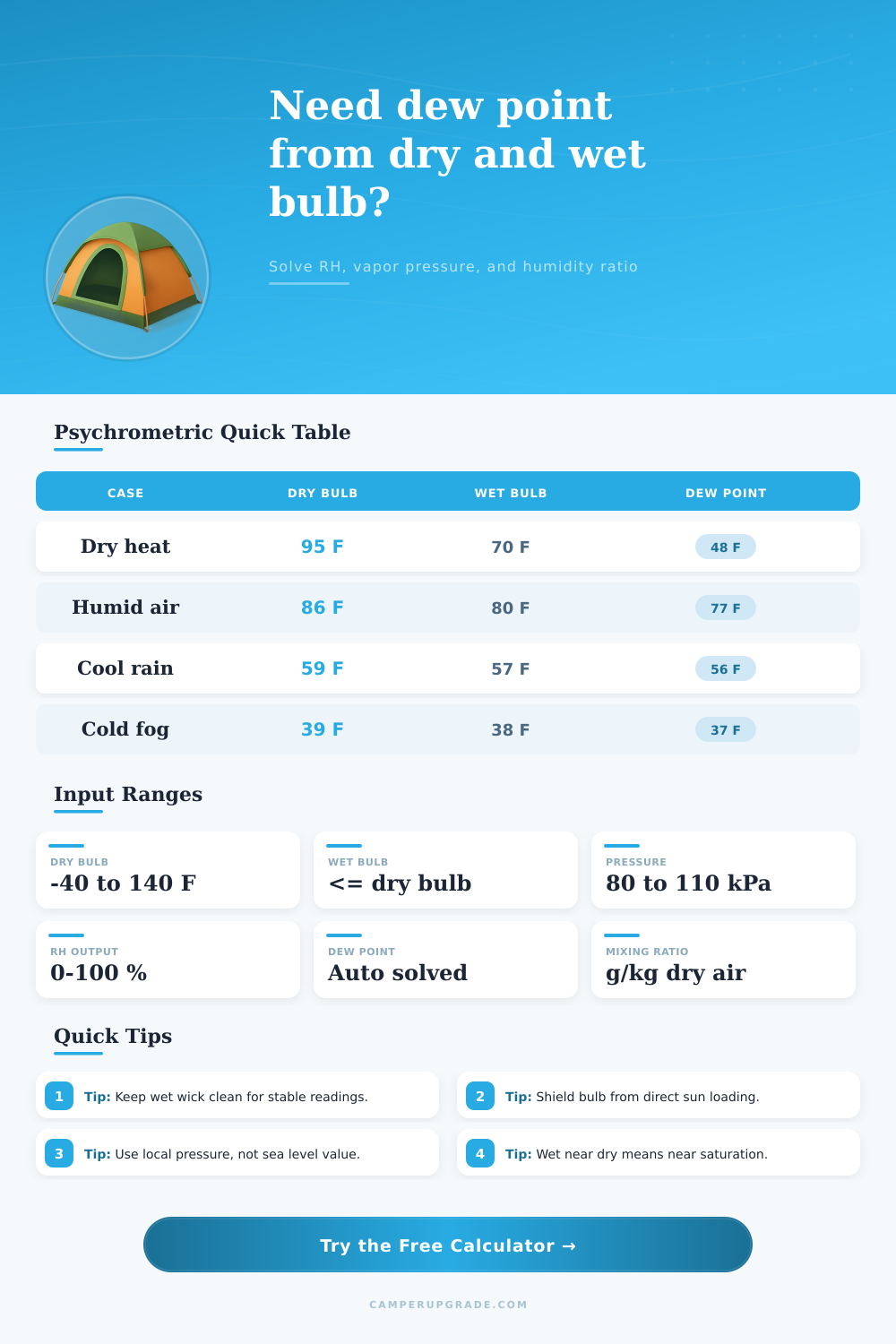
📘 Wet Bulb Dry Bulb Dew Point Reference Tables
| Dew Point Range | Moisture Feel | RH Tendency | Operational Cue |
|---|---|---|---|
| Below 10 °C | Dry air | Usually below 45% | Higher evaporation and static risk |
| 10 to 16 °C | Comfortable | Roughly 45 to 60% | Balanced ventilation conditions |
| 16 to 21 °C | Muggy | Often 60 to 75% | Monitor condensation-prone surfaces |
| Above 21 °C | Oppressive | Commonly above 75% | Heat stress and mold load increase |
| Dry-Wet Delta | Approx RH Band | Evaporation Rate | Field Meaning |
|---|---|---|---|
| 0 to 1 °C | 95 to 100% | Very low | Fog, drizzle, or saturated air mass |
| 2 to 4 °C | 75 to 95% | Low to moderate | Humid layer with weak drying |
| 5 to 8 °C | 50 to 75% | Moderate | Typical mixed outdoor conditions |
| 9+ °C | Below 50% | High | Dry advection and rapid moisture loss |
| Station Pressure | Approx Altitude | Psychrometric Effect | Note |
|---|---|---|---|
| 101.3 kPa | Sea level | Baseline correction | Standard reference condition |
| 95.0 kPa | ~1800 ft | Lower evaporation term | Slightly weaker wet-bulb depression |
| 90.0 kPa | ~3500 ft | Noticeable reduction | Use local pressure for accuracy |
| 84.0 kPa | ~5200 ft | Strong adjustment | Sea-level pressure will overstate RH |
A psychrometer are a tool that can be used to measure air temperature and moisture level within the air. The tool utilize two different temperature measurements to determine the humidity within the air. Each of these temperature measurement is either the dry bulb temperature or the wet bulb temperature.
The dry bulb temperature is the temperature of the air as measured with a thermometer that isnt cover in moisture. In contrast, the wet bulb temperature is the temperature of an thermometer that is covered in a damp wick. The damp wick allow for moisture to evaporate from the wick, which cool the thermometer bulb and results in the wet bulb temperature being lower than the dry bulb temperature.
How a Psychrometer Measures Humidity
The difference between these two temperatures is referred to as the wet bulb depression. A small depression indicate that the air is humid, while a large depression indicate that the air is dry. In addition to measuring the dry and wet bulb temperature, it is also important to account for the atmospheric pressure when using a psychrometer.
The atmospheric pressure of the area impact how much the wet bulb temperature will drop due to evaporation of the moisture from the damp wick covering the wet bulb thermometer. In area with high altitudes, for instance, the atmospheric pressure is lower and the evaporation of the water from the wick will change as a result. Thus, you must measure the barometric pressure of the area in order to calculate the humidity of the air more accurately.
Furthermore, it is also important to consider the type of psychrometer that a person is using. For instance, a fan-aspirated psychrometer utilizes a fan to move the air over the wet and dry bulb, but an individual must manually spin a sling psychrometer to move the air over the wet and dry bulbs. As a result, the psychrometric coefficient of a sling psychrometer will be more higher than that of a fan-aspirated psychrometer.
The dew point is the measurement of the temperature at which air will become saturated with moisture. In other words, if the air temperature drop to the temperature that measure the dew point of the air, the water vapor in the air will condense into liquid water. If the temperature of a surface is lower than the dew point, condensation will form on that surface.
The dew point can help you to determine whether fog will form in the atmosphere or whether moisture will condense on equipment. Relative humidity is another measurement of humidity that indicate the amount of water vapor in the air compared to the maximum amount of water vapor that can be contained in the air at a specific temperature. The relative humidity reading is dependent upon the dry bulb temperature reading.
Hence, 50% relative humidity at a high temperature will differ than 50% relative humidity at a low temperature. Another measurement of humidity is the humidity ratio and the vapor pressure deficit. The humidity ratio is the amount of water vapor that is contained in a specific amount of dry air.
The humidity ratio dont change with changes in temperature. The vapor pressure deficit is a measurement of how much moisture is in the air before it become saturated. Many people use the vapor pressure deficit to manage the irrigation of their plant.
Additionally, many people use the vapor pressure deficit to adjust the dehumidifier in their buildings. A high dew point in the environment indicate that the air is moist. As a result, a person will find it difficult to cool themselves through sweat.
A low dew point in the environment indicate that the air is dry. A persons skin might be dry or they might experience static electricity. To obtain accurate measurement with a psychrometer, the device must be maintained properly.
You must keep the wicks on the hygrometer clean so that evaporation from the wick is not slowed. The psychrometer should be kept out of direct sunlight so that the dry bulb temperature is not too high. You should ensure the device has enough airflow over the thermometers.
If the sling psychrometer is being used, the device should be swung vigorously to ensure that the air move over the wick. Following these step will ensure that the instruments will measure the wet bulb and dry bulb temperature correctly.