Weight Distribution Per Axle Calculator
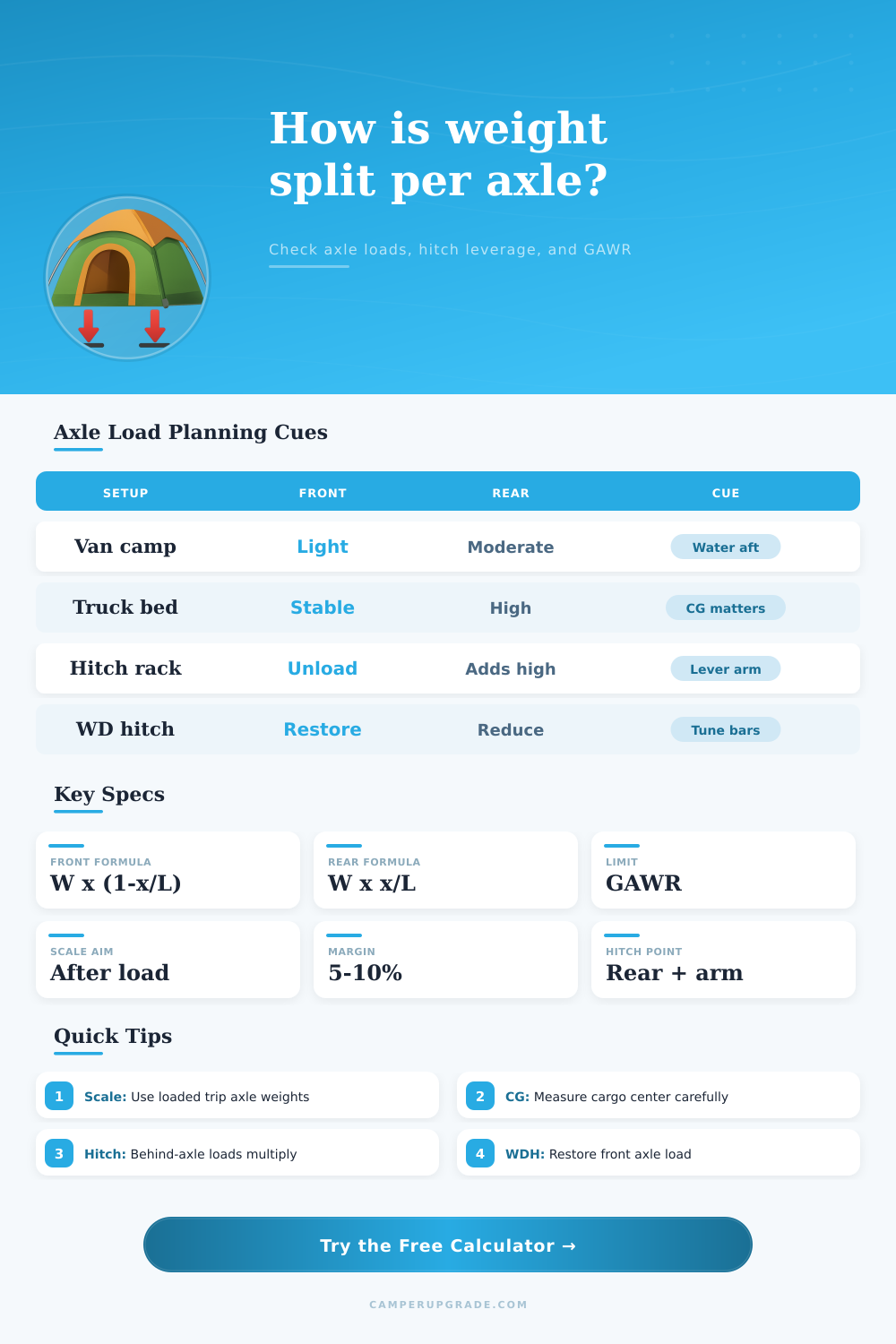
Estimate front axle reaction, rear axle reaction, GAWR margin, hitch leverage, camper cargo placement, water tank effect, gear balance, and weight-distribution hitch transfer before the next scale check.
🚙Real Camper Load Presets
⚖Axle, Limit, Load, and Hitch Inputs
📐Axle Formula Spec Grid
📋Axle Load Reference Tables
| Added load location | Position cue | Front reaction | Rear reaction |
|---|---|---|---|
| Cab passengers | Forward of midpoint | Positive and often large | Positive but smaller |
| Bed cargo over axle | Near rear axle | Small positive | Most of load |
| Truck camper aft CG | Just ahead or behind rear axle | Small gain or unload | Can exceed cargo weight |
| Hitch rack or tongue | Behind rear axle | Negative without WDH | Weight plus leverage |
| Status band | Axle percent | Meaning | Action cue |
|---|---|---|---|
| Comfortable | Under 85% | Good cushion | Confirm loaded scale weight |
| Watch zone | 85% to 95% | Limited cushion | Repack heavy items forward or lower |
| Tight | 95% to 100% | Very little margin | Reduce load before rough roads |
| Over rating | Above 100% | Rating exceeded | Unload or change rig setup |
| Load item | Typical weight | Likely center | Axle effect |
|---|---|---|---|
| Fresh water, 30 gal | 250 lb | Tank center | Depends heavily on tank location |
| Two e-bikes and rack | 150 to 220 lb | Behind rear axle | Rear axle gain exceeds raw weight |
| Hard-side truck camper | 2,200 to 4,500 lb | Often near rear axle | Rear GAWR is usually limiting |
| Travel trailer tongue | 10% to 15% | Hitch ball | WDH changes final split |
| WDH setting | Front axle result | Rear axle result | Trailer axle result |
|---|---|---|---|
| 0% restore | Front stays light | Rear carries leverage | No transfer modeled |
| 40% restore | Some front load returns | Rear load drops | Small trailer transfer possible |
| 60% restore | Common tow target | Better rear margin | Check trailer axle rating |
| 100% restore | Full front unload restored | May be too aggressive | Follow hitch and vehicle manual |
💡Axle Weight Tips
When a person drive a truck and trailer into a weigh station, the scale will display specific number that tell the person how the weight is distributed across the truck and trailer. The distribution of the weight of a truck and trailer impact the performance and longevity of the axles. For instance, if there is too little weight on the front axle, the steering of the vehicle may become vague when driving on wet pavement.
Additionally, if there is too much weight on the rear axle, the rear axle will suffer more damage when encountering potholes. Thus, the specific location of the load of the trailer will impact both the load on the front and rear axle. Every pound of weight that is placed onto a trailer will land in a specific location along the length of the trailer.
How to Check Trailer Weight and Balance
The location of that load will impact the amount of weight that is placed on each axle. For instance, if an individual is sitting in the cab of the truck, the weight that the passenger place on the trailer will create more weight on the front axle than if the person was sitting in the truck bed. Additionally, if a tank of water is located behind the rear axle of the truck, that water will add to the weight of the trailer, but the load will be placed onto the rear axle instead of the front axle.
Thus, the water in the tank may overload the rear axle of the truck prior to even considering the weight of the trailer. This calculator can help the person to determine the physics of the trailer’s loaded weight and remove the guesswork that may result in an unexpected load at the trailer’s scale. The inputs that a person enters into this calculator are the same as those that is made when loading the trailer.
One of the inputs is the trailer’s wheelbase. The trailer’s wheelbase will determine the leverage of the trailer that is used in the calculation of the load on each of the trailer’s axles. Additionally, the tongue weight of the trailer is another of the inputs.
This weight impacts the trailer because any weight located behind the axles will have a multiplying effect on the load on the rear axle. Additionally, some trailers has a weight-distribution hitch that will allow some of the load to be returned to the front axle. However, the weight-distribution hitch will only work if the bars of the hitch are adjusted to the proper setting.
Finally, the calculator allows people to view each of these variable and to understand how adjustments to specific inputs impact the trailer’s axle loads. In many cases, people are surprised by the way that the load on the axles can change with adjustments to the placement of the load within the trailer. One of the most common mistake that people make when loading their trailers is to treat the Gross Axle Weight Rating (GAWR) numbers as the target load for each axle.
Instead, these numbers represent the maximum load for the trailer’s axles. Furthermore, the GAWR numbers already provide for some dynamic loads and temperature loads for the trailer. Thus, if a person is loading the trailer so that each axle is running at 98% of its GAWR, there will be no margin for other variables.
The calculator will display the remaining margin for each axle so that the person can decide if the load is comfortable or if it needs to be adjusted. Another of the most common mistakes that a person can make with trailers is measuring the distance of the load from the wrong measurement. For instance, many people use the length of the trailer or the length of the rack to measure distances.
However, these measurements do not reflect the load of the trailer. For instance, if the load of a trailer consists of a long bike rack that is mounted behind the axle, the center of gravity of the trailer will be located further back than the rack measurements. Thus, the trailer will have a greater leverage on the rear axle and an unloading of the front axle.
This same load can be applied to trailers with other types of load such as campers and toy hauler. For instance, the center of gravity of the load within the camper or toy hailer may be located behind the rear axle of the trailer. Fresh water is another of the most commonly underestimated load of a trailer.
For instance, fresh water weighs 8 1/3 pounds per gallon. Furthermore, the amount of water that is required for a trip can quickly add up to a significant load on the trailer. Additionally, the location of the water tank is rarely the same as the center of gravity of the trailer.
If a person loads water into the tank after loading the remainder of the trailer’s load, the trailer can be in an overloaded state for one of its axles. Finally, the trailer weight calculator allows people to enter the center of gravity of the water tank separately. By entering the water separately, an individual can view the effect that the water will have on the trailer prior to beginning the route.
Lastly, it should be noted that the load that is calculated in the trailer weight calculator is rarely the same as the actual load that is transported during the trip. For instance, additional items like a cooler, a spare tire, and even a generator are additional load that must be accounted for on a trip. Furthermore, each of these items will have its own center of gravity.
The trailer weight calculator cannot calculate the weight of these items, but it can provide a starting point for the load of the trailer. Based off the weight that the trailer calculator calculates, a person can then decide if the remaining margin is an adequate load or if the trailer needs to be loaded in a different manner prior to departure from the trailer park. Thus, the goal is for the trailer to have a known weight distribution prior to reaching the scale.