
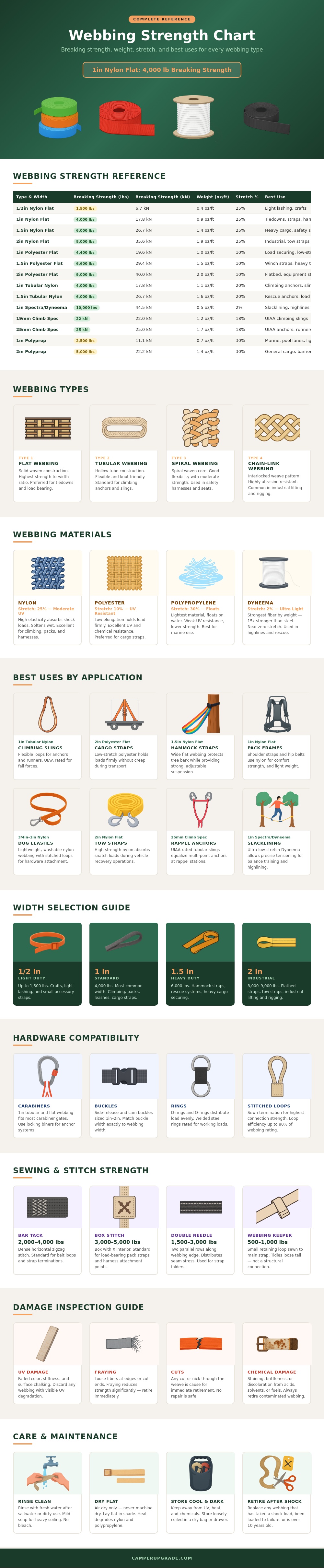
Webbing are a type of woven fabric that is used to secure load, and webbing is used in many different ways because webbing is strong and versatile. You must select the correct type of webbing for you’re task, because selecting the wrong type of webbing can lead to the webbing breaking or failing under tension. To select the correct webbing, you must consider the weave of the webbing, the material of the webbing, the width of the webbing, and the stitching of the webbing.
The weave of the webbing determine how the webbing handles weight and how the webbing moves. Flat webbing are a tightly woven fabric that provides high strength per inch of width, so people often use flat webbing for tie-down application where weight is a concern. Flat webbing spreads loads evenly across the surface of the load.
How to Choose and Care for Webbing
Tubular webbing is a different style of webbing that has a hollow core, and tubular webbing is more easy to bend around knots or carabiners because tubular webbing is more flexible than flat webbing. Spiral and chain link weaves are also types of webbing, and people use these weaves when you need more flexibility or more resistance to abrasion. The material of the webbing determines how the webbing react to tension and how the webbing reacts to the environment.
Nylon is a common material for webbing, and nylon is a stretchy material that can absorbs sudden jolt or impacts. Because nylon is stretchy, nylon webbing may stretch under constant tension, so nylon webbing might allow a load to shift over time. Polyester is another material used for webbing, and polyester webbing is much stiffer than nylon webbing.
Polyester webbing does not stretch much, and polyester webbing is resistant to damage from ultraviolet light, so polyester webbing is a good choice for long distance transport in the sun. Polypropylene is a third material used for webbing, and polypropylene webbing float in water, so polypropylene webbing is useful for marine environment. However, polypropylene webbing can degrade quickly when it is exposed to sunlight.
The width of the webbing determine how much weight the webbing can support and how the webbing distributes force. Narrow webbing that is half an inch wide is used for light task, but wider webbing is used for heavier tasks. One-inch webbing is a versatile width that can be used for many different task, and two-inch webbing is a wide width that is used for heavy loads like flatbed rigs or hammocks.
Wider webbing is useful because wider webbing distributes force over a larger surface area, and wider webbing is less likely to damage the object that the webbing is securing. The stitching of the webbing determines the strength of the finished webbing product. Manufacturers use specific sewing pattern to secure the webbing, and these sewing patterns include bar-tack zigzags and box-X patterns.
Bar-tack stitching is used to secure belt loop, and box-X stitching is used to reinforce shoulder strap on heavy packs. Proper stitching is important because stitching allow the webbing to retain it’s strength, whereas knots can reduce the strength of the webbing by half. You should also ensure that the hardware, such as D-rings or buckles, is the correct size for the webbing, because hardware that is too small can create pinch point that weaken the webbing.
You must inspect your webbing regularly to ensure that the webbing remain safe to use. You should look for faded color, because faded colors indicate that ultraviolet light has damaged the material. You should also look for frayed edge or small nicks in the fabric, because frayed edges and nicks significantly reduce the weight capacity of the webbing.
If a chemical like fuel or acid has stained the webbing, you should stop using that webbing. To maintain your webbing, you should rinse salt and grit away from the webbing, and you should air-dry the webbing in a shaded area. You should store your webbing in a cool, dark place, and you should replace any webbing that has been subjected to a sudden shock load or any webbing that is very old.