Water Treatment Drop Count Calculator
Estimate treatment drops for camp bottles, hydration bladders, jerry cans, and RV emergency water using treatment strength, water clarity, temperature, drop size, and contact-time targets.
Drop Count Results
| Treatment material | Typical field strength | Main use | Limit or caution |
|---|---|---|---|
| Plain household bleach | 5% to 9% sodium hypochlorite | Emergency treatment of clear water when boiling is not practical. | Use only plain, unscented bleach suitable for disinfection. Strength fades with age and heat. |
| Low-strength bleach | About 1% sodium hypochlorite | Countries or products where bleach is sold weaker than typical US labels. | Requires about five times the volume of 5% bleach. |
| 2% tincture iodine | EPA guide: 5 drops per quart or liter | Compact first-aid bottle backup for short-term use. | Avoid if pregnant, thyroid-sensitive, iodine-sensitive, or for use longer than a few weeks. |
| Chlorine dioxide drops | Varies by brand after activation | Backpacking drops and tablets, especially when longer protozoa contact time is acceptable. | Follow label strength and wait time. Product formulas are not interchangeable. |
| Custom liquid sanitizer | User-entered mg/mL active ingredient | Lab-labeled stock solution, pool test setup, or known camp concentrate. | Requires reliable concentration data and clean measuring tools. |
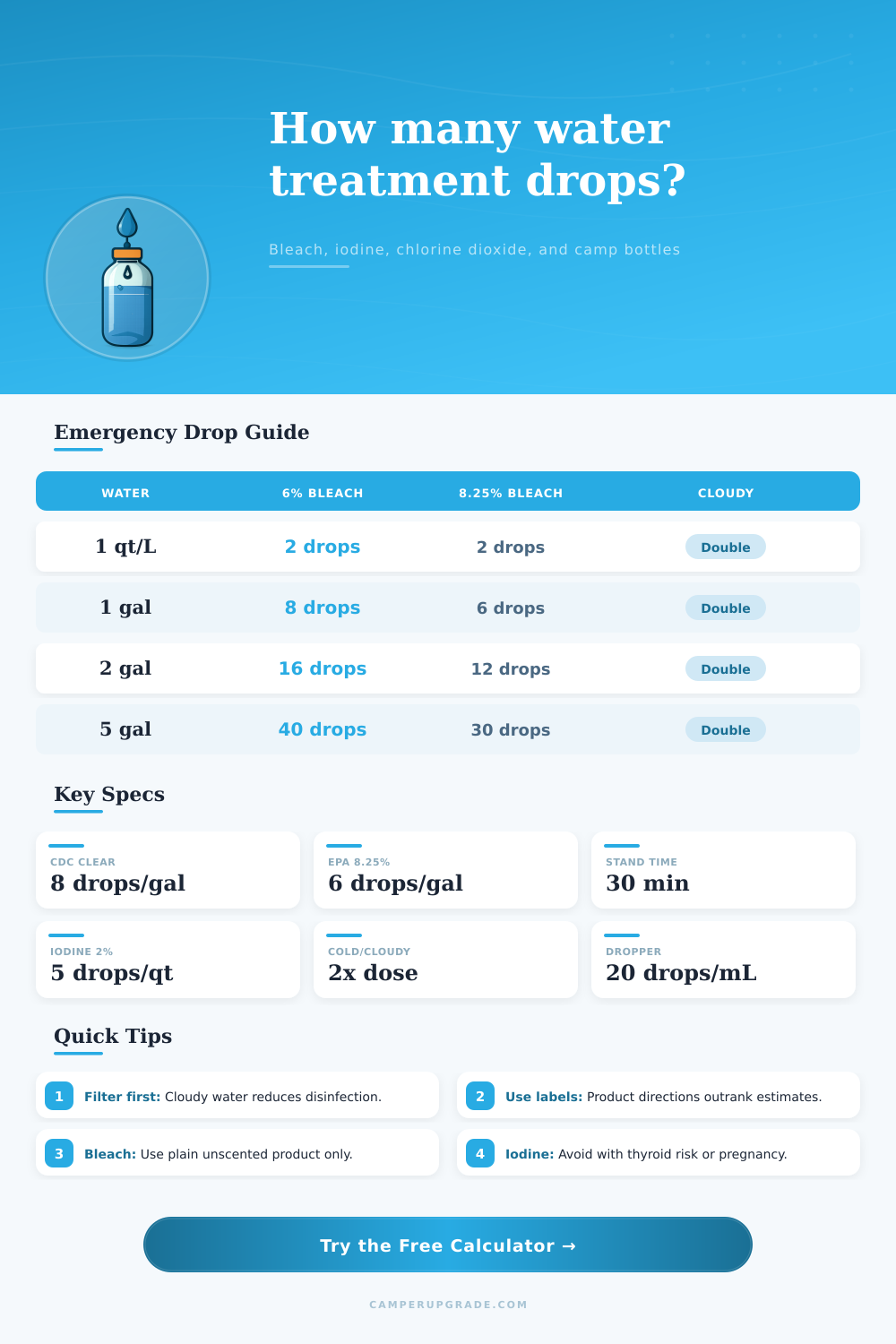
EPA bleach drop guide for clear water
| Water amount | 6% bleach | 8.25% bleach | If cloudy, colored, or very cold |
|---|---|---|---|
| 1 quart or 1 liter | 2 drops | 2 drops | Double the listed drops |
| 1 gallon | 8 drops | 6 drops | Double the listed drops |
| 2 gallons | 16 drops | 12 drops | Double the listed drops |
| 4 gallons | 1/3 teaspoon | 1/4 teaspoon | Double and mix well |
| 8 gallons | 2/3 teaspoon | 1/2 teaspoon | Double and mix well |
CDC emergency bleach guide
| Bleach concentration | 1 quart or liter | 1 gallon | 5 gallons |
|---|---|---|---|
| 5% to 9% sodium hypochlorite | 2 drops or 0.1 mL | 8 drops or 0.5 mL | 40 drops or 2.5 mL |
| 1% sodium hypochlorite | 10 drops or 0.5 mL | 40 drops or 2.5 mL | 200 drops or 12.5 mL |
| Cloudy, murky, colored, or very cold | Double the amount | Double the amount | Double the amount |
| Standing time | At least 30 minutes | At least 30 minutes | At least 30 minutes |
Iodine and contact-time planning
| Method | Clear water guide | Cloudy or colored | Notes |
|---|---|---|---|
| 2% tincture iodine | 5 drops per quart or liter | 10 drops per quart or liter | Stir and wait at least 30 minutes. |
| Chlorine dioxide drops | Follow product label | Follow label and extend wait | Some products require hours for Cryptosporidium claims. |
| Bleach after filtration | EPA/CDC table dose | Double dose if still cloudy or cold | Bleach does not remove chemical contamination. |
| Boiling | 1 minute rolling boil | Filter first if cloudy | Use 3 minutes above 5,000 to 6,500 ft guidance ranges. |
Dropper and spoon conversion
| Calibration | 1 mL | 1/8 teaspoon | Best use |
|---|---|---|---|
| 20 drops per mL | 20 drops | About 12 drops | Default medicine-dropper estimate. |
| 15 drops per mL | 15 larger drops | About 9 drops | Thicker liquids or wide droppers. |
| 25 drops per mL | 25 smaller drops | About 15 drops | Fine-tip backpacking bottles. |
| Teaspoon measure | 4.93 mL per teaspoon | 0.616 mL per 1/8 teaspoon | Useful for larger jugs when drops get tedious. |
Your canteen might be full of water that looks perfectly fine to drink, but that transparency won’t tell you anything useful about what you can’t see. Invisible things like Giardia cysts, which are thinner than a single strand of human hair, is waiting for you to let down your guard. When it comes to drinking water, there is no substitute for numbers. Your “gut” isn’t going to do you any good when it comes to math.
The calculator above does the math for disinfection. It handles all those pesky chemistry details so you don’t need to bring a lab with you. It takes those yucky real-world conditions and turns them into accurate drops of chlorine dioxide, iodine, or bleach.
Why Numbers Are Better Than Looking
The most commonly used emergency disinfectant is bleach, but it’s also the most easily misused. Don’t think you can just squirt some in there and say goodnight. It matter how strong the bleach is. Something with 8.25 percent sodium hypochlorite only take a few drops. Something at 6 percent takes more. Something faded from sitting in the hot sun for years, getting weaker as time goes by, will take even more drops then either of them.
Many people don’t even bother reading the label, treating their own drop count as if it were some kind of ironclad rule. It is a bad idea that lead to disaster. To help you get it right, this tool lets you tell it what percentage you actualy have on your bottle, so you won’t be underdosing because your bleach is old or overdosing because you thought it was fresh.
Another variable is temperature, which most guides don’t cover well. When the weather gets cold, chemical reactions happen slower. Chlorine take a lot longer to kill pathogens and bond with them in near freezing conditions. When you’re chlorinating alpine spring water in the morning hours, you can’t expect the same 30 minute contact time as during a summertime treatment. By accounting for thermal profile, the calculator will adjust the contact times accordingly. Waiting longer isn’t all there is to it: it’s also respecting the science behind how molecules hit each other. Disinfectant move sluggishly in cold water, too.
The second primary variable is clarity. Microbes in silt or turbid water hide inside grains of dirt and form microscopic fortresses that is shielded from chemical attack. Ideally, filter before treatment. If you must go with cloudy water, however, double your dosage. This is not a recommendation, but a cautionary note.
This is where the multiplier comes into play. The tables on the page clearly indicate doubling the dose when water are murky. Better to drink a gallon that tastes like chlorine than to drink a gallon infected with Giardia. Annoyance vs. Hospital visit.
Each chemical has a personality. Iodine is compact and does a good job killing viruses and bacteria (but some types of protozoa require a lot more time). For example, iodine is not for everyone: people with thyroid problems should avoid it completely; pregnant people cannot use it. Chlorine dioxide falls into the middle range; it kills a broader spectrum of things (including Cryptosporidium), provided you wait long enough. Knowing each one’s personality help you choose the proper tool for the job instead of just reaching into your first aid kit and grabbing whatever is there.
So maybe the dropper calibration is a bit pedantic, but practical. Not all drops are created equal. A fine-tip will dispense smaller blobs than a wide-tip. Even with the same drop number, you’ll have different milliliters. Once calibrated at home, you save having to guess in the field. Knowing what you’re adding matters. Precision isn’t about perfection; it’s about predictability. You should of known that.
At its heart though, putting drops in your water is an exercise in trusting chemistry over what you can see. The safety we’re buying, you can’t see. That’s where the calculator comes in to remove any of the uncertainty and make those variables come down to one number. Shake up that bottle, pour out the drops, and wait. Then take that first sip, knowing the invisible threat was dealt with long before it reaches your lips.