Water Carry Between Sources Calculator
Estimate how many liters to leave a source with, how heavy that carry will be, and whether your bottle capacity fits the next dry stretch.
💧Dry Stretch Presets
⚙Water Carry Inputs
🧪Carry System Spec Comparison
📋Drinking Rate Reference
| Condition | Typical rate | Use when | Calculator note |
|---|---|---|---|
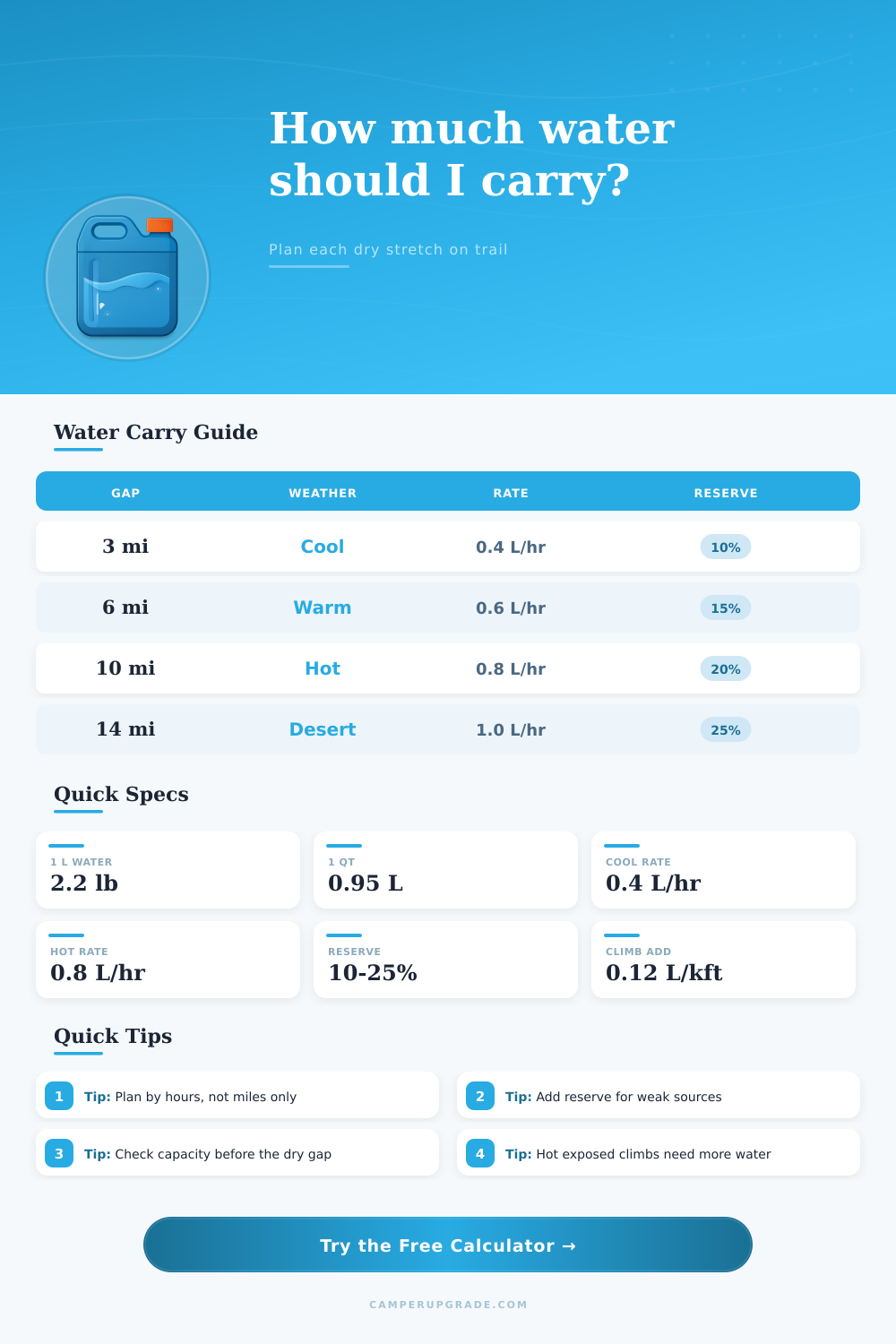
| Cool shaded travel | 0.30 to 0.45 L/hr | Low heat, easy grade, regular sources | Use the light or normal base rate with cool temperature. |
| Normal three-season hiking | 0.45 to 0.60 L/hr | Moderate effort with mixed shade | Good starting point for many backpacking water carries. |
| Warm exposed trail | 0.60 to 0.85 L/hr | Sun, dry air, heavier pack, or rough tread | Use warm temperature plus open exposure. |
| Hot desert or road walk | 0.85 to 1.20 L/hr | Heat above 90°F, radiant ground, or no shade | Use hot or extreme heat and a larger reserve. |
| Hard uphill push | Add 0.10 to 0.20 L per 1,000 ft | Long sustained climbs before refill | The calculator adds a climb-specific water amount. |
🗺Source Gap Planning Table
| Dry gap | Cool moderate carry | Warm exposed carry | Planning concern |
|---|---|---|---|
| 3 mi / 5 km | 0.7 to 1.2 L | 1.1 to 1.8 L | Usually simple if the next source is reliable. |
| 6 mi / 10 km | 1.3 to 2.1 L | 2.0 to 3.2 L | Reserve starts to matter if pace drops. |
| 10 mi / 16 km | 2.1 to 3.4 L | 3.4 to 5.2 L | Check bottle capacity before leaving the source. |
| 14 mi / 23 km | 3.0 to 4.8 L | 4.8 to 7.0 L | Source confidence and time of day become critical. |
| 18 mi / 29 km | 4.0 to 6.2 L | 6.5 to 9.0 L | May require dawn travel, caching, or route changes. |
| Container | Useful range | Strength | Watch point |
|---|---|---|---|
| Hard bottle | 0.7 to 1.5 L | Easy to measure and drink from | Bulky when empty. |
| Soft flask | 0.5 to 1.0 L | Good shoulder-strap access | Less durable in abrasion. |
| Hydration bladder | 1.5 to 3.0 L | High drink access while moving | Harder to monitor exact volume. |
| Dirty-water bag | 1.0 to 3.0 L | Doubles as filter storage | Keep dirty and clean water separate. |
| Camp reservoir | 2.0 to 6.0 L | Useful for dry camp approach | Heavy and awkward when full. |
| Treatment | Typical delay | Best fit | Water carry effect |
|---|---|---|---|
| Tap or known potable source | 0 min | Developed campground or cache | No added time buffer. |
| Squeeze filter | 5 to 10 min | Frequent trail sources | Small delay; good for quick refills. |
| Gravity filter | 15 to 30 min | Camp or group volumes | Adds stopped-time demand in heat. |
| Chemical treatment | 30 to 60 min | Backup or poor filter conditions | Carry enough while water treats. |
| Boiling | Fuel and cooling time | Camp use or emergency | Usually too slow for mid-day dry gaps. |
💡Water Carry Tips
Water needs vary by body size, acclimation, humidity, wind, illness, medication, and salt intake. Use this as a field planning estimate and adjust from recent personal consumption.
A water carry plan is used to determine the amount of water that you will need to carry between water source. A water carry plan is important because the amount of water that you need can change based on your walkingly rate and the amount of heat that you experience. You must make a water carry plan because the distance between water sources is not the only factor that will impact your water consumption.
You must also consider the amount of time that you will need to travel to the next water source and the number of environmental factors that may increases your need for water. The water calculator will help you determine the total amounts of water that you will need for your journey. To use the water calculator, you will need to enter a variety of variables such as the distance that you will travel, the pace at which you will travel, the amount of elevation gain that you will encounter, and various environment factors.
How to Plan How Much Water to Carry
Your water consumption will increase with higher level of heat, sun exposure, and altitude. If you plan to travel on an exposed ridge during the warmer months, you will need more water than if you travel in the shade during a mild day. Additionally, the amount of elevation gain that you travel will increase the amount of time that you will be walk.
The longer you walk, the more water that you will consume. The water calculator will combine these variables to calculate the total amount of liters of water that you should carry on your journey. A water carry plan will require that you include certain percentage of water to ensure that you have sufficient water.
The first percentage of water that you will include is known as the reserve percentage. This percentage of water is needed to account for any delay that you may experience during the journey. You may experience delay because of slowing walking rates or taking a turn that may move you away from your destination.
The second percentage of water that you will include is known as the source risk buffer. This percentage of water is needed to account for the possibility that some of the water sources that you will encounter may be dry or have a very low rate of water flow. A reserve percentage and a source risk buffer is both required so that your minimum amount of water for your journey is transformed into a reliable amount of water that you will need on the journey.
The water calculator will separate this percentage of water from the water that you will consume at your camp site so that you dont drink your reserve water before you reach your final destination. Another factor that you must consider in your water carry plan is your water capacity. Your water capacity is the total amount of water that you can carry in your bottle and your water bladder.
You may calculate that you need to carry five liters of water, but if your capacity for water is only four liter, you will be unable to fulfill your water carry plan. The water calculator will allow you to compare your total amount of water that you need to your total water capacity so that you can determine if you have sufficient water capacity. If your capacity for water is less then the amount of water that you need, the water calculator will show that you are short of the amount of water that you need to carry.
There are a variety of environmental factors that may continue to impact your water consumption even after you have completed your water carry plan. Factors such as humidity, wind, and recent illnesses may impact your water consumption. To adjust your water carry plan, you can observe how much water you drank during your previous walking trips under similar environment conditions.
This observation will allow you to calibrate the water carry plan to your bodys need for water. The reference tables can help you verify your water carry plan. These tables contain information regarding typical water consumption rates for different conditions.
These tables can also show you how your different method of treating the water that you find may impact the amount of time that you spend at each water source. For instance, a slow water filter will force you to spend more time at each water source. If you spend more time standing at your water source in the hot sun, you will sweat more and consume more water.
The weight of the water that you carry is another factor that you must consider when creating your water carry plan. Each liter of water weigh more than two pounds. This weight will increase the weight of your pack.
This weight will impact your ability to move quick. If you can move quickly, you will consume less water. The water calculator will show you the departure weight of your pack so that you can decide if you would like to increase the amount of water that you carry or decrease the distance between water sources.
Your decision to carry water or to not carry water is a carry plan for your water supply before you even begin your journey. You should of thought about this before you start.