☀️ Water-Resistant Sunscreen Duration Calculator
Calculate exactly how long your sunscreen protection lasts based on activity, water exposure, sweat level, and SPF rating.
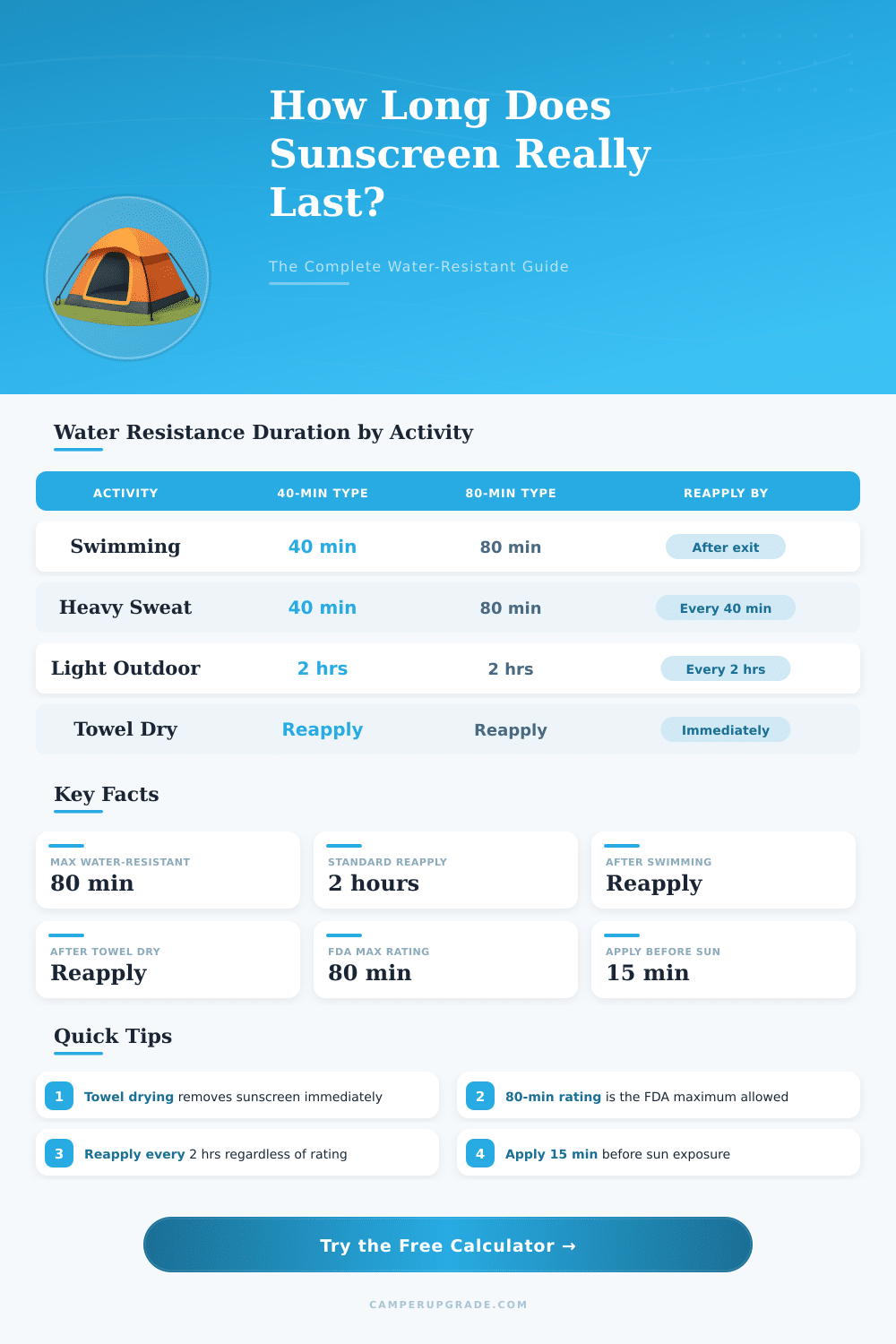
| Activity | 40-Min Rated | 80-Min Rated | Not Water-Resistant | Notes |
|---|---|---|---|---|
| Swimming (ocean/lake) | 40 min in water | 80 min in water | Washes off immediately | Reapply after every swim |
| Pool swimming | 40 min | 80 min | Washes off quickly | Chlorine accelerates removal |
| Heavy sweating / running | 30–40 min | 60–80 min | 15–30 min | Sweat reduces effectiveness |
| Moderate outdoor activity | Up to 80 min | Up to 2 hrs | Up to 2 hrs (no sweat) | Standard 2-hr rule applies |
| Beach lounging | Up to 2 hrs | Up to 2 hrs | Up to 2 hrs | Sand & wind also degrade SPF |
| Snow / skiing | 60–80 min | 80 min–2 hrs | 30–60 min | Snow reflects 80% UV |
| Kayaking / water sports | 40 min | 80 min | Not recommended | Water splash = water exposure |
| Casual outdoor (shade/picnic) | Up to 2 hrs | Up to 2 hrs | Up to 2 hrs | 2-hr max regardless of rating |
| SPF | UVB Blocked | UVB Passes Through | Recommended For |
|---|---|---|---|
| SPF 15 | 93.3% | 6.7% | Daily indoor use / low UV |
| SPF 30 | 96.7% | 3.3% | Everyday outdoor minimum |
| SPF 50 | 98.0% | 2.0% | Extended outdoor activity |
| SPF 70 | 98.6% | 1.4% | High UV / fair skin |
| SPF 100 | 99.0% | 1.0% | Medical / extreme conditions |
| Factor | Effect on Duration | Protection Remaining | Action Required |
|---|---|---|---|
| Towel drying after swim | Removes nearly all | ~10–20% | Reapply immediately |
| Pat drying (no rubbing) | Reduces significantly | ~40–60% | Reapply after drying |
| Heavy sweat (profuse) | Reduces by 30–50% | ~50–70% | Reapply every 40–60 min |
| Moderate sweat | Reduces slightly | ~70–85% | Reapply at 80–90 min |
| Light sweat | Minimal impact | ~90% | Standard 2-hr reapplication |
| Wiping face with cloth | Removes from wiped area | Varies by area | Reapply to face/wiped area |
| Rain exposure | Moderate removal | ~50–70% | Reapply when dry |
Water-resistant sunscreen works well, because it carries special ingredients that stick to the skin much more than usual mixes, even while one is out in surrounding water. Here is why it does not wash off as soon as the usual. The FDA dropped old marketing words like “waterproof” and “sweat-proof”, choosing instead the term “water-resistant”.
Truly, no water-resistant sunscreen can be considered waterproof according to FDA rules. Makers can mention only water resistance which means that the protective layer stays for 40 or 80 minutes after one enters the water.
Water-Resistant Sunscreen: What It Is and How to Use It
If you plan to swim, surf, run a marathon or simply do something active and sweaty for a bit of time, choose the 80-minute version. It truly matters to use water-resistant sunscreen because long sun exposure opens the way to skin cancer. Burns from sun happen surprisingly quikly, even during heavy sweat or repeated dipping in water.
Some brands got strong fame in that field. The line EltaMD of water-resistant sunscreen products protects well against sunburns, while it lowers risks of skin cancer and early aging, because it uses zinc oxide and stays gentle. SolRX offers tested mixes with 8-hour protection, broad spectrum covering, ingredients safe for reefs, without white trace and domestic production.
Surprisingly, one product of Shiseido claims that 30 minutes in water can actually strengthen its UV protection.
La Roche-Posay also deserves attention. Their light milk formulas are water-resistant, without any white trace and available everywhere in the land. Moreover they launched the series UVMUNE, designed for solid protection, that protects against water and sweat without quickly wearing off.
For instance, the Invisible Liquid SPF 50+ of La Roche-Posay is resistant against sand and truly waterproof.
For choices friendly to reefs, that do not damage marine ecosystems, zinc-based mineral water-resistant sunscreen is the most reliable option four your skin as well as for ocean life. Mellow created water-resistant sunscreen with only four natural ingredients, ideal for surfers and boaters, zinc oxide stays local, while sunflower oil cares about moisture. People4Ocean presents natural SPF 30 with zinc oxide and Tasmanian beeswax for good resistance in water.
P20 water-resistant sunscreen offers strong resistance against water, that should last around 10 hours, including up to 80 minutes during swimming. Neutrogena Ultra Sheer Dry-Touch SPF 50 forms another solid option, that avoids that annoying white cover. Sawyer Stay-Put SPF 30 works well for beach andoutdoor adventures.
Water-resistant sunscreen for sports comes in many forms… You find creams, spray aerosols, lip balms and everything possible. Aim for at least SPF 30 and put it on 30 minutes before going outside.
Later, reapply it regularly during the day.