Water Purification Calculator
Estimate treatment dose, contact time, safe volume, filter time, UV cycles, and backup tablets or fuel for camp water.
Water treatment estimate
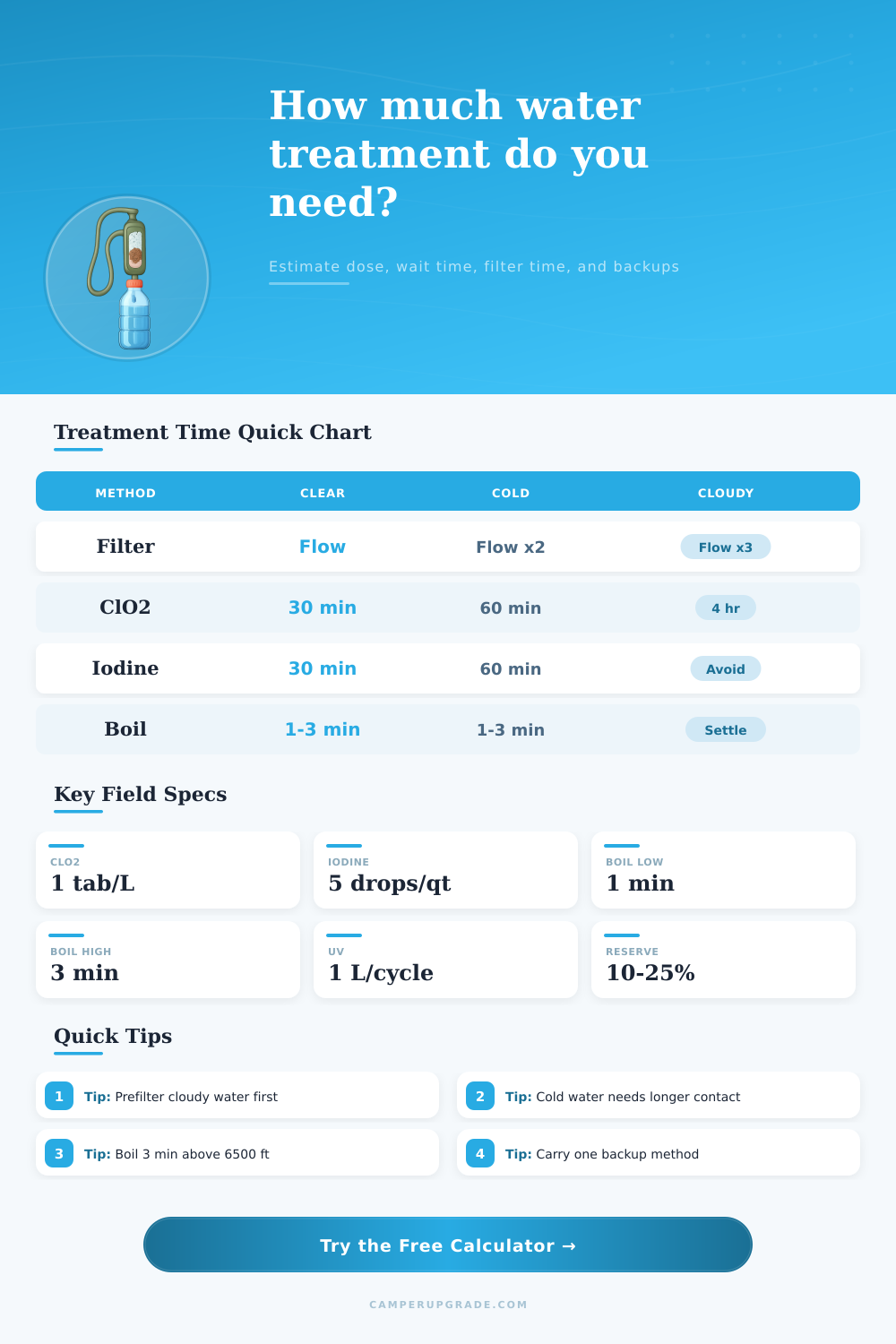
| Method | Clear warm water | Cold or cloudy adjustment | Important limit |
|---|---|---|---|
| Pump or gravity microfilter | Flow-rate based | Multiply time by 1.2-2.4 | Usually not virus rated |
| Chlorine dioxide | 30 min bacteria/virus | 60 min cold, 4 hr for Crypto | Use clear container water |
| Iodine | 30 min clear water | 60 min cold or hazy water | Poor Crypto coverage |
| Rolling boil | 1 min below 6,500 ft | 3 min at high elevation | Cooling time not included |
| UV purifier | About 90 sec per liter | Repeat or prefilter haze | Needs clear water |
| Treatment | Common field dose | Calculator dose rule | Backup planning note |
|---|---|---|---|
| Chlorine dioxide tablet | 1 tablet per 1 L | Round up to full tablet | Add one extra tablet per batch |
| Iodine drops | 5 drops per quart clear | Double for cloudy water | Carry enough for one redose |
| Boiling | Rolling boil hold time | 1 or 3 min by altitude | Fuel estimate scales by liters |
| UV purifier | 1 cycle per liter | Round up cycles by volume | Bring chemical tabs for battery loss |
| Filter only | No chemical dose | Flow time plus reserve | Add virus step if required |
| Water clarity | Filter time factor | Chemical confidence | UV confidence |
|---|---|---|---|
| Clear | 1.0x rated flow | Normal label time | Normal cycle |
| Light haze | 1.2x time | Use cool-water caution | Repeat if unsure |
| Cloudy | 1.7x time | Long contact preferred | Prefilter first |
| Silty or muddy | 2.4x time | Settle and prefilter first | Not recommended alone |
| Method | Bacteria | Protozoa | Viruses |
|---|---|---|---|
| Pump microfilter | Strong | Strong | Needs backup |
| Gravity hollow-fiber filter | Strong | Strong | Needs backup |
| Chlorine dioxide | Strong | Strong with 4 hr contact | Strong |
| Iodine | Good | Limited for Crypto | Good |
| Rolling boil | Strong | Strong | Strong |
| UV purifier | Strong in clear water | Strong in clear water | Strong in clear water |
In order to effective perform water treatment on a camping trip, it is essential to ensure that the method that are utilized to treat the water is in accordance with the specific water that is to be treated. If the individual dont ensure that the water treatment method is matched to the water that is to be treated, the method may fail to effectively treat the water. For instance, if the water treatment methods include filters that becomes clog with the particulate matter in the water, or if the water treatment tablets becomes expired and wear out, the process becomes difficult.
In order to effectively treat the water, there are a variety of different variable that must be accounted for. For instance, the individual must account for the volume of the water that must be treated, as the individual must ensure that there is a reserve of water to account for spills or the needs of cooking. Furthermore, the temperature of the water to be treated is another variable; chemical water treatment tablets will take longer to react with the water at temperatures that is lower than the temperature at which the chemicals would work.
How to Treat Water on a Camping Trip
Additionally, the clarity of the water to be treated is another variable; cloudy and silty water will slow the movement of water through a filter, and will also reduce the effectiveness of chemical water treatments and UV water treatment. In addition to these variables, the number and type of pathogens that are present in the water are another variable that must be accounted for. For instance, if the water contain viruses, a method based off a microfilter may not effectively remove those viruses.
In these instances, it is essential to use a water treatment method that can effectively remove the type of pathogen that is present in the water to which one is treating. Furthermore, another variable to account for is the altitude at which the water is to be treated; boiling water is one of the methods that can be used to treat water, but the amount of time that the water must boil varies with the altitude. For instance, water can be boiled for one minute at most altitude, but at altitudes above 6,500 feet, the water must be boiled for three minutes in order to ensure its safety.
Furthermore, there are different method for treating water, and each of these methods may have different variables in relation to the water. For instance, gravity filter may move the water quickly through the filter if the water is clear, but the water may move slowly through the gravity filter if the water contains fine sediment. Furthermore, water that is treated with chlorine dioxide take four hours to effectively kill the Cryptosporidium parasite, but it will take longer if the water is more colder or more cloudy.
Additionally, UV water treatments lose their effectiveness if the water is cloudy or contains sediment, so you should pre-filter the water prior to using a UV water treatment system. It is also essential to ensure that there is a backup method for water treatment for these different variables. For instance, if clear water is obtained at the beginning of the camping trip, the water may become silty along the trip, so having a backup water treatment method will allow the camping trip to continue.
Furthermore, chemical water tablets are a backup method for these reason; they are light and they provide insurance for instances in which the primary water treatment method fails. When planning for camping trip, it is essential to ensure that water treated with chemical tablets will account for the time it may take for those chemicals to react to water from glacial streams or water from area near cattle. In addition to these different variables, more water will be needed for individual who are traveling in groups.
While calculators can help to determine the number of liter of each type of water treatment method that will be needed, the individual will still have to make the decisions regarding the type of method that will be used based upon the condition of the water that will be treated, the altitude of the camping trip, and the type of pathogens that is contained within the water. Thus, water treatment is a process that require individuals to recognize the various variable regarding the water and to develop countermeasures or treatments for those variables. You should of planned for alot of things when your out in nature.