Wag Bag Count Calculator
Estimate how many human-waste pack-out bags to carry from group size, trip length, toilet rule, event rate, reserve margin, odor-bag plan, and expected packed weight.
Pack-Out Bag Plan
Bag-use rule planning
| Rule type | Events per bag | Best use | Planning note |
|---|---|---|---|
| Strict single-use | 1 solid event | Permitted routes with individual bag rules | Most conservative and easiest to audit at trailheads. |
| Personal reuse | Up to 2 solid events | One person keeps one active bag | Only use if the product and local rule allow it. |
| Shared camp toilet | Up to 3 solid events | Bucket toilet or privacy shelter setup | Requires careful closure, gel capacity, and group discipline. |
| Custom capacity | User-entered | Known kit or agency instruction | Keep the custom value at or below the posted rule. |
Expected event-rate settings
| Group condition | Event rate | When to use | Reserve advice |
|---|---|---|---|
| Low-use adult trip | 0.7 to 0.9 per person-day | Short trips with reliable pre-trip toilets | Still round up because disposal options may be absent. |
| Normal backpack or overland trip | 1.0 per person-day | General planning baseline | Add 15% to 25% reserve for most camps. |
| Kids, rich food, or altitude | 1.2 to 1.5 per person-day | Family trips, group meals, or gut uncertainty | Add spare individual kits and more odor bags. |
| Illness-risk or long exit | 1.5 to 2.0 per person-day | Remote trips where running out is unacceptable | Use strict one-event bags and a high reserve. |
Kit style comparison
| Kit style | Dry weight | Used weight estimate | Bulk behavior |
|---|---|---|---|
| Standard wag bag kit | About 2.5 oz | About 10 oz used | Balanced size for backpacking, climbing, and RV backup. |
| Double-bagged odor barrier kit | About 3.5 oz | About 12 oz used | Heavier, but better when bags ride inside a vehicle or pack. |
| Ultralight solid-waste kit | About 1.5 oz | About 8 oz used | Lower dry weight with less structure and odor protection. |
| Bucket toilet liner kit | About 3 oz | About 14 oz used | Useful for basecamp but bulkier after closure. |
| Hard-sided carry canister | About 16 oz empty | Canister plus bag weight | Protects contents from puncture on rough routes. |
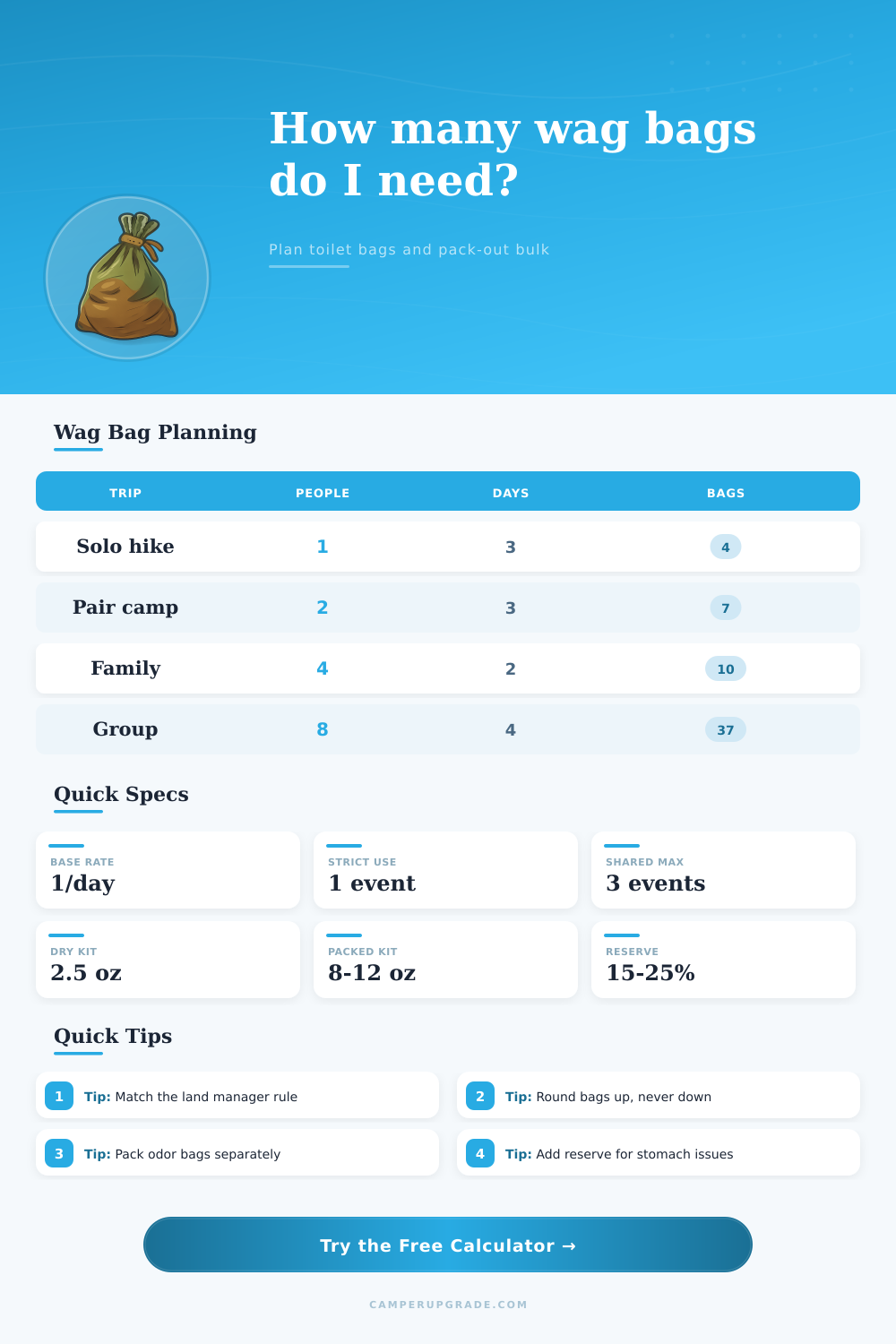
Common trip examples at 1 event per person-day
| Trip | People-days | Strict bags | With 20% reserve |
|---|---|---|---|
| Solo long weekend | 3 | 3 bags | 5 bags with one spare |
| Two-person four-day hike | 8 | 8 bags | 11 bags with one spare |
| Family of four weekend | 8 | 8 bags | 11 bags with one spare |
| Eight-person group for four days | 32 | 32 bags | 40 bags with two spares |
Yes, there’s the silence of a high alpine ridge or desert canyon as part of the deal. But waste management logistics is also part of it. Bring as many gourmet freeze-dried meals as you’d like; without factoring in what exits on the other end, you’ve got nothing more than a pile of plans left at trailhead.
A wag bag isn’t just a plastic pouch stuffed full of some magical thickening agent. It’s a trade-off between the dry weight I have to carry now and environmental impact I can avoid later. For campers, climbers, overlanders, and group pack-out excursion, this calculator helps you figure out how many toilet bags to bring, how much reserve margin to have, how many odor-bags you may need, how big those bag are when packed, and how much they weigh… All so you don’t freak out midway through your trek.
How to Plan Your Waste Bags for the Trip
The basic math problem is how many bags you need per day. One per person are a good starting place for healthy adult going on a short hike. But as anyone who’s been in the backcountry can tell you, life doesn’t follow any sort of textbook schedule. Consider the event rate; this is a term for how often someone poops depending off altitude, diet, and stress level. If you’re on a short hike with some mild altitude sickness or eating a lot of rich food, your number will go way up. You can use this tool to bump it up. This is helpful if you have kids along or if you’re going somewhere remote where bathroom emergency would be unacceptable.
You might want to bump up your rate from one to one point two or even one point five per person-day. It works because it makes you face the fact that humans aren’t all the same when we go out there, not at all.
And finally, what about bag capacity and rules of the land managers? Single use bags is required in some very restrictive wilderness areas. Use it and leave it. Others allow personal reuse or shared camp toilets where one liner might handle multiple events. A one-liner may get several uses. The calculator takes care of figuring out how many you’ll need by having you select the kind of rules at your location and plugging in your group size.
Will that standard kit be enough? Or do you want something a little beefier with double-bagged items? Don’t guess. Proper waste disposal helps environment, while improper disposal hurts it. Plus, breaking local rules can mean getting fined (or worse). Before you lock down your pack list, always look up the details for your destination.
In a more literal way, it matters how much waste weigh and how large of a space it will occupy. When filled with waste, thickening gel, and potentially an odor neutralizing powder, one wag bag weighs somewhere between 8-12 oz. For a weekend trip, times that by ten bags (for a small group) and now we’re talking about quite the load! The calculator gives expected volume and weight packed so you can see how that translates in your vehicle or pack. You don’t want to find out too late that your waste stash fills up half your bottom compartment.
Good packing lists includes reserve margins. Packing an extra fifteen to twenty-five percent of your bags isn’t paranoia; it’s insurance. It is insurance against getting sick with stomach troubles, running into unexpected delays, or just being tired and dehydrated and forgetting how much you’ll need. A good packing list has its reserve margins spelled out clearly on the page (see the reference table). That way you can get a sense of scale before you even go shopping for anything.
Lastly: What about odor control? Sure, I sealed it in a bag, but how’s that going to hold up on a long carry out? Hard-sided canisters and/or outer barrier bags will increase weight, but they’re an added security blanket when there is other people around camp. You should of planned for this. If you enter your wanted odor-bag-to-kit ratio and style of kit into the calculator, those additions are accounted for as well.
Not only does it tally your number of empty plastic sleeves, it gives you an overall understanding of the logistical weight. That’s part of planning (eliminating the friction from a trip). You worry less about the details because you have already decided where to put everything. How much do all these bag weigh? Do I need more or fewer bags? It removes the thought process from the equation so you can enjoy the view around you.
With the bag weight calculator above, it crunches the numbers for you. You can see the path forward and worry less then the road already traveled. Preparation makes for a good trip, not just scenery. Get a handle on your pack list before tying your boots tight.