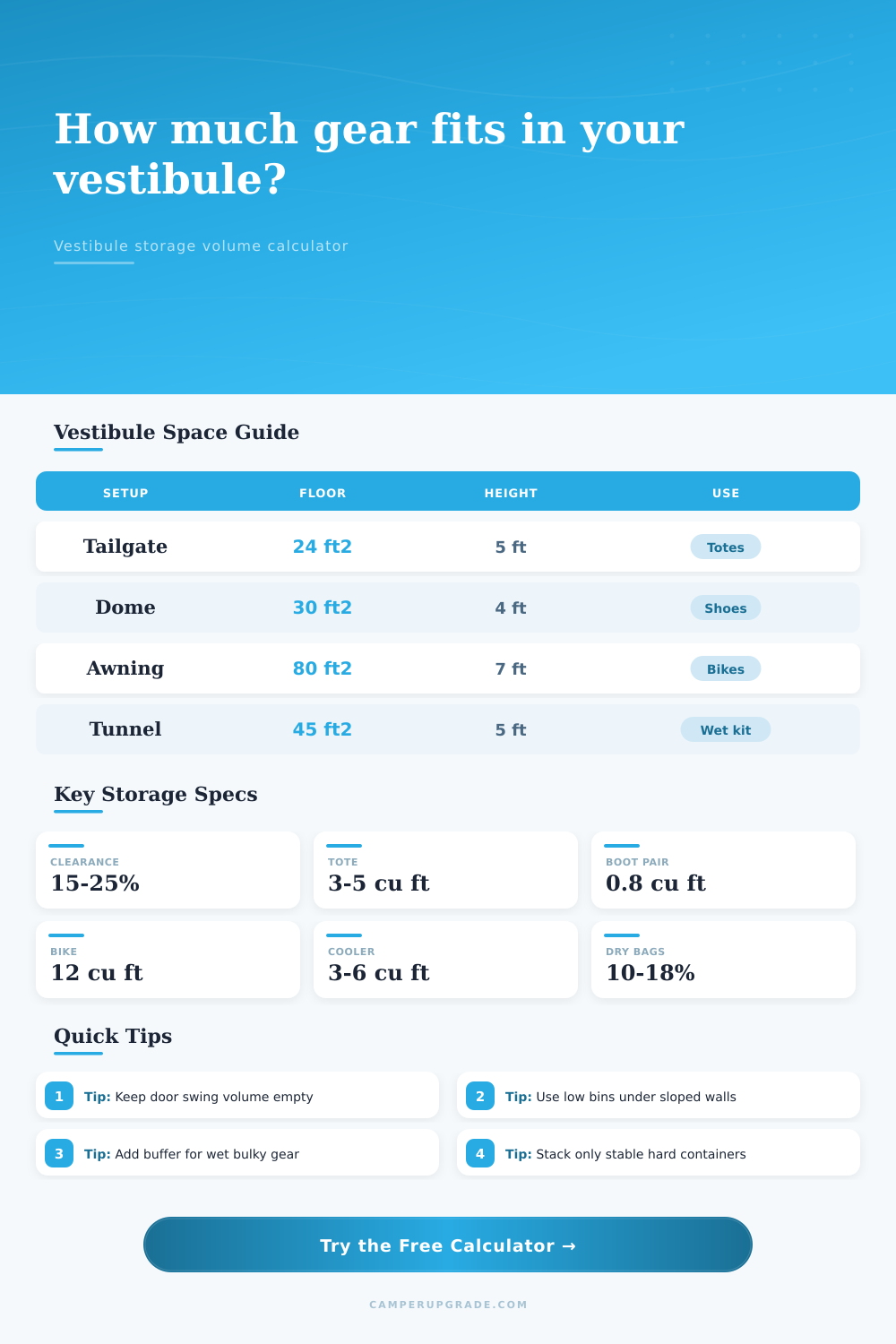
Vestibule Gear Storage Volume Calculator
Estimate how much usable storage your vestibule, awning room, tailgate shelter, or tent porch can actually hold after slope, clearance, packing, and access space.
Formula Breakdown
| Shape | Gross Volume Formula | Typical Loss | Best Use |
|---|---|---|---|
| Straight wall rectangle | length × width × height | 5% wall clearance | Van tailgate rooms, squared awning rooms |
| Single-slope wedge | length × width × average height | 12% slope loss | Tent porches and side-entry vestibules |
| Tapered trapezoid room | floor area × average height × 0.88 | 12% to 28% | Annex rooms that narrow toward the roof |
| Tunnel or hoop vestibule | length × width × height × 0.785 | 20% edge loss | Hoop tents, bikepacking vestibules |
| Custom measured volume | entered volume only | User selected | Manufacturer volume specs or measured bins |
| Gear Item | Planning Volume | Stackable | Storage Note |
|---|---|---|---|
| Pair of hiking boots | 0.8 cu ft / 23 L | No | Leave airflow space when wet |
| Camp chair in sleeve | 1.3 cu ft / 37 L | Partial | Works along low side walls |
| Medium cooler | 3 to 6 cu ft / 85 to 170 L | No | Reserve top access clearance |
| Firewood crate | 2.2 cu ft / 62 L | Yes | Keep off tent fabric and doors |
| Adult bicycle | 10 to 14 cu ft / 283 to 396 L | No | Bars and pedals waste edge volume |
| Wet clothing bundle | 1.0 cu ft / 28 L per person | Partial | Use extra buffer for drying space |
| Scenario | Floor Area | Gross Volume | Typical Usable Storage |
|---|---|---|---|
| Bikepacking tent porch | 12 sq ft | 30 to 45 cu ft | 10 to 18 cu ft |
| Family dome mudroom | 30 sq ft | 105 to 150 cu ft | 35 to 60 cu ft |
| SUV tailgate shelter | 48 sq ft | 240 to 300 cu ft | 85 to 135 cu ft |
| RV awning room | 120 sq ft | 780 to 900 cu ft | 300 to 500 cu ft |
| Overland shower vestibule | 16 sq ft | 80 to 112 cu ft | 20 to 42 cu ft |
| Packing Style | Efficiency | Clearance Target | When To Use |
|---|---|---|---|
| Loose shoes and bags | 45% to 55% | 20% to 30% | Wet trips, fast exits, family tents |
| Mixed totes and duffels | 60% to 68% | 15% to 25% | Weekend camps with shared access |
| Hard cases or crates | 70% to 82% | 10% to 20% | RV staging, overland bins, van gear |
| Bikes and long gear | 35% to 50% | 25% to 35% | Handlebars, pedals, poles, skis |
When you’re standing in a tent vestibule looking up at that slanting ceiling, it’s naturaly to think: How do I get my cooler inside? Usually there is plenty of floor area, right? But then you notice the roof constricts as it lowers.
Measuring square footage are the downfall of most storage plans. That’s why the amount of space left after considering shape, door swing, and foot traffic makes all the difference, determining whether it is comfortabley or a trip hazard. This page will calculate the math for you.
How to Calculate Tent Vestibule Storage Space
Enter in dimensions, and the calculator will show how some is relevant and others aren’t.
Begin with the shape. Because the roof is curved, there’s less usable space near edges of a tunnel tent than there would be in a rectangular one like a van annex. Plan for a room size without considering slope, and you’re planning for a room that doesn’t exist. It includes a loss amount based off shape to estimate the space more truthfully then simply multiplying length x width.
The other thing that determines how full it gets is how much are being packed. Soft dry bags don’t stack well, hard totes do. Loose boots and duffels create air pockets between object, reducing their effective storage by 1/2 or more. It’s not that the gear is defective; it’s that it is made of soft matter.
The tool requests an efficiency rating for packing. Do you have soft stuff or square bins? If not sure, go with less. It’s something most folks overestimate.
And don’t forget about the human part. A vestibule is more than just a closet; it’s a hallway where people need to step in and out without bumping their headlamps on the door as it opens. This means there should of be room for that, too. The calculator accounts for that by reserving some clear space so you’re not jamming stuff into every corner, only to reach something at the end of the last foot.
At that point, you may as well not have a vestibule since you can’t get back there anyway.
Of course, the weather change all this. Wet stuff will take up more space; a sopping wet down jacket won’t fit in your pack like a dry version. Boots will get dirty. Account for the mud by creating some wiggle room. Wet gear should has its own buffer. That’s why this buffer allows for expanding wet gear and also gives you a spot for bulkier, soggy items and some air to dry them out.
It’s important to understand that this turns abstract measurements (cubic feet) into things like “reference” containers (27- gallon totes). So if it tells you that you can fit four totes, picture four totes on the floor. Do they block the door? Are they beneath the lowest point of the roof? Time to scale back.
There is tradeoffs with vestibule storage. More storage or easier access? Rarely do we get both. The math is in the calculator but the decision is yours on what’s important. When it’s close, sacrifice the bulky item NOT the clearance.
The tent walls aren’t movable, but you can relocate gear down the road. Honor the slope, keep the door open and realize the space was there for you all along; now it just needs to be used properly.