UV Purifier Battery Cycles Calculator
Estimate how many UV treatment batches, liters, reserve days, and battery equivalent cycles your camp power bank can support.
This calculator estimates electrical capacity only. UV treatment still depends on clear water, correct exposure, clean quartz sleeves, and a purifier rated for the source water.
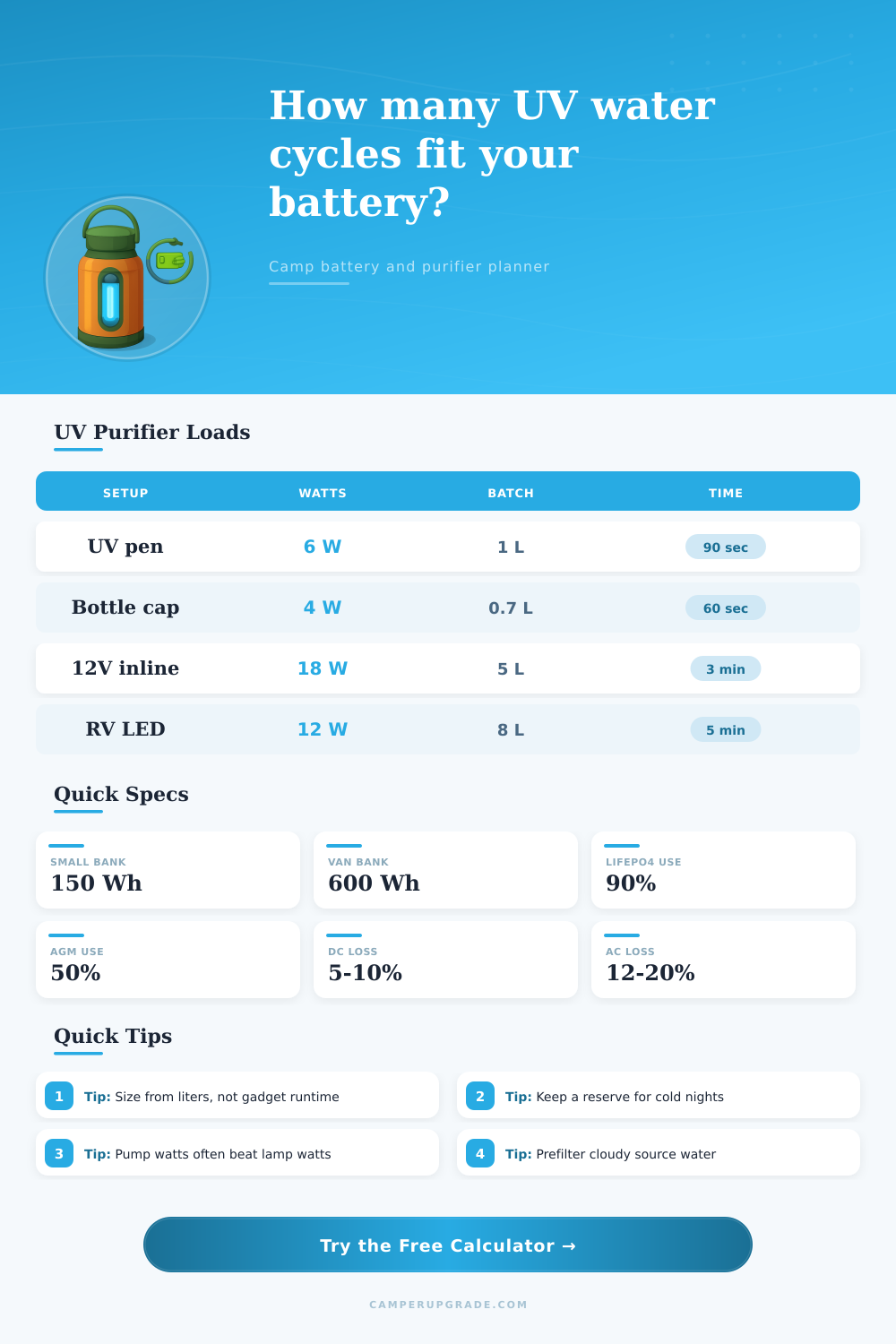
| Purifier style | Typical draw | Cycle volume | Cycle time | Battery note |
|---|---|---|---|---|
| Handheld UV pen | 3 to 7 W | 0.5 to 1 L | 45 to 90 sec | Low watts, many small batches |
| USB bottle cap UV | 4 to 6 W | 0.5 to 0.8 L | 60 to 180 sec | Small cells need frequent charging |
| Gravity reservoir UV | 8 to 15 W | 4 to 10 L | 3 to 8 min | Efficient for groups if flow is slow |
| 12V inline UV and pump | 18 to 45 W | 5 to 20 L | 2 to 10 min | Pump draw can dominate |
| RV under-sink UV LED | 10 to 18 W | 5 to 12 L | 4 to 8 min | Best on direct 12V or 24V DC |
| Battery type | Common camp size | Practical usable depth | Good reserve | Why it matters |
|---|---|---|---|---|
| AGM lead acid | 35 to 100 Ah | 45% to 55% | 20% to 30% | Voltage sag reduces small inverter reliability |
| LiFePO4 | 20 to 200 Ah | 80% to 95% | 10% to 25% | Flat voltage supports steady UV output |
| Lithium power station | 150 to 1000 Wh | 75% to 90% | 15% to 30% | AC outlets lose extra energy through inversion |
| USB power bank | 37 to 100 Wh | 65% to 85% | 10% to 20% | Boost converter losses matter on small loads |
| Camp use case | Liters/person/day | Extra water | UV planning note | Battery impact |
|---|---|---|---|---|
| Cool weather overnight | 2.0 to 3.0 L | 0 to 1 L | Mostly drinking water | Low daily cycles |
| Warm hiking basecamp | 3.5 to 5.0 L | 1 to 3 L | Hydration plus cooking | Moderate daily cycles |
| Desert or high exertion | 5.0 to 7.0 L | 2 to 4 L | Plan larger reservoirs | High daily cycles |
| RV sink drinking tap | 2.5 to 4.0 L | 2 to 6 L | Batch treat tank or jug water | Pump draw matters |
| Nameplate bank | Usable after reserve | 0.20 Wh cycle | 1.50 Wh cycle | 5.00 Wh cycle |
|---|---|---|---|---|
| 100 Wh mini station | 72 Wh | 360 cycles | 48 cycles | 14 cycles |
| 150 Wh compact station | 108 Wh | 540 cycles | 72 cycles | 21 cycles |
| 300 Wh camp station | 216 Wh | 1080 cycles | 144 cycles | 43 cycles |
| 12.8V 50Ah LiFePO4 | 461 Wh | 2304 cycles | 307 cycles | 92 cycles |
| 12.8V 100Ah LiFePO4 | 922 Wh | 4608 cycles | 614 cycles | 184 cycles |
Quartz sleeve lamp
Traditional UV lamps often draw more steady power but tolerate inline flow designs. Keep the sleeve clean because fouling forces longer exposure plans.
UV-C LED module
LED modules can sip power in short batches and switch instantly. They still need confirmed dose, good mixing, and a clean treatment chamber.
Pump-assisted flow
Pumps add convenience and pressure, but their watts often exceed the UV emitter. A slower gravity feed can greatly extend battery cycles.
Propane isn’t the only thing people fear will run out while camping; they also fret over there supply of clean water. Then they find out their UV purifier can absorbs battery life quicker then they thought. And suddenly what was supposed to be a relaxing weekend away becomes a race against time at every wall plug.
It’s all about knowing how many real treatment cycle your power bank contains. It is not about minutes or hours on the device itself, but how long it takes to treat X amount of water. Don’t make most common mistake of thinking UV lamp is the sole consumer of power. In almost every case, it’s not. Most systems has some sort of pump that moves water into and out of chamber; in those cases, the motor typically eats far more juice than lamp does. For gravity-fed reservoirs (which don’t use electricity to generate their flow, but instead depend off height), subtract out both the lamp AND whatever mechanical components and the calculator above will do the math for you.
How to Make Your Camp Battery Last Longer
It removes all the marketing hype and tells you what your batteries can realy produce in the field. This is where battery chemistry matters. Some batteries can be used at nearly ninety percent of their capacity and still won’t take any damage. These include lithium iron phosphate batterys. Others, including old lead-acid or AGM varieties, are very strict, topping out around fifty percent usable depth before there voltage drops too low to run small electronics reliably. If you act as though your battery holds more juice than it actualy does, the purifier will shut off mid-cycle. Not only is this annoying; it also results in half-treated water you cannot safely drink.
Finally, budget some contingency. Don’t assume that all the water from the bank will be consumed. Twenty percent is a reasonable amount to leave in reserve for electronics failing unexpectedly, or a cold night where the sun won’t charge anymore. You find this spelled out clearly in the reference table on the page which plots usable capacity vs added safety margin. That transforms a theoretical figure into something practical.
Wattage isn’t everything, Water clarity is. Suspended particles block UV light from penetrating. The microbes can stay hidden and is protected. Treat only clear water. Muddy source water requires pre-filtration to remove particles. While this increases treatment time, it conserves energy by preventing having to double-up on treatments later. Three failed attempts at dirty water will require more total battery power then a single, quick treatment of clean water. That’s a small efficiency gain worth paying for.
There is another sneaky factor to consider: temperature. Cold weather reduce the capacity of batteries. What works great during a hot summer day might feel weak and wimpy when the snow melts in spring. Derating factors account for this in the tool itself. However, mentally adjust your expectations when you’re packing up, especially if you’re camping somewhere around freezing. Don’t expect peak performance.
Water treatment can be viewed as an energy budget. You need a gallon of fuel, so you fill up the tank. Same with food. You go to grocery store and load up. What’s the equivalent for energy? That 4 liters per day your crew consumes (plus whatever you use in cooking) requires some amount of electricity. The calculator converts that into months of batterys and lets you see what’s required, whether what you have will work or not. People often buy the wrong size because they focus on maximum wattage rather than actual stored capacity. That thing may be able to take a large surge load, but it will run dry within an hour.
Slow water purification is the new fast. Gravity feed slow treatment methods dramatically increase the lifespan of your batteries versus high-flow pumping systems. You should of considered this earlier. The bottom line on dependable camp water is to honestly account for what you have. There’s no way around it; you can’t hope that a small battery will last longer then the laws of physics allow. Be conservative with your plans, carry some reserve, and don’t overextend your gear.
When you’re not concerned about the safety of the water, the taste of your morning coffee is all the sweeter.