UV Exposure Time Calculator
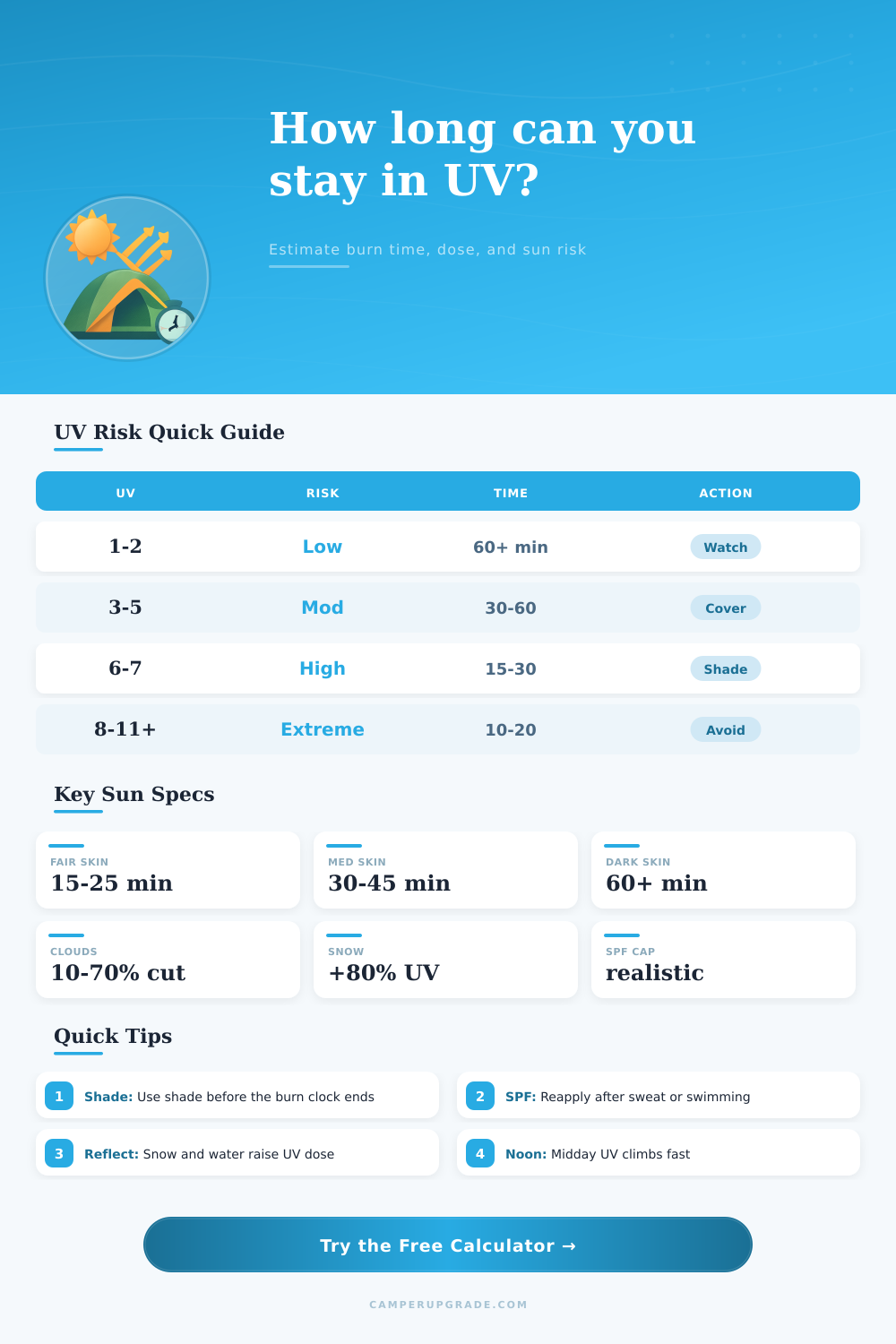
Estimate burn time, adjusted UV dose, sunscreen interval, and risk band from UV index, skin type, altitude, clouds, shade, SPF, reflection, start time, and reapply timing.
☀UV Exposure Presets
⚙Sun, Skin, Shade, SPF, and Reflection Inputs
This calculator is a planning estimate, not medical advice. Individual photosensitivity, medicines, recent burns, altitude weather, and reflected light can change real burn time.
UV exposure estimate
🛡Sun Protection and Exposure Spec Grid
📊UV Index, Skin Type, and Protection Tables
| UV Index | Risk Band | Unprotected Action | Planning Note |
|---|---|---|---|
| 1-2 | Low | Watch long exposure | Burns are slower but still possible. |
| 3-5 | Moderate | Use hat and sunscreen | Midday exposure can add up quickly. |
| 6-7 | High | Seek shade near midday | Fair skin may burn in under 25 minutes. |
| 8-10 | Very high | Limit direct sun | Use clothing, shade, and timed breaks. |
| 11+ | Extreme | Avoid extended exposure | Snow, sand, and altitude intensify dose. |
| Skin Type | Baseline MED | Burn Pattern | Planning Use |
|---|---|---|---|
| Type I | 200 J/m2 | Always burns | Use the most conservative result. |
| Type II | 250 J/m2 | Burns easily | Common fair-skin planning baseline. |
| Type III | 350 J/m2 | Sometimes burns | Still needs midday protection. |
| Type IV | 450 J/m2 | Burns less often | Dose can still cause damage over time. |
| Type V | 600 J/m2 | Rarely burns | Use protection for long exposure. |
| Type VI | 800 J/m2 | Least likely to burn | UV eye and skin exposure still matter. |
| Surface | Reflection Add | Example | Exposure Effect |
|---|---|---|---|
| Dry ground | 0-5% | Forest soil | Little added reflected UV. |
| Grass or dirt | 5% | Campsite lawn | Small boost from surrounding surface. |
| Sand or pale rock | 10-25% | Beach or desert | Higher face and underside exposure. |
| Open water | 15-25% | Lake, river, shore | Reflected UV rises with glare. |
| Snow | 50-80% | Spring alpine route | Can nearly double UV dose. |
| Protection | Typical Reduction | Best Use | Calculator Input |
|---|---|---|---|
| Deep shade | 50-95% | Rest stops | Enter shade percent. |
| Cloud cover | 10-70% | Forecast adjustment | Select cloud reduction. |
| UPF clothing | High coverage | Shoulders and arms | Reflect as shade/coverage. |
| SPF sunscreen | Varies by use | Exposed skin | Select SPF and reapply. |
| Wide hat | Local shade | Face, ears, neck | Add a modest shade percent. |
📌Practical UV Timing References
| Scenario | UV | Modifiers | Likely Risk |
|---|---|---|---|
| Morning campground walk | 2-3 | Low angle, mixed shade | Low to moderate for long walks. |
| Open trail at lunch | 7-9 | Little shade | High to very high burn pressure. |
| Lake paddle | 6-8 | Water reflection | High exposure on face and hands. |
| Snow travel | 5-8 | Altitude plus reflection | Very high even in cool weather. |
| Forest rest stop | 4-6 | 60-90% shade | Lower dose but not zero. |
| SPF | Ideal Block | Field Factor | Reapply Check |
|---|---|---|---|
| None | 0% | 1x | Use shade and clothing. |
| SPF 15 | About 93% | Often 4-8x | Good only with enough product. |
| SPF 30 | About 97% | Often 6-12x | Common outdoor baseline. |
| SPF 50 | About 98% | Often 8-16x | Useful for high UV or fair skin. |
| SPF 100 | About 99% | Often capped | Still needs reapplication. |
The amount of ultraviolet radiation that reaches your skin are the primary factor that determines when your skin will burn. While it may seem like the temperature of the air is the factor that determines how fast your skin will burn when exposed to a Sun, the temperature of the air does not have any effect upon the rate at which your skin burns. The amount of ultraviolet radiation that reaches your skin determine your risk of experiencing a burn, and the amount of that radiation changes based on a variety of factor.
Those factors include the altitude of the location at which you are standing, the amount of cloud cover in the sky above you, the amount of reflection of that radiation from the ground reflects back off of your skin, and the amount of sunscreen that you are wearing. The calculator that are provided in the article uses these various variables to calculate the amount of time that you can stand outside without your skin burning. The calculator begins with the ultraviolet index that is displayed on the weather forecast.
How the Sunburn Time Calculator Works
This initial index is modified according to your elevation above the ground; higher elevations has thinner air, which allows for more ultraviolet radiation to reach your skin. The index is reduced if there is cloud cover or shade outside, but increased if there is a great deal of reflection from the ground (snow, water, sand). This adjusted index is referred to as the “effective” ultraviolet index, and is used to calculate your total burn time.
The calculator uses your skin type as a starting point for calculating your total burn time. Individuals with lighter skin has less tolerance for uv radiation than those with darker skin. Based upon the effective uv index for the location where you are standing, the calculator assigns a value for the number of minutes that it will take for your skin to burn.
However, this value is adjusted according to the strength of sunscreen that you use; lighter applications of sunscreen provide less protection to your skin than is provided by sunscreen as measured in laboratory test. This adjustment is made for the understanding that the sunscreen that you apply to your skin in the real world will be thinner than the sunscreen sold in bottle. Sunscreen provides protection to your skin for a limited period of time.
Water, sweat, or physical movement can wear off your sunscreen from your body. As a result, your risk of burning increases as your sunscreen wears off. Based off the amount of time that you plan to spend outside, the calculator can provide an estimate as to when you should reapply your sunscreen to ensure that your skin does not burn.
The calculator includes the amount of time outside required to reach a burn risk; this number can help you to decide what type of clothing to wear, if you should move to shade areas outside, or if you should limit the amount of time that you spend outside. Reflection of the uv radiation from the ground (snow, water, sand) has the potential to increase the uv radiation that reaches your skin. Any uv radiation that is reflected back into your body can reach parts of the body that are not protected by a hat, sunglasses, or shade.
The calculator takes into account the potential effects of reflection from the ground. Cloud cover has an effect upon uv radiation that reaches the skin. Thick clouds can reduce uv radiation of the sun that reaches the skin, but thin clouds will reduce the uv radiation of the sun that reaches the skin to a much less degree.
Broken clouds can lead to rapid changes in uv radiation that reaches the skin; the sun can move quickly from one cloud to another. To account for this movement of the clouds, the calculator utilizes an average percentage of uv radiation that will be blocked by the clouds. Thus, the calculation of the calculator is of the maximum amount of time that the skin will take to burn; you should enter the shade prior to the time that the calculator calculates.
The calculator includes tables that contain the information that is used for calculations. One table includes the uv index ratings and the risk of burning based upon those ratings; each risk level includes recommendations for what action you should take to reduce the uv radiation exposure of your skin. A second table includes information about different skin types and the amount of uv radiation tolerance of each skin type.
A third table includes information about the ability of different types of reflective surfaces to reflect uv radiation back into the body. These tables can be used to review the information that is calculated by the calculator. Many people make mistake when they attempt to calculate the amount of time that their skin will take to burn.
Some individuals do not account for the fact that the uv index may change throughout the day. Others do not account for the fact that sunscreen wears off of the body. Still others do not account for the fact that the amount of uv radiation increases with increases in elevation and with increases in the amount of reflection of uv radiation from the ground.
Thus, an individual can avoid these mistakes by utilizing the calculator to understand how each of these factor may change their total burn time. With the use of the calculator, an individual can begin to recognize the different variables that impact the burn time of an individual’s skin. Each factor can be adjusted in relation to the other factors in order to understand how these factors interact with each other.
An understanding of these variables will allow an individual to make decisions regarding their clothing and the route that they will take outside. The goal of the calculator is to allow an individual to remain within limits of uv radiation that is safe for their skin to expose, to avoid causing damage to the skin from uv radiation from the Sun.