USB Device Charge Time Calculator
Estimate real charging time, usable USB watts, taper delay, source energy, and power bank capacity for phones, tablets, cameras, radios, lights, and camp electronics.
1.Pick a camping USB preset
2.Enter device and charger details
USB charging estimate
3.USB charging spec grid
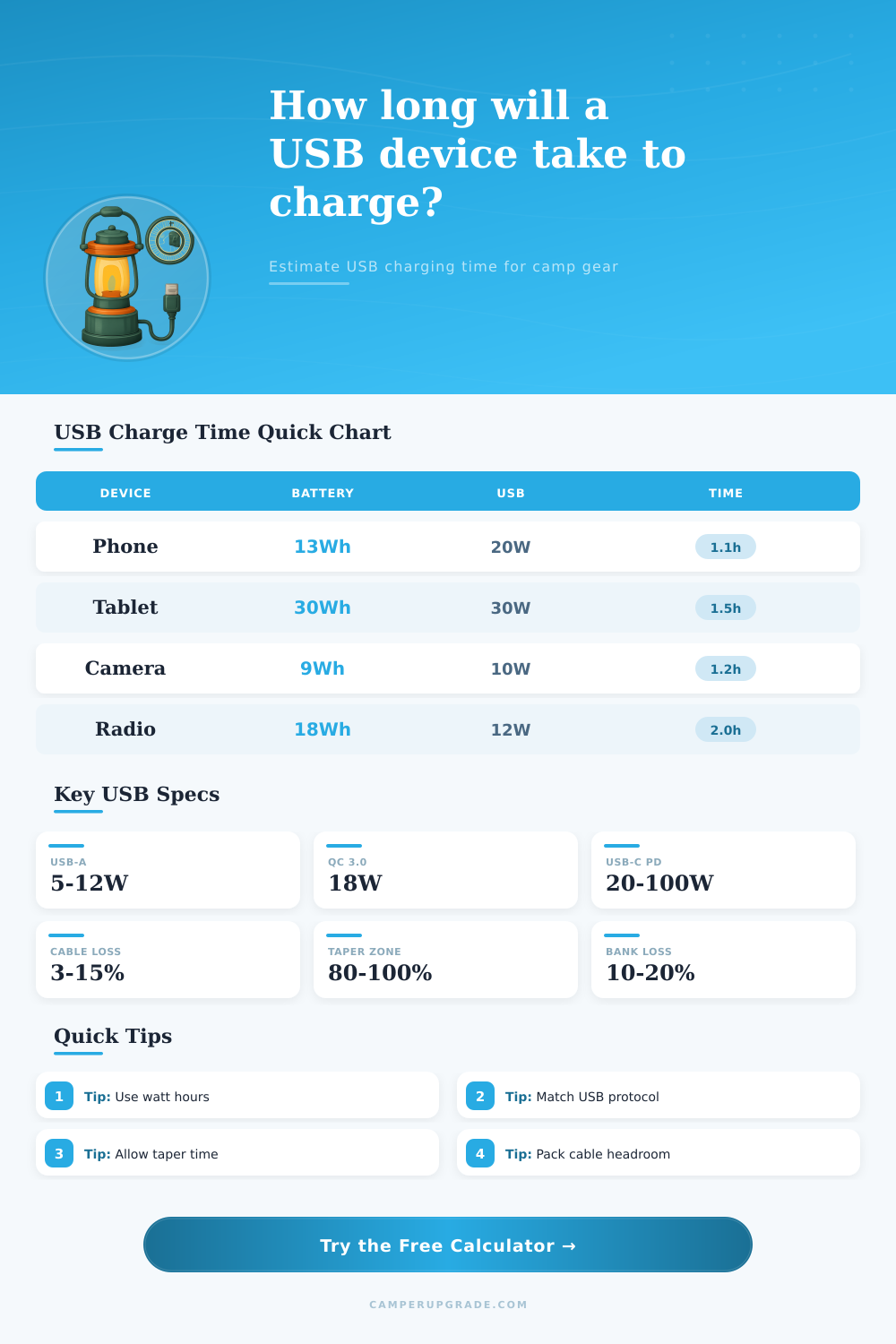
4.USB protocol reference
| USB source | Common voltage and current | Rated watts | Best camp use |
|---|---|---|---|
| USB-A basic | 5 V at 1 A | 5 W | GPS watch, small light, emergency top-up |
| USB-A high current | 5 V at 2.1 to 2.4 A | 10 to 12 W | Headlamp, speaker, radio, older phones |
| Quick Charge / AFC | 9 V at 2 A typical | 18 W | Compatible phones and older fast chargers |
| USB-C PD phone | 9 V at 2.22 A typical | 20 W | Modern phones, small cameras, compact gear |
| USB-C PD tablet | 15 V at 2 A or 20 V at 1.5 A | 30 W | Tablets, drone controllers, large battery packs |
| USB-C PD high output | 20 V at 2.25 to 5 A | 45 to 100 W | Large stations, laptops, high draw chargers |
5.Common device battery examples
| Camp device | Typical battery | Approx Wh | Likely charger |
|---|---|---|---|
| Smartphone | 4,000 to 5,500 mAh at 3.85 V | 15 to 21 Wh | 18 to 30 W USB-C PD |
| Small tablet | 7,000 to 8,500 mAh at 3.85 V | 27 to 33 Wh | 20 to 30 W USB-C PD |
| Action camera | 1,200 to 1,800 mAh at 3.85 V | 5 to 7 Wh | 5 to 10 W USB |
| Rechargeable headlamp | 1,500 to 3,500 mAh at 3.7 V | 6 to 13 Wh | 5 to 10 W USB-A |
| Handheld radio | 2,000 to 5,000 mAh at 7.4 V | 15 to 37 Wh | 10 to 18 W dock or USB-C |
| USB lantern | 4,000 to 10,000 mAh at 3.7 V | 15 to 37 Wh | 5 to 12 W USB-A or USB-C |
6.Cable, taper, and condition factors
| Factor | Light effect | Moderate effect | When to use it |
|---|---|---|---|
| Cable loss | 2 to 5 percent | 8 to 15 percent | Long, thin, worn, or high-current cables |
| Charge efficiency | 88 to 94 percent | 75 to 85 percent | Small packs, warm devices, older batteries |
| Taper above 80% | 60 to 80 percent speed | 25 to 45 percent speed | Phones, tablets, and protected lithium packs |
| Temperature derate | 0 to 10 percent | 20 to 30 percent | Charging in a cold tent or hot vehicle cab |
| Use while charging | 0.5 to 2 W | 3 to 8 W | Screen on, GPS track, radio standby, file transfer |
7.Power bank sizing shortcuts
| Advertised bank size | Approx internal Wh | Usable USB Wh | Good for |
|---|---|---|---|
| 5,000 mAh | 18.5 Wh | 14 to 16 Wh | One phone top-up or small accessories |
| 10,000 mAh | 37 Wh | 29 to 33 Wh | One large phone charge plus reserve |
| 20,000 mAh | 74 Wh | 58 to 66 Wh | Weekend phone, light, camera bundle |
| 26,800 mAh | 99 Wh | 78 to 89 Wh | Longer trips under many airline limits |
| 40,000 mAh | 148 Wh | 118 to 133 Wh | Base camp electronics or group charging |
8.Camp charging tips
When planning for cameras, radios, headlamps and phones, batteries has to be thought of in terms of hours, not days, rather than just hoping the pack last. How much energy is stored on paper matter far less then how quickly you can recharge battery using USB ports, considering cables, device quirks, temperature changes, and how much power it can absorbs at any moment.
At first glance, most folks checks battery capacity from the device itself and then look at advertised wattage of its charger. That’s not the whole story, those two numbers only provides a ballpark figure, and don’t take into account what happens when you plug it in. In fact, the charger and device will negotiate a charge rate, which is frequentely less than either says it can do. Your cables has some resistance that saps a bit more power. Finally, most batteries can’t just take full speed all the way back to 100 percent; they slows down near the end. And if you’re using the thing while it charges, some of incoming current doesn’t even make it to the battery.
Why Batteries Take Longer to Charge Than You Think
All this means extra time, and each effect contribute differently based off your use case, topping off a phone while camping vs. One example is filling a tablet before everyone leaves camp. Plug numbers into that calculator above. Use your battery size, your actual charging protocol, and the conditions you’ll be operating under. Tweak the taper setting, and you’ll understand value of stopping at 80 or 90 percent rather than pushing further. Tweak the temperature derate, and you can see how operating in a hot car or a cold night affect the schedule. And the reserve power bank field gives you some insight as to how much spare capacity you want to maintain in your source pack (e.g., don’t leave yourself stranded with no charge for a headlamp or navigation after dark).
And all of this gets more realistic when thinking about actual camp use: The battery in a tablet that’s showing you maps and photos is going to draw hard and run slower than one that’s primarily in standby mode with occasional radio use. That long, slim cable that’s great for your watch is going to cost you minutes on a device that draw harder. Neither of those are dramatic difference on a single charge. However, multiple days of limited sunlight and shared ports can make the difference between everyone having what they need or someone having to wait for a slow charge.
Then there’s the addition of power banks. These don’t output all of their rated capacity via the USB port. A portion of energy get lost during the conversion process, and most people would of prefer to leave some battery left in the pack instead of draining it down to zero. The calculator turns those losses into actual size of the bank you should carry. This helps you avoid the rookie error of packing a pack that seems big enough on paper but falls short after factoring everything in.
I’m not expecting perfection. I’m hoping to see how different changes will change results enough to affect your decisions. That understanding of how device limits, cable quality, and taper behavior all come into play makes the decisions easier. Rather than grabbing the largest number off the pegboard, you choose a charger based on your device. Instead of realizing it’s too late when it’s dark out, you determine if partial charging is OK in advance. Instead of just relying on capacity sticker sizes to estimate your load, you bring a power bank big enough to handle the expected load.