Underquilt Length Calculator
Estimate the hammock underquilt length, body coverage, end gaps, draft allowance, and metric equivalent from your sleeper size, hammock body, season, and lay style.
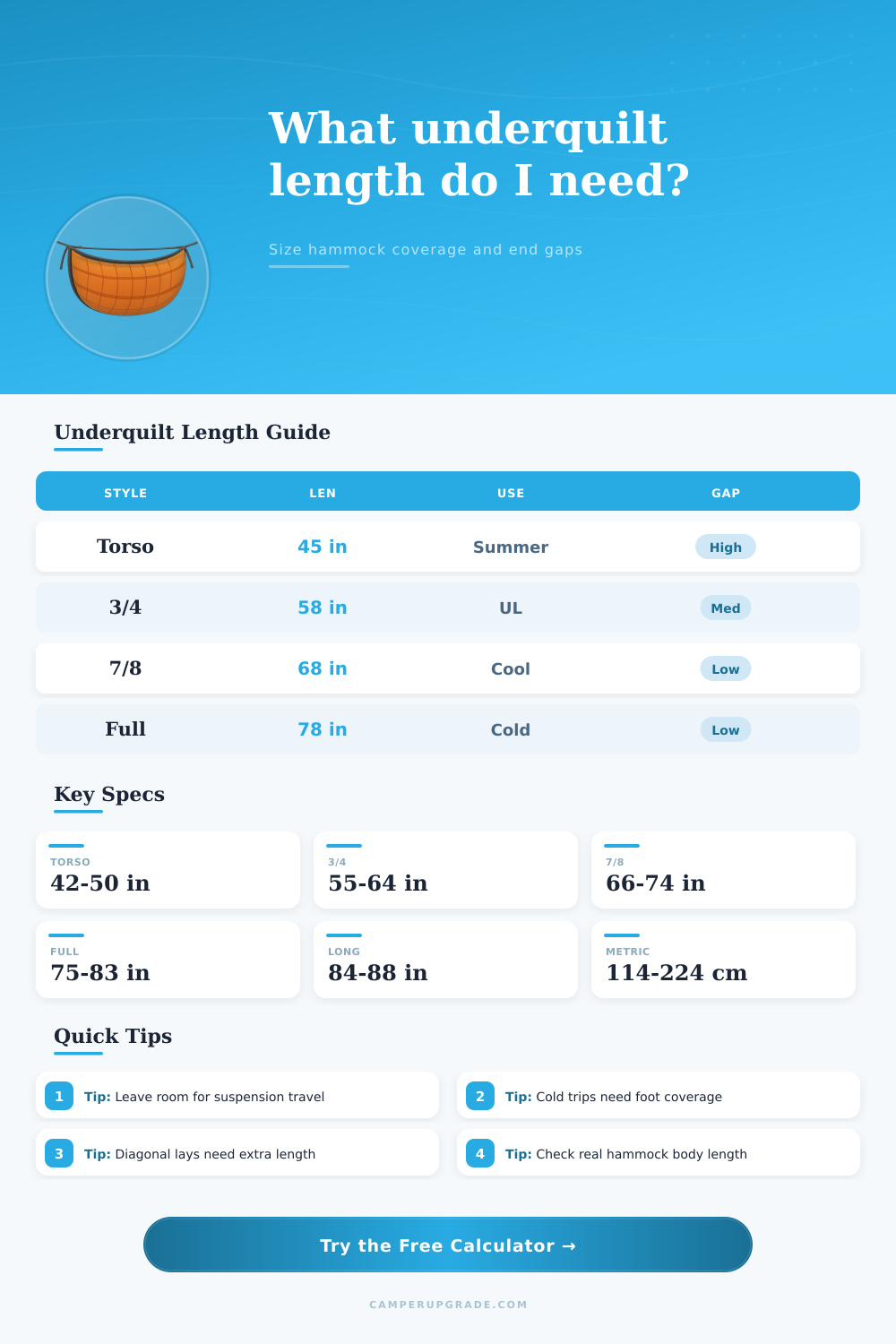
| Coverage class | Typical length | Body coverage | Best use |
|---|---|---|---|
| Torso / half | 42-50 in / 107-127 cm | Back, hips, upper thighs | Warm weather, fastpacking, pad under feet |
| Three-quarter | 55-64 in / 140-163 cm | Shoulders through lower legs | Ultralight three-season trips |
| Seven-eighths | 66-74 in / 168-188 cm | Nearly full body | Cool nights and taller hikers |
| Full length | 75-83 in / 191-211 cm | Head-to-foot insulation zone | Cold weather and easy positioning |
| Long winter | 84-88 in / 213-224 cm | Extra end seal and tall coverage | Winter, side sleepers, high-loft builds |
| Hammock body | Typical ridgeline | Common underquilt range | Fit note |
|---|---|---|---|
| 9 ft / 274 cm | 97 in / 246 cm | 45-68 in / 114-173 cm | Short body limits long quilt travel |
| 10 ft / 305 cm | 100 in / 254 cm | 50-75 in / 127-191 cm | Works well with 3/4 and compact full |
| 11 ft / 335 cm | 109 in / 277 cm | 55-83 in / 140-211 cm | Most common gathered-end baseline |
| 11.5 ft / 351 cm | 114 in / 290 cm | 60-86 in / 152-218 cm | Good for tall diagonal sleepers |
| 12 ft / 366 cm | 119 in / 302 cm | 64-88 in / 163-224 cm | Long underquilts position easily |
| Input | Adjustment | Why it changes length | Calculator treatment |
|---|---|---|---|
| Diagonal lay | +1 to +2 in | Body contact line is longer than a straight lay | Adds lay-style allowance |
| Side sleeper | +3 in | Knees and hips shift the cold spots | Adds extra coverage buffer |
| Winter season | +4 to +7 in | End gaps are less forgiving in wind and cold | Adds draft-risk length |
| High loft | +0.5 to +3 in | Thicker insulation needs less compression at the ends | Uses loft-based allowance |
| Bridge hammock | -2 to -4 in | Lay path is straighter and more defined | Reduces diagonal allowance |
| Scenario | Sleeper / hammock | Coverage pick | Starting length |
|---|---|---|---|
| Warm fastpack | 68 in, 10 ft GE | Torso | 45-48 in |
| UL three-season | 70 in, 11 ft GE | 3/4 length | 58-62 in |
| Cool shoulder trip | 71 in, 11 ft GE | 7/8 length | 68-72 in |
| Average cold setup | 70 in, 11 ft GE | Full length | 76-80 in |
| Tall winter user | 76 in, 12 ft GE | Long full | 84-88 in |
| Bridge hammock | 70 in, 90 in bed | Full bridge | 70-76 in |
Determining the correct length for an underquilt is an important process. The length of the underquilt will determine how much warmth you experience while sleeping on your hammock and the amount of weight that you will have to carry. If the length of the underquilt is too short, your legs or shoulders might feel cold.
However, if the length is too long, you will be adding extra weight and bulk to your sleeping load. The length will typicaly be off by only a few inch, but those few inches of underquilt fabric will come in handy during the colder months or when the wind pick up in your camping spot. When determining the length of the underquilt that you would like to utilize, you could use your own height and the length of the hammock body to calculate the length.
How to Pick the Right Underquilt Length
These two measurement will provide you with the minimum and the maximum length that the underquilt can be. You could use a calculator to make these calculations for you. However, the calculator does not take into account the way that you will sleep on the hammock.
For example, if you sleep in a straight lay position on the hammock, the contact line between your body and the hammock will be short. If you sleep in a diagonal lay position on the hammock, the contact line will be longer. Side sleeper will also have to account for the movement of their limbs with their sleep.
The length of the underquilt that you will use will also change according to the sleeping seasons. If you are sleeping during one of the warmer sleeping seasons of the year, you can leave gaps open at the ends of the underquilt. However, if it is one of the colder sleeping seasons of the year, having gaps at the end of the underquilt will allow for heat to escape from the sleeping space.
During the winter months, you can use more fabric at the foot end of the underquilt so that you can cinch the underquilt close to your body. In addition to the sleeping position and sleeping seasons, the amount of clearance that you require at the head and feet of your sleeping space will impact the length of your underquilt. You have more flexibility in leaving the head area of your sleeping space open to accommodate a sleeping bag hood.
However, you will have more difficulty leaving the sleeping space at the feet open if you are sleeping in cold weather. These two clearances can be accounted for separately in a calculator that determine underquilt length. Many people will find that reducing the gap at the feet of their sleeping area will reduce the total length of the underquilt that they have to carry on camping trip.
The style with which you sleep on the hammock and the type of hammock that you use will also impact the length of the underquilt that you need. For example, bridge hammock will allow for an individual to sleep in a straight position on the sleeping platform. The use of double layered gathered end hammocks will add thickness to the sleeping platform that might reduce the insulation provided to the sleeper by the underquilt.
The length of the body of the hammock will also impact the length of the underquilt that you use. Short bodies of hammocks will reduce the length that the underquilt can be. You can use reference tables to determine the lengths of underquilts that will work best with different lengths of hammock bodies.
For example, if the length of the body of the hammock is around 10 feet, three-quarter coverage underquilt options will work best for most individual. If the length of the body of the hammock is 11 feet in length, seven-eighths or full-length coverage underquilts can be used. If the length of the body of the hammock is 12 feet in length, it will allow for sleepers of tall stature to use a longer length of underquilt without having issues with the length of there sleeping platform.
Finally, the way in which you will use the hammock during your camping trip will also play a role in the length of underquilt that you will use. If you are going to be moving around in your sleeping spot during the camping trip, you will want to use a longer length for your underquilt. If you will be sleeping in the same spot each night on camping trips, a shorter length for your underquilt will reduce the total weight that you will be required to carry on each camping trip.
If you are camping trips will experience cold weather, using a longer length of underquilt will ensure that you will remain warm while sleeping in place. However, if you are going on camping trips that require you to be on the move quickly and frequent, using a shorter length for your underquilt will allow you to reduce the total weight that will be a burden on your camping trips. Your goal in using an underquilt for your sleeping space on hammock trips will be to find a length that will keep you warm in the sleeping environment while minimizing the amount of weight that you have to use to carry your sleeping load.
The measurement provided to you from the underquilt length calculator is just a starting point for you to purchase your underquilt. You will be able to determine if the length of your underquilt is the correct length for your sleeping spot during your first sleeping trip using the underquilt. If your feet is warm and the underquilt remains in place on your sleeping spot, then the length is correct for your sleeping spot.
However, if you have to adjust the underquilt during the sleeping period, it is clear that you should of purchased a new length of underquilt for your next camping trip.