Ultralight Pack Target Weight Calculator
Set a realistic ultralight target from base weight, consumables, worn weight, body-weight percentage, terrain, weather, and category-specific cut potential.
🎒Hiker and Trip Presets
⚙Pack Target Inputs
📊UL Target Spec Grid
📋Reference Tables
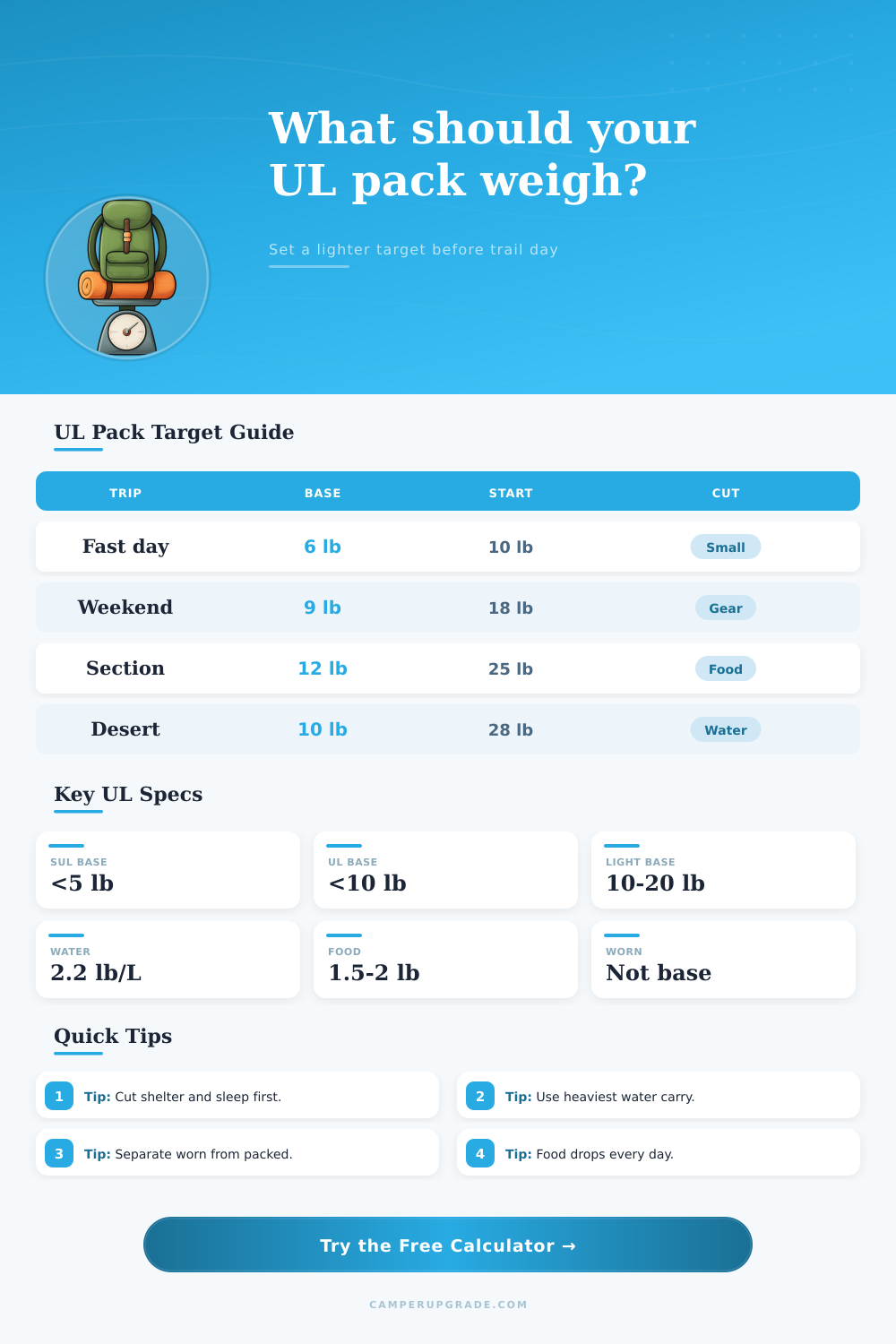
| Preset profile | Base target | Start-pack driver | Good target check |
|---|---|---|---|
| SUL overnight | 4 to 6 lb | Tiny shelter and minimal extras | Keep safety layers appropriate for forecast. |
| UL weekend | 7 to 10 lb | Short food carry | Most hikers can aim near 12 to 16 percent start weight. |
| Desert dry carry | 8 to 12 lb | Water volume | Use the heaviest water segment instead of average water. |
| Cold shoulder season | 11 to 16 lb | Insulation and sleep warmth | Do not cut warmth below expected low temperature. |
| Long food carry | 9 to 13 lb | Food days | Expect the first day to be the outlier. |
| Base weight class | Range | What it usually means | Planning note |
|---|---|---|---|
| Super ultralight | Under 5 lb | Highly minimal kit | Requires strong skill and low margin for extras. |
| Ultralight | 5 to 10 lb | Dialed shelter, quilt, pack, and clothing | Common sweet spot for three-season backpacking. |
| Lightweight | 10 to 20 lb | Still controlled, with more comfort or weather margin | Good transition zone for most cutdown projects. |
| Traditional | Over 20 lb | Heavier systems or many backups | Category cuts often produce large gains. |
| Consumable | Formula used | Typical range | Target note |
|---|---|---|---|
| Water | liters x 2.2046 lb | 1 to 5 liters | Water is often the largest temporary load swing. |
| Food | days x food per day | 1.5 to 2.0 lb per day | Calorie density matters more on long carries. |
| Fuel and supplies | manual entry | 0.2 to 1.5 lb | Group cooking and cold trips increase this line. |
| Finish pack | start pack minus consumables | near base weight | Shows how quickly the load improves on trail. |
| Cut category | Reasonable first cut | High cut warning | Best use |
|---|---|---|---|
| Shelter | 10 to 25 percent | Do not remove weather protection | Big savings if tent system is heavy. |
| Sleep | 8 to 20 percent | Do not exceed expected warmth need | Quilt, pad, and stuff-sack tuning. |
| Clothing | 10 to 30 percent | Keep rain and insulation margin | Remove duplicate packed layers. |
| Other and tech | 15 to 45 percent | Keep navigation and emergency basics | Fastest way to trim luxuries. |
💡Target Weight Tips
This calculator is for planning pack weight targets. Route hazards, weather, water reliability, injury history, and local regulations may require carrying more than the lightest possible kit.
Ultralight backpacking is a type of hiking that involve managing the total weight of the person’s pack in order to make movement easy for that person. If a persons pack isnt too heavy, then that person will experience less strain on there shoulders, and will be able to maintain their natural stride. Many individuals seek to hike with an ultralight pack, as it can make the hiking process more efficient.
However, a person must calculate the target weight of an ultralight pack according to the weight of the person and the distance between resupplies. Weights are calculated in a specific way when ultralight hiking. Base weight is the total weight of all item in the pack except food and water.
How to Calculate Your Ultralight Pack Weight
Base weight is considered to be a fixed cost, as the weight of these items does not change with the number of days that a person is hiking. However, food and water weight is variable costs. Food weight will vary based off the number of days between resupplies.
Water weight will vary with the distance between water sources. The cost calculators for ultralight hiking account for these variable costs to indicate how many item should be included in each category of the hiking pack. Terrain and weather will impact the total weight of the items that a person should carry while hiking.
For instance, an individual who is hiking on smooth trails will need to carry less items then an individual who is hiking on rough terrain or experiencing cold weather. In the case of rough terrain or cold weather, individuals will have to carry more gear to ensure their safety. Factors that account for terrain and weather allow individuals to calculate weights that will account for these variables, making the goal for the individual to be realistic with their target weights.
Worn weight is that portion of total weight of the hike that is represented by the items that an individual wears, like shoes, trekking poles, and clothing. This type of weight is not accounted for in the base weight calculation, but does contribute to the total weight that an individual will feel while on a hike. If worn weight is not accounted for in the total weight calculation, that total weight will be inaccurate.
Total weight is calculated as the weight of the items in the pack plus the total weight of the items worn by the individual. Therefore, a person must separate the weight of the items in the pack from the weight of the items worn to calculate the skin out total weight, which represents the total weight that an individual will feel during a hike. After calculating the total weight that an individual will feel during the hike, they can begin to look at each category of gear that will be brought to determine methods of reducing the weight of those categories.
For instance, shelter and sleep systems will provide the largest reductions in total weight. Following those systems are clothing layers, which also will reduce the total weight of the individual if those layers is redundant. Small items will not reduce the total weight as much as the other items, so individuals should focus upon reducing the weight of shelter and sleep systems before reducing the weights of small items.
These calculators make evident which gear categories will provide the most weight reduction. Food will also impact the total weight of the pack. Each additional day’s worth of food to consume will add to the total weight that an individual will have to carry.
Furthermore, each additional day of food will also include additional fuel needed to cook that food. An individual can calculate the weight of the food that they will consume to determine at how many days they should stop in a town while on the hike. Reference tables are also included with these cost calculators.
These reference tables provide the total weights of each type of hike according to length and environment. For instance, trips to deserts will have more water to account for than trips to the forests. Therefore, trips to deserts will have a higher total weight than trips into the forests.
These tables are not rules that should be applied to all types of trips, but are helpful in determining if an individual intends to hike with a realistic goal for total weight. These reference tables should not be applied to all types of trips, however, as each trip is likely to have different requirements than others. These calculators cannot account for the risk that an individual is willing to take on a hike.
For instance, individuals may calculate that they will require a certain amount of supplies for 3 days of hiking. However, if the weather becomes significantly colder during the hike, or if an individual gets injured and can no longer hike as quickly as they did with their calculated time, the individual may find it difficult to meet these targets. These targets must include all safety items that are required for the individual to stay safe on the hike; items can only be removed if they are sure that those items will not be utilized on the hike.
One of the benefits of using these types of calculators is that the individual can use the mathematics to plan their movement while on a hike. For instance, if an individual consumes the food and water that they calculated for their trip, their total weight will decrease. Furthermore, that decrease in total weight will cause their pack to sit higher on their hips, which will change the way in which they move.
These calculators allow individuals to plan for these changes in total weight and the effect that such changes will have on the individual’s movement.