Tubing Float Time By Flow Calculator
Estimate river tubing time from current speed or flow class, float distance, tube drag, route shape, wind, stops, group spread, shuttle delay, and safety buffer.
🛟River Tubing Presets
Your Tubing Float Time Snapshot
⚙Flow, Route, Tube, And Stop Inputs
📊Tube Setup And Material Comparison
📘River Tubing Reference Tables
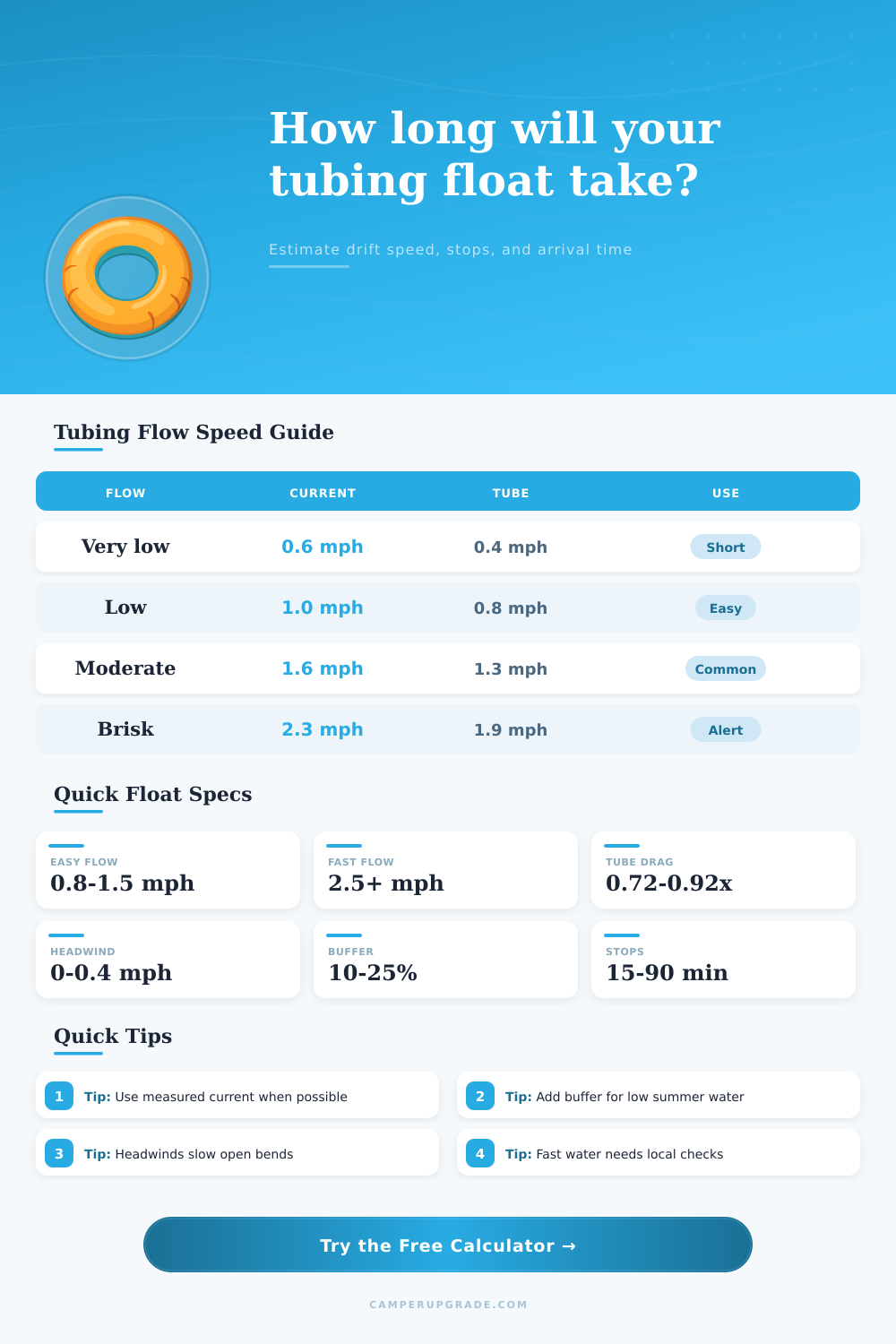
| Flow Class | Typical Current | Typical Tube Speed | Best Planning Use |
|---|---|---|---|
| Very low summer scrape | 0.4 to 0.8 mph / 0.6 to 1.3 km/h | 0.3 to 0.6 mph after drag | Short routes only; expect walking through shoals. |
| Low relaxed tubing | 0.8 to 1.2 mph / 1.3 to 1.9 km/h | 0.6 to 1.0 mph after drag | Common family tubing pace with frequent stops. |
| Moderate floatable flow | 1.3 to 1.9 mph / 2.1 to 3.1 km/h | 1.0 to 1.6 mph after drag | Efficient day float when weather is calm. |
| Brisk but manageable flow | 2.0 to 2.7 mph / 3.2 to 4.3 km/h | 1.6 to 2.3 mph after drag | Plan tighter supervision and faster take-out timing. |
| Fast release or rain rise | 2.8 to 3.8 mph / 4.5 to 6.1 km/h | 2.2 to 3.2 mph after drag | For experienced groups after local safety checks. |
| Swift water caution | 4.0+ mph / 6.4+ km/h | Often too fast for casual tubing | Use outfitter, ranger, or gauge advisories before launch. |
| River Character | Route Factor | Why It Changes Time | Planning Note |
|---|---|---|---|
| Pool-drop with slow eddies | 0.82x | Long pools reduce average downstream movement. | Add stop time if swimmers linger in pools. |
| Meandering family river | 0.92x | Bends, eddies, and shade pockets slow drift. | Good default for rental tubing routes. |
| Mostly straight channel | 1.00x | Current carries tubes close to measured speed. | Use when gauge velocity matches the float reach. |
| Riffle-and-run current | 1.08x | Continuous current keeps tubes moving. | Watch for shallow rocks at low water. |
| Braided gravel bars | 0.74x | Split channels and shoals interrupt drifting. | Expect walking and regrouping delays. |
| Obstructed or portage route | 0.62x | Strainers, downed trees, or mandatory exits add time. | Use conservative timing and local reports. |
| Tube Or Material Setup | Drift Factor | Typical Strength | Best Use |
|---|---|---|---|
| Light vinyl open-bottom tube | 0.92x | Fastest casual drift, least abrasion reserve. | Gentle sandy routes and warm water. |
| Standard river vinyl tube | 0.86x | Balanced drag, comfort, and packability. | Most outfitter-style recreational floats. |
| Canvas-covered commercial tube | 0.78x | Better abrasion handling with more weight. | Rocky rivers and repeated rental use. |
| TPU or urethane bladder tube | 0.88x | Light, flexible, and more puncture resistant. | Packable trips where low weight matters. |
| Backrest lounge tube | 0.76x | More wind area and more surface drag. | Relaxed short floats on wide slow water. |
| Cooler tube or tethered gear | 0.70x | Tether drag and frequent repositioning. | Social floats with generous time margins. |
| Distance | At 0.75 mph | At 1.25 mph | At 2.00 mph |
|---|---|---|---|
| 1 mile / 1.6 km | 1 hr 20 min moving | 48 min moving | 30 min moving |
| 2 miles / 3.2 km | 2 hr 40 min moving | 1 hr 36 min moving | 1 hr moving |
| 3 miles / 4.8 km | 4 hr moving | 2 hr 24 min moving | 1 hr 30 min moving |
| 5 miles / 8.0 km | 6 hr 40 min moving | 4 hr moving | 2 hr 30 min moving |
| 8 miles / 12.9 km | 10 hr 40 min moving | 6 hr 24 min moving | 4 hr moving |
💡Float Time Planning Tips
So there you are pulling in on bank with tubes blown up and the cooler full, but the sun gets low as they cover half of the stretch out. That’s because we tend to mistake water volume for water speed. You have a wide, deep river that move slow or a narrow channel that rushes past fast. You need to understand that distinction if you’re going to plan a day and get done when you’d like to.
After plugging in your conditions and distance, the calculator (see above) does the rest of the math, no need to guess at conversions and coefficients. Everyone thinks their tube will travel two miles an hour if the river run two miles an hour. But that’s seldom the case. When wind blows across your tube, it pushes back; when eddy currents move past they divert your tube. And then there are those pesky fish… So what happens? By using drag factors based off your equipment type, the tool accounts for these forces. A light vinyl-tubed float travels easier through slow-moving water than a large, bulky, heavy-duty canvas-covered tube with a sail that catch every breeze. This is a little mechanical nuance that add up over the course of five miles.
How to Plan Your Float Trip
In addition to straight-up current speed, also consider character of river. Does it snake along like a lazy family river that’s got a bunch of broad meanders and shaded pools? Or is it more like a straight shot through some kind of canyon? That will kill your pace big time different than the other one. The page has a reference table that assign a route factor based on type of terrain you’re in. Expect long pauses between action when you’re floating a pool-and-drop type section. These lulls can be awesome for swimming, but if you’ve got a tight deadline (like shuttle availability or someone picking you up), they’ll ruin your timeline.
The other kind of schedule killer most floaters overlook is wind. An open bend with headwind will cut half a mile per hour off your effective speed. That’s nothing you have to be a meteorologist to see, just check the weather first thing, before launch. To help ground yourself from hope to reality, use the calculator to add a cushion for wind speed and direction. Wind’s cold? Add more time. Is it calm and sheltered? Trim the cushion.
While it’s one thing to predict how fast you’ll travel floating alone, it’s another if you’re with a dozen people spread between three adult-sized sofa; they’re going to get separated somehow. One guy stops for a snack, another swims off into middle of river. Regrouping will take time that never shows up on any map. To account for this, the tool considers both duration of your stops and number of people, and returns total time for the trip that is more like reality and less like a theoretical best case. When your friends are involved, better to plan for three hours instead of two.
Don’t overlook the off-the-water logistics. Waiting in lines for shuttles, hoofing it to parking spots, and pumping up tubes all chew up a lot of your time just as much as sluggish current can. That 15 minutes wasted at launch seems insignificant until it makes you show up after dark or closing time at some bar below. Ten to twenty percent extra in the plan allows for unexpected, such as hitting an unexpectid sandbar or running out of air while diving. It’s about getting within a few minutes either way, not down to the second, though.
It’s about knowing that if you plan well, you won’t find yourself stuck on the water after dark without a ride. Account for human error, gear drag, and current velocity to get a good idea of when to arrive. This will allow you to sit back, chill out, and enjoy your time on the water without staring at your watch every 20 minutes. Even if it’s not an easy float, it could of felt like one when you account for real-world challenges in your plan.