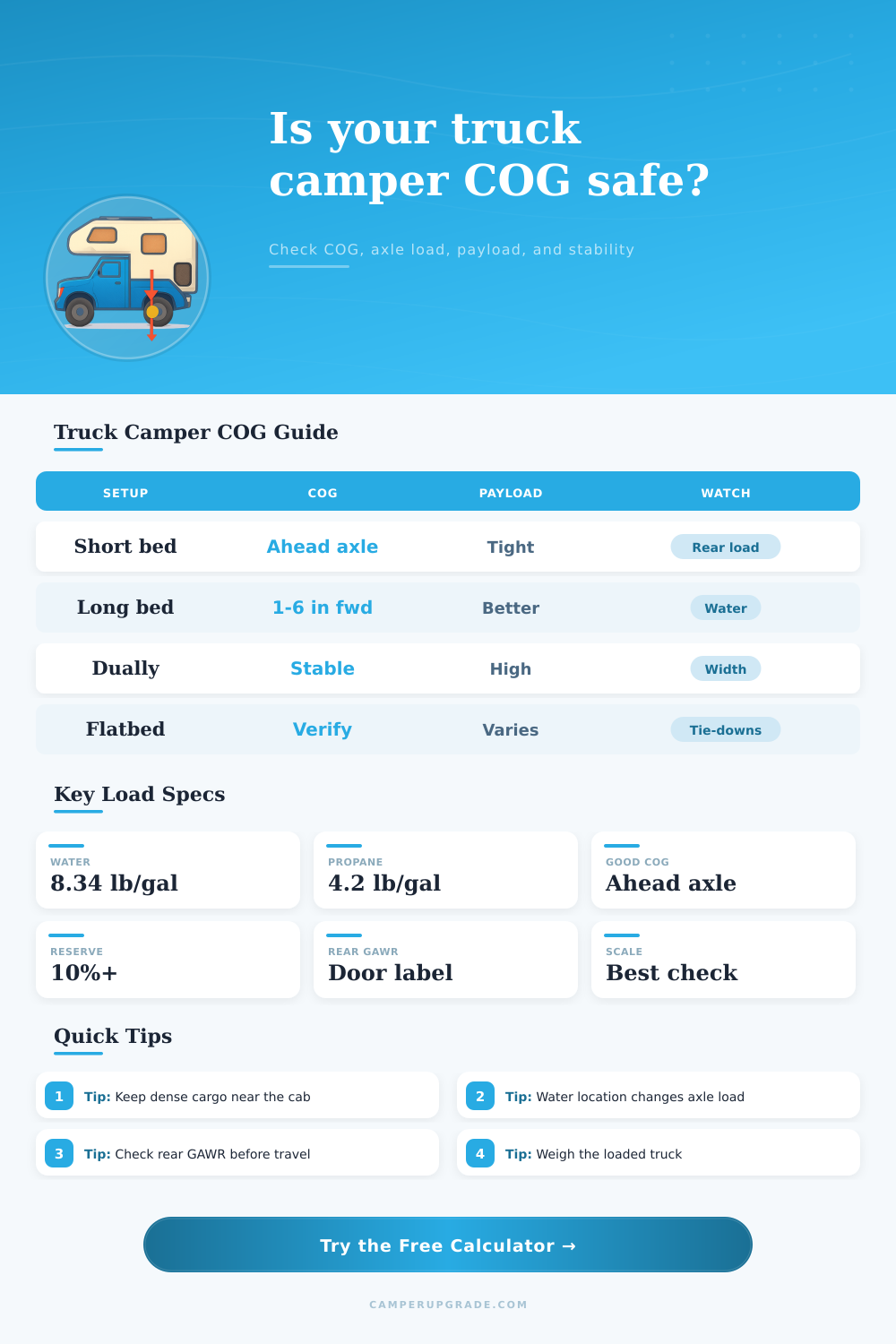
Truck Camper Center of Gravity Calculator
Estimate loaded camper COG from the bed front wall, COG relative to the rear axle, front and rear axle load change, payload margin, GAWR margin, and a practical stability score.
🚙Truck Camper Presets
⚖Camper, Cargo, Bed, Payload, and Axle Inputs
Axle load changes are static estimates. The calculator treats each item as a point load measured from the bed front wall and resolves the combined load across the truck wheelbase.
📊COG and Truck Spec Grid
📋Truck Camper COG Reference Tables
| COG Result | Meaning | Likely Effect | Action |
|---|---|---|---|
| 6+ in ahead | Comfortable forward COG | Front axle gains load | Still check RAWR |
| 0 to 6 in ahead | Usable but close | Rear axle carries most load | Keep cargo forward |
| 0 to 3 in behind | Marginal planning zone | Front axle may unload | Move weight forward |
| 3+ in behind | Rearward COG | Rear axle leverage rises | Verify before travel |
| Load Item | Weight Factor | COG Effect | Watch Point |
|---|---|---|---|
| Fresh water | 8.34 lb/gal | Depends on tank | Full vs empty shift |
| Propane | 4.2 lb/gal fuel | Often forward | Cylinder weight too |
| Lithium bank | 30 to 120 lb | Useful if forward | Secure mounting |
| Rear rack | 50 to 250 lb | Moves COG aft | Leverage behind axle |
| Truck Setup | Typical Payload | Rear Axle | Common Limit |
|---|---|---|---|
| Half-ton short bed | 1,400 to 2,200 lb | 3,800 to 4,300 lb | Payload sticker |
| 3/4-ton single rear | 2,400 to 3,500 lb | 6,000 to 6,600 lb | Rear GAWR |
| One-ton single rear | 3,400 to 4,500 lb | 7,000+ lb | Tire capacity |
| One-ton dually | 4,800 to 6,500 lb | 9,500+ lb | Total weight |
| Score Band | Reading | Typical Cause | Next Check |
|---|---|---|---|
| 85 to 100 | Strong plan | COG forward, margins good | Scale loaded |
| 70 to 84 | Usable plan | One margin getting tight | Repack dense gear |
| 50 to 69 | Needs review | Rear COG or low margin | Reduce load |
| Below 50 | High concern | Overload or rear leverage | Do not assume safe |
💡Truck Camper Loading Tips
Calculating the center of gravity for a truck camper is an necessary task before hitting the road. The center of gravity of the truck with the camper determines how the truck will remains stable when turning or when exposed to the wind. If the camper is too far back on the truck, the camper will lift the weight of the camper off the front axle of the truck.
A camper that lifts the weight off the front axle will make the steering of the truck feel lightly. A camper placed too far back on the truck may also cause the rear axle of the truck to be pushed to a weight limit that the truck was rated to carry. Because of this potential issue, many campers may find that the weights of their truck with the camper at the scale are different than the weights that they calculated that the camper would add.
How to Find the Camper’s Center of Gravity
To calculate the center of gravity correctly, there is specific distance that are asked of the camper owner. The camper owner must provide the distance from the front wall of the truck bed to the center of gravity of the camper. Additionally, the camper owner must also provide the location of the rear axle of the truck from the front wall of the truck bed.
Each of these measurements will help to show how the camper will distribute its weight between the front and rear axle of the truck. Additionally, the calculation must account for the locations of each of the water tank and propane tanks on the camper. The weight of the water in the water tanks and the weight of the propane in the propane tanks will change based on how full the tanks are.
Any water or propane tanks that are located behind the rear axle of the truck will add to the weight of the camper behind the rear axle. While the camper weight is an important variable in the equation, the location of the camper’s weight is the most important variable. The lighter the camper, the more important it is to ensure that its weight is correctly place on the truck.
Additionally, the weight of any cargo that is placed in the camper will impact the weight that is distributed between the axles of the truck. The calculation of the location of the camper’s center of gravity can account for the weight of any forward cargo in the camper. Additionally, the weight of any cargo that is placed in the rear of the camper can also be accounted for.
The location of the cargo within the camper will help to determine how the camper will distribute its weight to the truck’s axles. An essential number to determine is the payload margin for the truck. The payload margin for the truck is the total weight capacity of the truck minus the weight of the driver, the passengers, and the hitch gear.
Once the calculation also accounts for the weight of the camper and the campers cargo, this number will represent the payload margin left for the truck. This remaining payload margin can help the camper owner understand if there is still enough weight capacity for any additional gear to be added to the truck. Another important rating to understand is the rear axle rating.
The camper often exceeds the rear axle rating for the truck. The rear axle of the truck has a weight limit set for it, and the tires that are located on this axle are closer to the camper than the front axles of the truck. Additionally, many campers find that even if the camper seems to be balance, the camper may push the rear axle of the truck past its gross axle weight limit.
However, if the weight of the camper that is behind the rear axle of the truck is too much, it will create a shift in the weight that shifts onto the front axle of the truck. This shift in weight will make the camper feel lighter when steered and will reduce the effectiveness of the brakes on the front wheels of the truck. The stability score allows the camper owner to understand if any adjustments needs to be made to the camper to ensure that the camper will remain within its weight limit.
The reference tables for the center of gravity calculations will provide context for the results of the calculator. The tables will show a range of acceptable centers of gravity for campers to remain within the weight limits of the truck’s axles. If the center of gravity is a few inches ahead of the rear axle of the truck, most campers will remain within the weight limits of both axles of the truck.
However, if the camper’s center of gravity is behind the rear axle of the truck, then the owner must make adjustments to the camper or the total load of the camper. Additionally, these tables will allow the camper owner to understand if the weight of the truck and camper is within normal ranges for other campers on the road. While the calculator provides a good estimation of the total weight of the truck and camper, there are variables in the real world that cannot be accounted for in the calculator.
For example, passengers can change the total weight of the truck. Other items, such as recovery boards, spare tires, and fuel cans can also add to the total weight of the truck without being accounted for in the calculator. The same is true for the effects of the wind or the crown of the road.
The calculator will provide a good estimate for the total weight of the truck and camper. However, the best way to determine the actual total weight of the truck and camper is to visit a scale with the truck when it is fully loaded. Some of the most common mistake made with the camper and the calculation of the center of gravity are treating the camper as a single block.
The camper is made up of many different components, and each component may have a different effect on the center of gravity. For instance, the user can enter the total weight of the camper into the calculator, but the calculation should also account for the locations of the individual parts of the camper. The weight of forward cargo in the camper can be accounted for in the calculator.
However, the location of the cargo within the camper will also affect the center of gravity. Another common mistake is to assume that the payload rating for the truck is the total amount of weight that the truck can have on its axles. The payload rating for the truck includes the weight of the driver, the passengers, and any hitch gear.
Once the weight of the camper and its cargo are included, the total weight of the camper and its cargo will reduce the payload limit of the truck. Additionally, the total weight of the camper and its cargo will also reduce the payload margin. This mistake leads many campers to not have enough room for any additional gear.
The goal for most campers who use this calculator is not to find the best stability score for their truck and camper combination. Instead, using this calculator allows the camper owner to understand how each component of the camper may move the center of gravity of the truck and camper setup. Once the camper owner understands how the components of the camper impact the center of gravity, then the camper owner can make adjustments to the camper to move the center of gravity to an ideal spot.
For instance, the owner could move a battery box within the camper forward, remove some of the water from the water tank to reduce the weight behind the rear axle of the truck, or even leave behind a rack that is placed in the rear of the camper. Regardless of the make and the moddern model of the truck that is being used for camping, the same principles will apply. Whether the camper is a small truck with a pop-up camper or a large pickup truck with a hard-side camper, each camper will have its variables that impact the stability of the truck.
However, the calculator will help to answer the question of where the weight of the camper is located. Additionally, the scale will confirm that the calculator has provided the correct answer for the total weight of the truck and camper. Thus, the camper owner can use both the calculator as well as the scale for this calculation to create a repeatable process for finding the total weight of the truck and camper.