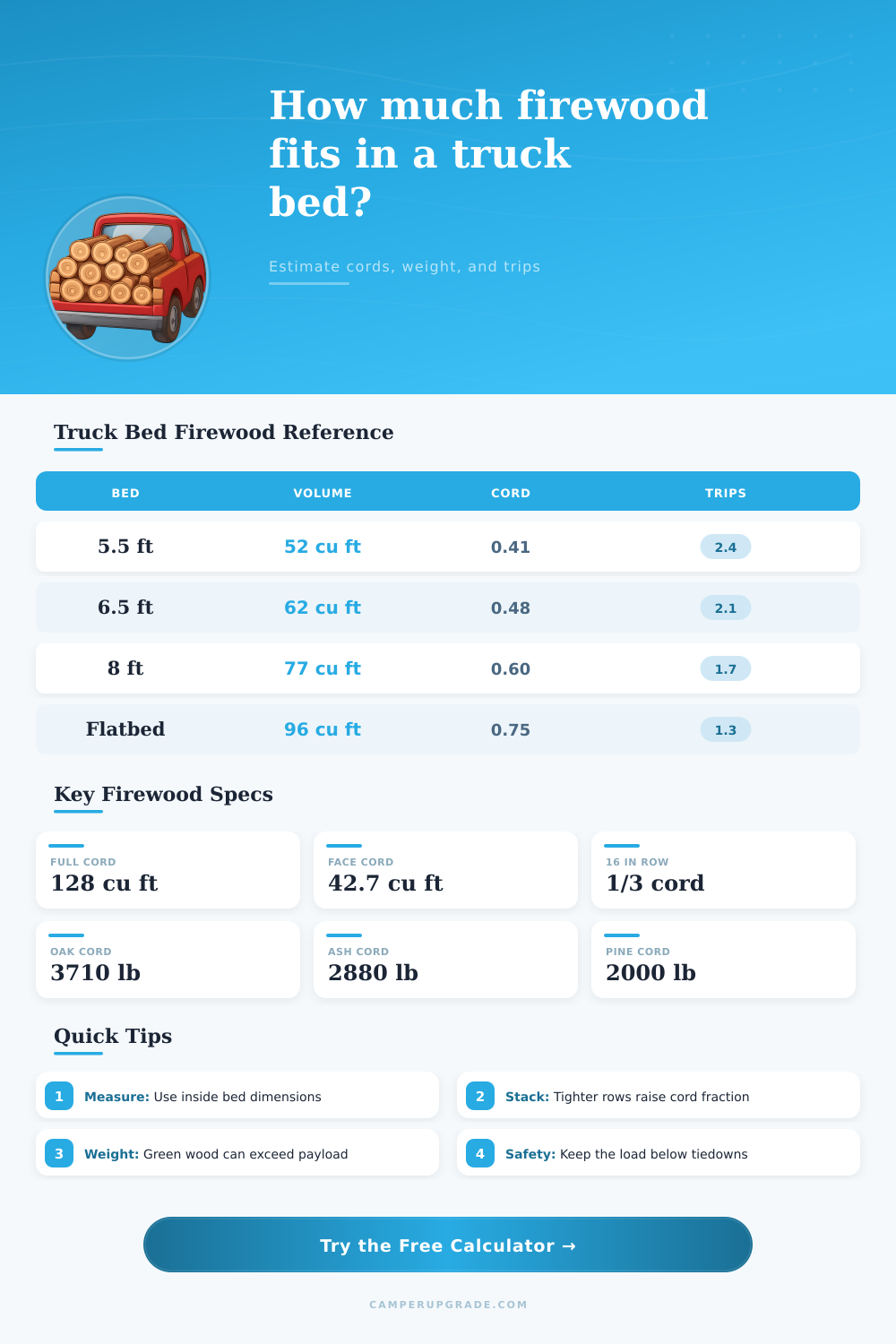
Truck Bed Firewood Capacity Calculator
Estimate how many cubic feet, cords, face cords, and pounds of firewood fit in a pickup bed using real inside dimensions and stacking conditions.
Calculation Breakdown
| Inside bed example | Level volume | After 12% wheel loss | Full cord share |
|---|---|---|---|
| 60 in x 44 in x 18 in compact bed | 27.5 cu ft | 24.2 cu ft | 0.19 cord |
| 66 in x 50 in x 20 in short half-ton | 38.2 cu ft | 33.6 cu ft | 0.26 cord |
| 78 in x 50 in x 21 in standard bed | 47.4 cu ft | 41.7 cu ft | 0.33 cord |
| 96 in x 50 in x 22 in long bed | 61.1 cu ft | 53.8 cu ft | 0.42 cord |
| 96 in x 72 in x 24 in flatbed rack | 96.0 cu ft | 96.0 cu ft | 0.75 cord |
| Firewood measure | Stacked volume | Typical dimensions | Notes |
|---|---|---|---|
| Full cord | 128 cu ft | 4 ft x 4 ft x 8 ft | Legal standard in many regions |
| 16 in face cord | 42.7 cu ft | 4 ft x 8 ft x 16 in | One-third of a full cord |
| 18 in face cord | 48.0 cu ft | 4 ft x 8 ft x 18 in | Three-eighths of a full cord |
| 24 in face cord | 64.0 cu ft | 4 ft x 8 ft x 24 in | Half of a full cord |
| Loose tossed cord | 160-180 cu ft | Loose pile | Needs more bed volume for same wood |
| Stacking condition | Fill factor used | Best use | Capacity effect |
|---|---|---|---|
| Loose tossed, uneven pile | 0.76 | Quick loading from pile | Lowest cord fraction |
| Hand stacked, normal gaps | 0.84 | Typical pickup loading | Balanced estimate |
| Tight rows, aligned splits | 0.90 | Maximizing delivery volume | Higher cord fraction |
| Cribbed ends and tight rows | 0.95 | Rack or flatbed sides | Highest practical estimate |
| Common load target | Stacked cu ft | 16 in face cords | Standard-bed trips |
|---|---|---|---|
| Camp weekend bundle load | 12 cu ft | 0.28 face cord | 1 trip |
| Quarter cord | 32 cu ft | 0.75 face cord | 1 trip |
| Half cord | 64 cu ft | 1.50 face cords | 2 trips |
| Full cord | 128 cu ft | 3.00 face cords | 4 trips |
| Load setup | Typical advantage | Watch item | Calculator setting |
|---|---|---|---|
| Pickup with wheel wells | Common daily truck setup | Irregular side pockets reduce rows | 10-15% wheel loss |
| Level with bed rails | Cleaner tie-down and tarp line | Usually under half cord | 0 in above rail |
| Stake sides or rack | Large volume increase | Payload can be the limit | 12-24 in above rail |
| Flatbed with side racks | Rectangular stacking space | Needs strong containment | 0% wheel loss |
The first time you try hauling firewood, you might be standing in your driveway with a half-full bed of oak splits, looking up at the open tailgate wondering how you’re going to fit it all, when suddenly you realize that you’re already past your truck’s payload limit. And the wood hasn’t even reached the top of the rails yet. That’s because there is something deceptive about staring at a pile of stacked timbers: A cubic foot of green white oak alone weigh almost 40 pounds, so volume doesn’t always match our intuition of what we think things weigh. If you want to match the actual density of whatever it is you’re trying to move into your truck bed with the amount of space you have in there, you’ll need a solution.
To start with, here’s the deal: When people say a cord of wood, they’re talking about a measurement of stacked volume, not an amount of raw timber. A full cord mean one hundred twenty-eight cubic feet of stacked wood in a nice, neat four by four by eight foot stack. After you enter the dimensions of your specific bed, our calculator does all the calculations for you, saving you from wasting time trying to guess at how many cubic feet of storage all those wheel wells cost you.
How to Calculate Firewood for Your Truck
Here’s the thing most folks don’t think about, even though most pickups are labeled as “half-tons,” they have tapered sides and wheel arches which gobble up a large portion of their useful carrying area. They typically lose twelve to fifteen percent of their floor space to these obstacles, yet still load as if they had a perfectly rectangular box. This miscalculation explains why we end up in the sagging suspension situation described above.
Just as important as the truck is how you stack it. Tight rows of rounds produce far more actual wood per cubic foot than a loose toss which leaves big air pockets between them. To compensate for this, the tool lets you choose a fill factor, ranging from neat rows of split logs to messy piles. You could achieve 90 percent efficiency in how tightly you pack everything into the space, or far less. This depends on whether you’re neat-stacking or merely tossing logs in until no more will fall. Think of the difference between hauling home a full cord and a scant half-cord of firewood within the same physical area.
But then there’s weight. When you start adding weight restrictions, species become even more important. For example, some of the hardest woods are hardwoods, specifically hickory and white oak, that can exceed four thousand pounds per cord (when dried). These types of woods makes great firewood if you need it for cooking; however they take a long time to get hot as well as cool down after burning. On the other hand, softwoods such as pine have less density and therefore will be lighter (and easier to load) but will also burn much quicker and hotter. This is ideal for making kindling but not so great for providing overnight heat.
To further complicate things, green wood (freshly cut) can weigh upwards of thirty-five percent more than dry seasoned wood. The reason is all of the water in the wood’s cell structure. If you’re hauling a full cord of dry ash in your bed, loading that same volume with freshly cut maple could push you past your manufacturer’s payload rating, but I’m telling you, you’ll feel the difference. Going over that weight can cause problems during safety inspections at weigh stations and bottoming out at speed bumps.
The other thing that can confuse people in the wood business is something called face cords. If someone advertises that they have a “full load” of firewood, that’s probably just a face cord, which is only about one third as much as what’s considered a cord! A face cord is only sixteen inches deep rather than forty-eight, so buyers who expect to see eight feet of stacked-up logs are being shortchanged if they don’t check their dimensions. The table below spells it all out…
How converting from cord to face cords takes into account the effect of split length. Knowing this lets you negotiate a good price, and make your truck run right once and for all, so you won’t have to run the same trip three times when two would of done the trick.
No matter how confident you are with your tie-downs, it never hurts to add some safety margin for peace of mind. Loads get shaken loose on rough roads, and that weight shifts dynamically which can’t be predicted from static calculations. A ten to twenty percent buffer will keep that wood where you want it and prevent it from sliding out while braking. Better to take one more trip than beat up your truck’s bed liner or lose your load on the highway.
In conclusion, moving fire wood isn’t so much a matter of brute force as it is weight distribution and math. You should know how to measure interior dimensions. You also need to understand how wheel wells affects interior volume and factor in the relative densities of each species. Doing this can help you avoid costly mistakes and spend less time working.
And the next time you’re standing out there staring into an empty bed, keep in mind that what you see ain’t necessarily what you get: accounting for only what’s safe to carry will prevent broken backs and bent axles. With proper planning, this chaotic weekend task becomes something manageable; a routine with measurable results and each load bringing you one step closer to staying warm this winter.