Truck Bed Camper Fit Calculator
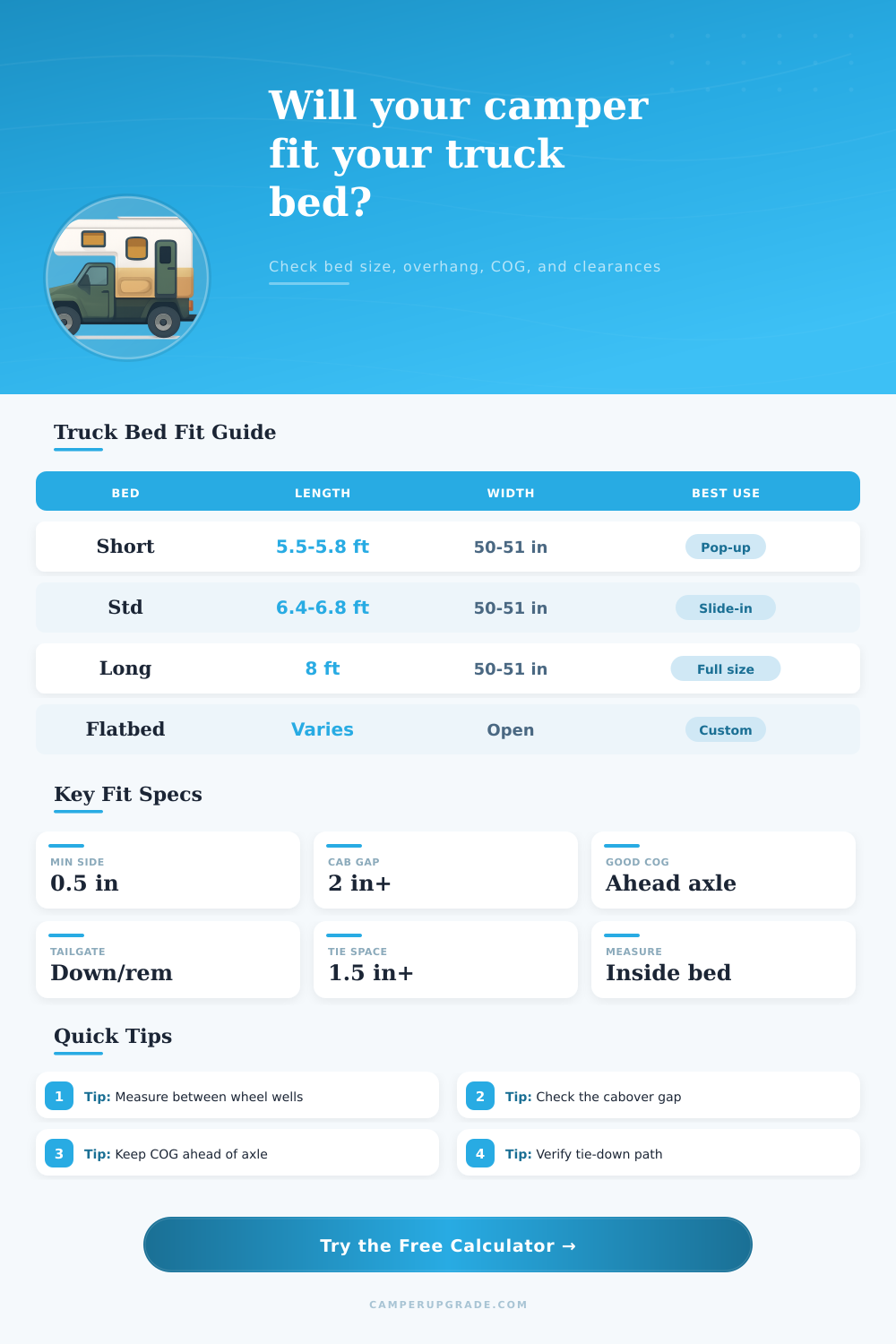
Check whether a slide-in camper floor fits your truck bed by comparing bed length, bed width, tailgate state, wheel-well opening, cab clearance, rear overhang, center-of-gravity mark, and tie-down clearance.
Truck bed camper fit results
| Truck bed class | Typical inside length | Typical rail width | Wheel-well opening |
|---|---|---|---|
| Midsize short bed | 59 to 63 in | 56 to 59 in | 41 to 45 in |
| Midsize long bed | 72 to 74 in | 56 to 60 in | 41 to 45 in |
| Half-ton short bed | 65 to 69 in | 62 to 66 in | 50 to 51 in |
| Half-ton standard bed | 76 to 80 in | 62 to 66 in | 50 to 51 in |
| Long bed pickup | 95 to 99 in | 62 to 66 in | 50 to 51 in |
| Flatbed or tray | 84 to 108 in | open deck | usually none |
| Camper lower floor | Common truck match | Rear overhang note | Fit watch point |
|---|---|---|---|
| 60 to 68 in floor | Midsize or half-ton short bed | Often little overhang | Wheel-well width is usually tight |
| 72 to 80 in floor | Full-size standard bed | May overhang short beds | Confirm tailgate choice |
| 84 to 90 in floor | Full-size short or standard bed | Common 6 to 22 in overhang | COG mark must stay forward enough |
| 94 to 102 in floor | Long bed pickup | Usually fits bed length closely | Check cabover height and rear bumper |
| 102 in or longer | Dually or tray setups | Overhang is expected | Use axle scale and tie-down geometry |
| COG position | Meaning | Planning verdict | What to check next |
|---|---|---|---|
| 6+ in ahead of axle | Comfortable forward COG | Best fit geometry | Still verify payload and RAWR |
| 0 to 6 in ahead | Near axle but acceptable | Usable with careful loading | Keep dense cargo forward |
| 0 to 3 in behind | Marginal rearward COG | Fit needs review | Measure loaded axle weights |
| 3+ in behind | Rear leverage increases | High concern for fit plan | Choose longer bed or lighter rear load |
| Clearance check | Good target | Borderline | Why it matters |
|---|---|---|---|
| Side buffer per side | 0.5 in or more | Under 0.25 in | Bed liners, taper, and loading angle can steal space |
| Wheel-well clearance | 1 in total or more | Under 0.5 in total | Camper floor may bind on the wheel humps |
| Cabover clearance | 2 in or more | Under 1.5 in | Frame flex and bed mat compression change the gap |
| Tie-down clearance | 1.5 in or more | Under 1 in | Turnbuckles and brackets need a clear pull path |
| Rear overhang | Within camper spec | Past owner limit | Steps, bumper, lights, hitch, and jacks need clearance |
A truck bed camper has to fit within the truck bed correctly; it has to align with the features of the truck bed. The truck bed has specific features, such as rails, wheel wells, a front wall, and a rear edge to the truck bed; each of these features must correspond to the truck bed camper. If the measurements of the truck bed and the truck bed camper isnt correct, the truck bed camper can become crookedly within the truck bed, it can become bound within the truck beds wheel wells, or it can hang too far past the axle of the truck.
A fit calculator can help determine these measurements for both the truck bed and the truck bed camper, and can indicate whether or not the truck bed camper will clear the truck bed and have a reasonable weight distributions. The length of the truck bed and its camper can be measured with the bed length. The length of the truck bed determine how much the truck bed camper will overhang the truck bed.
Will a Truck Camper Fit Your Truck?
If the floor of the truck bed camper are longer than the truck bed length, it will overhang the tailgate of the truck. Individuals can remove the tailgate from the truck bed, or they can leave it attached. A fit calculator will calculate the length of the truck bed camper, the length of the truck bed, and indicate how much of the truck bed camper will be overhang the tailgate.
The width of the truck bed is another measurement that can be taken with the truck bed camper. The width of the truck bed is not uniform throughout the bed; it changes with the location of the truck bed. Thus, one can measure the width of the truck bed’s rails, as well as the width of the truck bed’s wheel wells.
A truck bed camper may not be as narrow as the truck bed and it may still become caught on a wheel well. A fit calculator will ask for the width of the truck bed’s rails, the width of the truck bed’s wheel wells, and the side buffer for the truck bed. The side buffer accounts for the truck bed liners, the tapering of the bed, and the angle of the bed when loading the truck bed camper.
Cab clearance is another measurement that can be accounted for when placing the truck camper into the truck bed. The truck bed camper and the truck will move while the truck is being driven; the truck bed may flex or rock, and the mats within the truck bed may be compressed due to the weight of the truck bed camper. A fit calculator will ask for the vertical clearance between the cab of the truck and the underside of the truck bed camper’s cabover.
If the truck camper is too low to the cab of the truck, the truck bed camper may contact the cab of the truck while the truck is in motion. If the vertical gap between these two components is less than two inches, the truck camper will be a marginal fit to the truck. If the vertical gap is less than one and a half inches, it is a hard problem to fit the truck camper to the truck.
Another set of measurements regarding the placement of the truck bed camper is the position of the center of gravity of the truck bed camper. The fit calculator will ask for the distance of the center of gravity of the truck bed camper from the rear axle of the truck; the manufacturer of the truck camper has programmed the camper to have the center of gravity of that specific make and model of truck camper sit at a certain distance from the rear axle. If the center of gravity of the truck camper is positioned behind the rear axle of the truck, the truck bed camper will place extra leverage upon the rear axle of the truck.
If the center of gravity is positioned ahead of the rear axle, it will place most of the weight of the truck camper upon the front axle of the truck. Tie down clearance is another measurement that is performed with the truck bed camper within the truck. The tie downs that hold the truck camper to the truck bed may require a certain amount of clearance to allow the turnbuckles or brackets to be placed into the truck bed.
The fit calculator will ask for the gap between the smallest opening in the truck bed for the turnbuckle, such as the bed rail, stake pocket, or jack plate. If the opening is less than one and a half inches, the turnbuckle may become bound within the truck bed, or it may require an adjustment to the angle of the camper. While a fit calculator can calculate all of the geometric measurements of the truck bed camper and the truck bed, there are other factors to consider the truck camper once it is placed upon the truck.
Factors like the payload and the axle ratings of the truck can become important; the truck camper may fit into the truck bed correctly but may overload the rear axle of the truck. Additionally, the flex of the truck bed may change the fitment of the camper within the truck bed; some truck beds flex more than others, especially when the truck bed is on uneven ground. Other factors that can impact the fitment of the truck camper are the tire pressure of the truck, and the condition of the truck’s suspension system.
There are some common mistakes that individuals make when measuring the truck and the truck bed for the placement of a truck camper. For instance, an individual may measure the length of the truck bed to the inside of the tailgate, rather than to the actual opening of the tailgate. This could cause individuals to believe that their bed length is longer than it is.
Additionally, individuals may measure the width of the truck bed’s wheel wells at the top of the bump of the truck bed rather than at the tightest point of the truck bed. Finally, individuals may measure the clearance between the cab of the truck and the truck bed camper while the truck is unloaded, but the truck bed will drop when the truck camper is placed into the truck bed. An individual may make these errors, but the fit calculator does not prevent these mistakes.
Despite the fact that a fit calculator can calculate the geometric measurements of the truck camper and the truck bed, there are other factors to the placement of a truck camper. For instance, while the truck camper may visually appear to be a good fit to the truck, depending on how the camper will impact the tailgate, the relocation of tie downs, or the required length of the bed for the truck camper, a fit calculator may indicate that it is not the best camper to fit to that truck. Thus, the fit calculator is a helpful tool for individual to determine if the truck camper will physically fit to the truck.
Additionally, while a fit calculator does not allow an individual to calculate the impact of placing the truck camper upon the axle ratings of the truck, it is still helpful in revealing whether or not the truck camper will be physically correct for the truck. Once the truck camper is confirmed as a fit for the truck, there are other factors to consider to ensure that the truck camper will remain securely on the truck while in motion, such as the loading order of the camper, the tire pressure of the truck, and the way that the truck may feel when driven on the road.