Trip Meal Count Planner Calculator
Estimate camping meal servings, snack packs, cooler volume, and pantry backup from real trip patterns.
Trip meal plan results
| Traveler group | Serving factor | Use for meal count | Planning note |
|---|---|---|---|
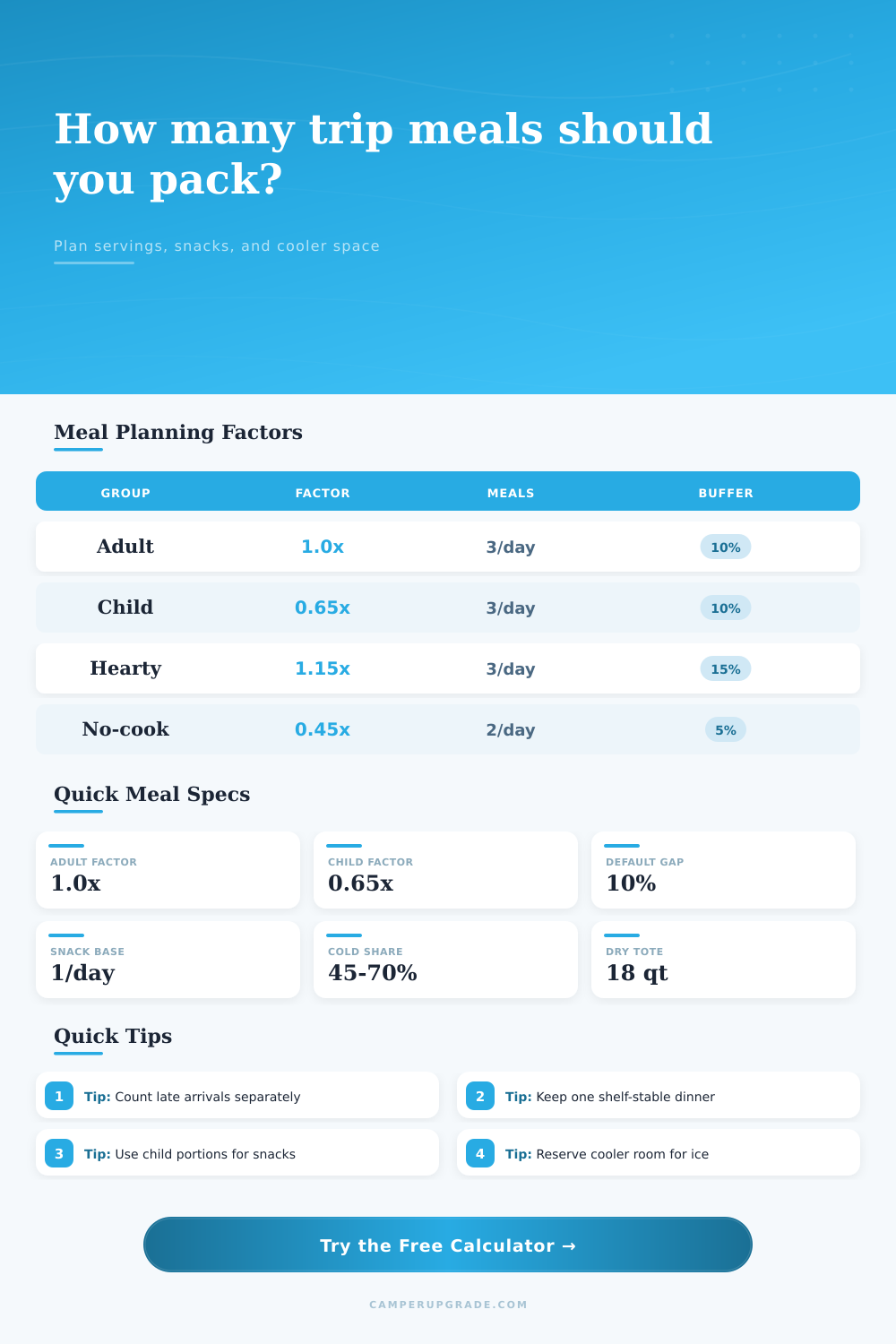
| Adult or teen | 1.00 adult-equivalent | Breakfast, lunch, dinner, snacks | Best default for RV rallies, couples, and mixed groups. |
| Child under 12 | 0.65 adult-equivalent | Meals and snacks | Increase toward 0.80 for highly active children or cold weather. |
| Guest dinner only | 1.00 per dinner | Dinner participation | Add them by raising dinner participation or adult count for one day. |
| Trail-day appetite | 1.12 to 1.25 multiplier | All servings | Useful for hiking, paddling, fishing, cold mornings, or long setup days. |
| Cooking plan | Main serving factor | Cold share | Dry pantry share |
|---|---|---|---|
| Balanced camp kitchen | 1.00 | 48% of meal volume | 52% shelf-stable or dry goods |
| Hearty grill and skillet meals | 1.15 | 64% of meal volume | 36% shelf-stable sides and breakfast goods |
| Simple soups, wraps, and bowls | 0.90 | 38% of meal volume | 62% cans, packets, bread, rice, and tortillas |
| Mostly no-cook meals | 0.70 | 45% of meal volume | 55% dry snacks, spreads, shelf-stable pouches |
| Freezer-prepped mains | 1.05 | 70% of meal volume | 30% dry sides and breakfast pantry food |
| Shared potluck rotation | 0.72 | 40% of meal volume | 60% dry add-ons, backup meals, and shared snacks |
| Storage item | Usable planning volume | Typical food role | Calculator treatment |
|---|---|---|---|
| 25 quart compact cooler | 16 quarts after ice allowance | One to two people, short chilled meals | Divides cold food quarts by your entered usable capacity. |
| 52 quart family cooler | 34 quarts after ice allowance | Weekend family produce, dairy, meat, drinks | Default input when the cooler rating is known. |
| 75 quart group cooler | 49 quarts after ice allowance | Group dinners, frozen mains, multi-day camps | Helpful when grill meals dominate the plan. |
| 18 quart pantry tote | 18 quarts of dry capacity | Cereal, pasta, rice, pouches, snacks, backup meals | Dry totes are rounded up from dry food quarts. |
| Common trip | People and days | Meal servings | Snack packs |
|---|---|---|---|
| Weekend Couple RV | 2 adults, 2.5 days | About 16 with a 10% buffer | About 9 with one to two rounds daily |
| Family Long Weekend | 2 adults, 2 children, 4 days | About 36 with a 12% active appetite lift | About 30 when snacks happen twice daily |
| Scout Patrol Camp | 8 adults or teens, 3 days | About 84 with full shared meals | About 40 for trail and campfire snack rounds |
| Minimal No-Cook Stopover | 2 adults, 1.5 days | About 7 with partial breakfasts and lunches | About 5 compact single-serve snacks |
It’s a scene you know well: You’re standing by refrigerator, cooler jam-packed, and then suddenly, it hits you; you brought plenty of cheese to go on that picnic, but no meat to last all week. It’s something many of us do when we plan our trips; we let our optimism beat our math. When we load up our coolers, we do so like we do our wardrobes, throwing in whatever we think will look good, hoping it’ll work. Except a cooler isn’t a closet; it’s a limited space with a ticking time bomb (melting) on each side.
This is not a hungry problem. Usually, it’s an invisible math problem involving participation and space management. You know what? Nine dinners sounds like nine meal. Three days usually means three meals. But when you go camping, you’ll probably eat one meal in town and maybe have breakfast in the car. That makes dinner the one time you are most likely to sit down and really enjoy your food. Purchase accordingly to actual participation (not guessing) each day, and you’ll wind up with a ton of half-eaten wraps and wilted lettuce in your cooler.
How to Pack Your Cooler
This thing (above) does all the math for you if you plug in the number of folks you’re bringing and how long you’re gone. Instead of having to guess at the math, it saves you the effort. It makes you think through exactly who is going to eat what when.
Consider children. The little belly isn’t all there is to it. There’s the whole waste reduction thing too. The typical plan assumes that a child eats two-third’s what an adult eats. That sounds like a lot, but over a weekend, that makes a big difference because you’re not carrying extra food. And, adults differ in their appetite levels too. Sitting in a trailer at an RV rally is very different than hiking in the woods at a backpacking basecamp. Our tool accounts for that with a multiplier on your starting serving size. Hike eight miles per day? You need more calories. Relax on the couch? Not so much. It’s a basic adjustment. It helps you avoid the common error of buying too much food for comfort and too little for your energy needs.
Most people’s plans go off the rails in snacks. They forget that each snack round is a separate unit of food. A piece of fruit. A bar. A handful of chips. There are two snacks per day for two adults and one child. That’s six snack units a day. Multiply that by five days. That’s thirty individual things over five days. It adds up faster than you would think.
And how much do those snacks take up? The reference table on the page shows how many snack units match group size. As you’ll see, snacks can often take up more dry tote space then you thought. But there’s also the matter of capacity. How much space is actually available for food? This is the hard stop. Coolers can only hold so much before they’re full. So if you like to pack in the food, but don’t plan to use all that space because it’ll be taken up by ice, then how will you know?
The general rule of thumb is that about thirty-five percent of a cooler should be set aside for ice and water. For example, with a fifty-two quart cooler, only about thirty-four quarts will be free for actual food. The calculator will estimate this breakdown for you, telling the difference between what goes in cold storage versus what stays in the dry pantry. Why does this matter? Because it prevents the bagged chips from touching the raw chicken and it also prevents running out of cold space on night two.
Your safety net is your backup. The tool recommends bringing at least one shelf-stable backup meal. No, this isn’t about redundancy for its own sake. This is about resilience. Things change. The power goes out. The cooler leaks. Better coolers do not exist yet (a melted cooler means wasted food). Having a dry option prevents you from being hungry and losing food to a melted cooler. Small thing, but it matters.
If you’re stumped, use its built-in presets. Scout patrol camp is very different from a weekend couple RV trip. Speed and variety is important for the former; simplicity and bulk are important for the latter. Choose a preset to load sensible defaults, then tweak them for the real value. If you have picky eaters, raise the buffer. If you’re leaving early, lower the breakfast participation.
Logistics: Packing is also logistics. It involves planning and anticipating needs. You must consider weight. Volume. You must also consider timing. To pack as much as possible isn’t the objective; packing the right stuff in the right quantity are. That allows you to close that lid and go off duty until dinnertime. A good cooler plan is a quiet one, staying calm while you keep your mind on the campfire.