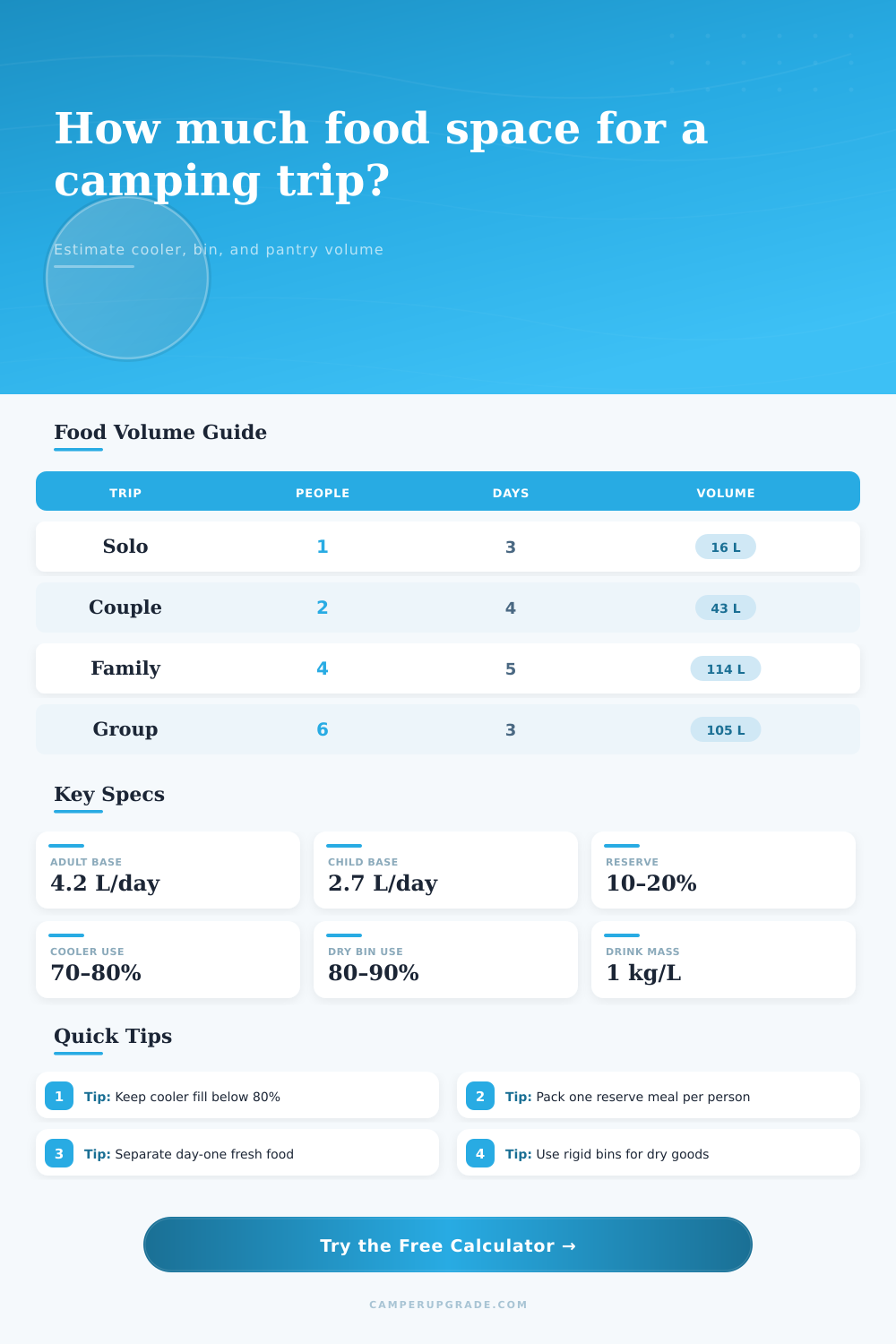
Trip Food Volume Calculator
Estimate packed food liters, cooler space, dry storage bins, and carry weight for RV meals, van trips, and campsite cooking.
🚗Trip Presets
⚙Calculator Inputs
Use 0 for all shelf-stable meals, 70+ for fresh-heavy menus.
Counts bottled drinks and extra cooking beverages, not campground tap water.
A 55 qt cooler is about 52 L before ice and air gaps.
Common lidded camp bins are 27 L, 45 L, 64 L, or 102 L.
Food Storage Estimate
📦Storage Spec Comparison
🍞Food Volume Reference
| Food Plan | Adult Volume | Child Volume | Typical Cold Share | Density Used |
|---|---|---|---|---|
| Compact dry meals | 3.4 L per day | 2.2 L per day | 15% to 30% | 0.32 kg/L |
| Balanced camp menu | 4.2 L per day | 2.7 L per day | 35% to 55% | 0.43 kg/L |
| Fresh-heavy cooking | 5.4 L per day | 3.4 L per day | 60% to 80% | 0.48 kg/L |
| Family shared cooking | 4.6 L per day | 3.0 L per day | 45% to 65% | 0.45 kg/L |
| Dehydrated meal plan | 2.6 L per day | 1.7 L per day | 0% to 15% | 0.24 kg/L |
| Canned pantry meals | 4.8 L per day | 3.1 L per day | 10% to 30% | 0.68 kg/L |
🧊Cooler and Bin Conversion Table
| Container | Nominal Capacity | Practical Food Space | Best Use | Planning Note |
|---|---|---|---|---|
| 28 qt cooler | 26.5 L / 0.94 cu ft | 18 to 21 L with ice | Solo weekend cold food | Works best with frozen meals |
| 45 qt cooler | 42.6 L / 1.50 cu ft | 30 to 34 L with ice | Two-person mixed menu | Keep drinks separate if possible |
| 55 qt cooler | 52.0 L / 1.84 cu ft | 36 to 42 L with ice | Family short trip | Common RV and campsite size |
| 75 L fridge | 75.0 L / 2.65 cu ft | 60 to 68 L usable | Fresh-heavy RV trip | No ice loss, but allow airflow |
| 45 L dry bin | 45.0 L / 1.59 cu ft | 36 to 40 L packed | Staples and snacks | Leave room for rigid packaging |
| 64 L dry tote | 64.0 L / 2.26 cu ft | 51 to 58 L packed | Family pantry load | Heavier when packed with cans |
🥤Drink and Packaging Allowances
| Allowance | Multiplier | When To Use | Volume Impact | Weight Impact |
|---|---|---|---|---|
| Repacked flat bags | 1.05x | Portioned meals, cereal bags, vacuum pouches | Lowest bulk | Same food weight |
| Mixed packaging | 1.15x | Typical grocery boxes, bags, jars, wrappers | Normal bulk | Same food weight |
| Bulky packaging | 1.28x | Produce clamshells, chip bags, boxed snacks | High bulk | Same food weight |
| Rigid meal boxes | 1.22x | Stacked prep tubs and bento-style boxes | Predictable shape | Container weight extra |
| Reusable ice packs | 12% cooler space | Fridge backup or short cooler trips | Moderate cold loss | Often 1 to 3 kg |
| Block or loose ice | 20% to 28% | Cooler-only food safety planning | Large cold loss | Melts during trip |
🗺Common Trip Size Table
| Trip Scenario | People and Days | Food Volume | Cold Space | Dry Storage |
|---|---|---|---|---|
| Solo weekend with compact meals | 1 adult, 3 days | 11 to 14 L | 4 to 7 L | 8 to 11 L |
| Couple four-day RV loop | 2 adults, 4 days | 38 to 48 L | 18 to 26 L | 20 to 27 L |
| Family campsite weekender | 2 adults, 2 kids, 3 days | 52 to 68 L | 27 to 42 L | 25 to 36 L |
| Family five-day base camp | 2 adults, 2 kids, 5 days | 88 to 116 L | 45 to 72 L | 43 to 61 L |
| Six-person group weekend | 6 adults, 3 days | 92 to 122 L | 42 to 68 L | 50 to 69 L |
| Remote overland reserve | 2 adults, 8 days | 92 to 126 L | 28 to 55 L | 64 to 87 L |
💡Trip Food Planning Tips
Geography is as much about feeding yourself as appetite. You may imagine some epic menu in your mind, but if it won’t fit in your dry bin or cooler, it’s not happening. People tend to overstate the space theyve got and under-estimate bulk of packaged items.
After you plug in your trip length and party size, calculator does all that math for you. No need to do unit conversions, mess with coefficients, or fumble around with back-of-the-napkin guesses. It converts vague hunger into solid cubic measures, letting you precisely see what’ll fit before you ever set out from home.
How to Pack Food for Your Trip
Volume alone is not a meaningful metric. It is a flat number that fails to account for how much food are stored in a certain space, known as density. It also fails to show whether that food takes up much room relative to its calorie count. Although two items may contain roughly equal calories, one might take up significantly more space then the other. For example, storing fresh veggies will require almost twice the pantry capacity as dehydrated or canned meals.
Your spatial footprint (shown in the reference table on this page) depends entirely on the way you plan to eat. Do you prefer to cook together? Do you cook mostly from scratch with fresh ingredients? Or are you a solo hiker who eats mostly dehydrated meals? Because fresh-heavy cooking requires strict temperature control and heavier packs, you’ll sacrifice volume efficiency. Keep this tradeoff in mind.
There’s also the matter of cooler size, which is another place marketing figures can trip us up. That fifty-five quarts looks like a lot of space. But nothing stacks perfectly, and all that ice still needs room. To account for that, you’re asked what kind of cooling system you’ll be using: reusable packs? Loose ice? Block ice? Block will cool more slowly than loose, but settle into places more easly. Loose will fill empty spaces but weigh a ton when liquefied. If you intend on keeping items cold, leave yourself roughly twenty percent of your total cooler space for ice. Otherwise you’ll have some wasted space and warm sandwiches to boot. These small details matter for food safety.
Dry goods aren’t as efficient (packaging-wise) but don’t need ice. A box of cereal is largely empty space. A bag of chips? Even worse. You can reduce your needed dry storage by 10% or more if you repack them into flat pouches or rigid bins. The calculator uses a packaging multiplier to account for this. Store-bought will mean larger bins. Repacked-at-home may mean the same food quantity fits into a smaller bin. It also impacts your carry weight, rigid bins is heavier than flimsy plastic bags but will better protect breakable contents.
Any time you’re taking food with you, whether in hand-carried form or packed into a small vehicle, weight becomes a quiet limitation. Using the tool, you can estimate how much water (one kilogram/liter) and what the total carry weight of your planned meals and drinks will be for a given trip. The tool estimates total carry weight based off the density of your chosen meal style and volume of drinks you plan to bring.
Adding a 20% or greater margin when planning for remote overland travel makes sense (since there’s no grocery store on your next campsite). On shorter trips where you’re able to resupply daily, a 10% margin is typically enough to account for minor calculation errors or unexpexted hunger. That knowledge empowers you to make better decisions regarding food: What’s worth carrying? What isn’t?
When you’re packing, understanding those factors will prevent you from freaking out in camp because you have more than enough food but no way to fit it all. With that said, here’s how to run some numbers to give yourself an accurat sense of what you’re going to need (or not need) on the trail. But planning is what separates a relaxing vacation from a haphazard, let’s-see-if-this-stuff-will-fit-in-the-back-of-the-van ordeal. Packing by the liter lets you pack with confidence rather than hope. It removes the guesswork: Will my one last box of pasta fit? Nope, I knew that. Or maybe yes, I knew that. Either way, that sense of certainty shifts the whole feel of the trip before you even leave home. The math doesn’t eliminate good taste; it just ensures that your good taste makes it all the way to the campstove.