Trekking Pole Length Calculator
Set a trail-ready pole length from body fit, terrain, and pack load with quick uphill and downhill adjustments.
🏔️ Trail Presets
⚙ Body Fit And Terrain Inputs
📊 Pole Fit Spec Grid
📘 Trekking Pole Reference Tables
| Hiker Height | Base Pole Length | Fixed Size Pick | Imperial Equivalent |
|---|---|---|---|
| 150 cm | 102 cm | 100 cm | 40.2 in |
| 160 cm | 109 cm | 110 cm | 42.9 in |
| 170 cm | 116 cm | 115 cm | 45.7 in |
| 180 cm | 122 cm | 125 cm | 48.0 in |
| 190 cm | 129 cm | 130 cm | 50.8 in |
| 200 cm | 136 cm | 135 cm | 53.5 in |
| Terrain Profile | Adjustment | Why It Helps | Use Pattern |
|---|---|---|---|
| Mostly Flat Track | 0 cm | Neutral elbow support | General walking |
| Rolling Trail | +1 cm | Smoother transitions | Frequent short grades |
| Steep Sustained Climb | -5 cm | Reduces shoulder lift | Long uphill switchbacks |
| Long Technical Descent | +8 cm | Improves bracing reach | Downhill stability |
| Mixed Climb And Descent | +3 cm | Balanced all day setup | Variable routes |
| Rocky Scramble | +2 cm | More contact options | Boulder fields |
| Trail Scenario | Main Setting | Uphill / Downhill | Suggested Lock Range |
|---|---|---|---|
| 170 cm, rolling trail | 117 cm | 112 / 125 cm | 110 to 128 cm |
| 180 cm, steep climb | 119 cm | 114 / 127 cm | 112 to 130 cm |
| 165 cm, long descent | 118 cm | 113 / 126 cm | 111 to 129 cm |
| 190 cm, heavy load | 134 cm | 129 / 142 cm | 127 to 145 cm |
Trekking poles must be the correct lengths for trekking poles to function effectiveley while on a hike. If trekking poles is not of the correct length for an individual, they can cause issue such as shoulder pain or quad strain. If trekking poles are of a correct length, they will help an individual to maintain there balance and distribute their weights properly while on a hike.
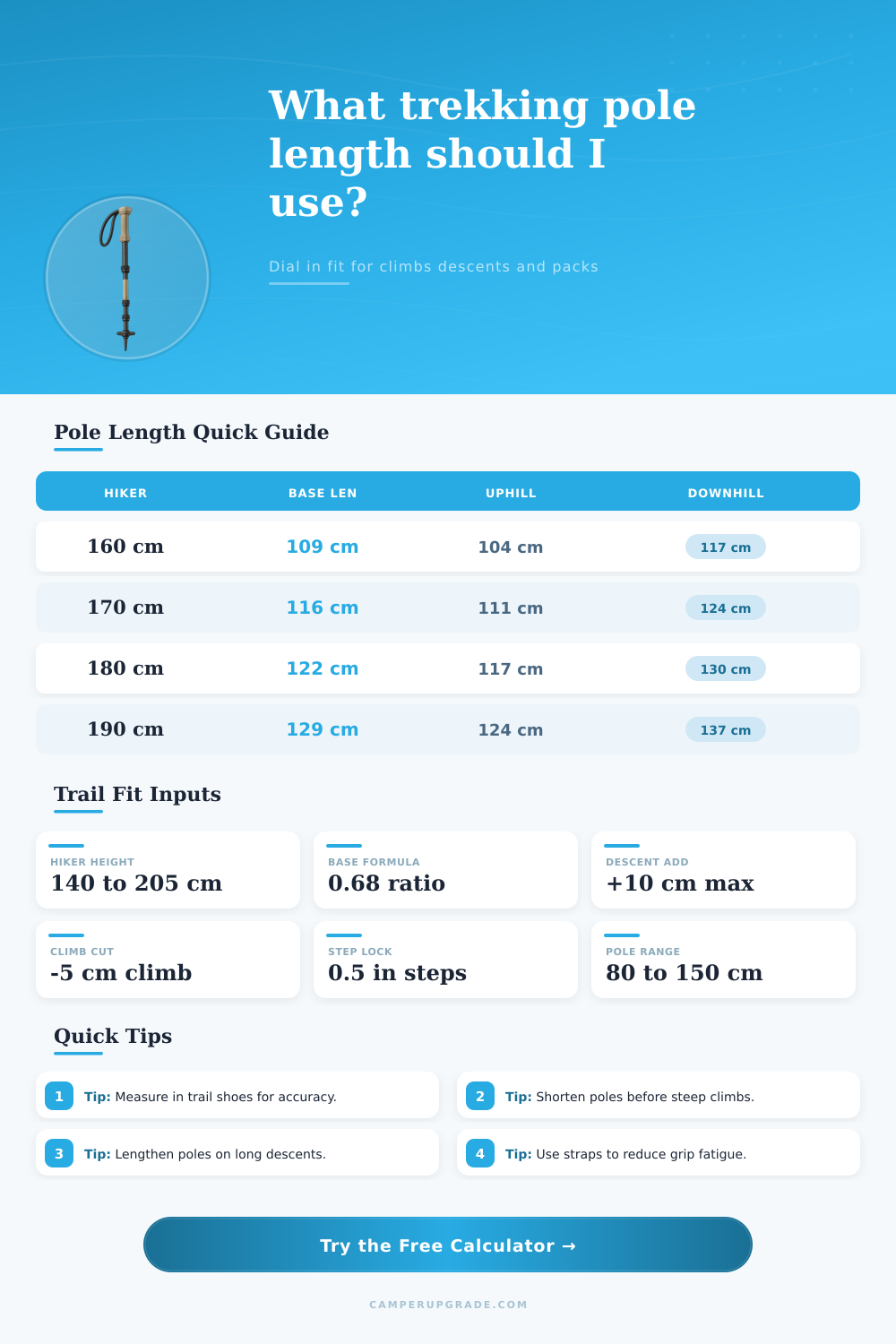
An individual can determine the length of trekking poles by measuring from the wrist to the floor while wearing an individual’s hiking shoe. The individual should drop one of their arm to the side while standing in a relaxed posture. The most common measurement for trekking poles is two-thirds of an individual’s height.
Find the Right Length for Your Trekking Poles
However, the individual should use the wrist to floor measurement to account for the length of their arms. When holding trekking poles with an individual’s arms hang loosely, the trekking poles should allow for the elbow to be at a ninety degree angle. The terrain that an individual is on may require adjustment to the trekking pole length.
For instance, an individual may need to adjust trekking pole length according to the terrain that they are hiking on. If the terrain is flat, the length of the trekking poles should remain at a neutral length that was determined for the individual. On a steep hill climb, the individual should shorten the trekking poles so that the individual can keep their shoulder down.
On a steep hill descent, the trekking poles should be lengthened to act as a brake for the trekking poles to improve the stability of an individual’s knees. Additionally, the weight of a pack will change how a person use their trekking poles. A person who is carrying a heavy pack should lengthen their trekking poles to allow for better counterbalance of they’re body.
A person should also test the setting of their trekking poles on a trail that they are familiar with before encountering any trail that might be more difficult to navigate with the trekking poles. A person might set the trekking poles to a certain length for a trail, but then forget about adjust the poles according to the changes in the terrain. If a person finds that they are using trekking poles that are too short for flat area, they may feel awkward when hiking on even terrain.
In the same token, trekking poles that are too long might place strain on a person’s shoulder when climbing hills. A person can mark their trekking poles with tape or a marker to show there preferred settings. Lastly, a person should also maintain trekking poles so that they are effectively use while trekking.
A person should clean the locking mechanism of their trekking poles to ensure they dont slip while trekking. If the locking mechanisms are dirty, the trekking poles might become unstable on uneven terrain. A person should also utilize the strap on the poles to take the weight off of their hand.
This will allow the persons forearm to rest, and they will be able to maintain enough grip on the trekking poles over long distance. By using trekking poles of the proper length for a persons body, they will be able to hike more efficient, and their physical strain on the body will be reduced.