Trailer Weight Distribution Calculator
Estimate tongue weight, trailer axle load, cargo balance, and center of gravity from trailer geometry, axle position, water, propane, batteries, front cargo, rear cargo, and hitch ratings.
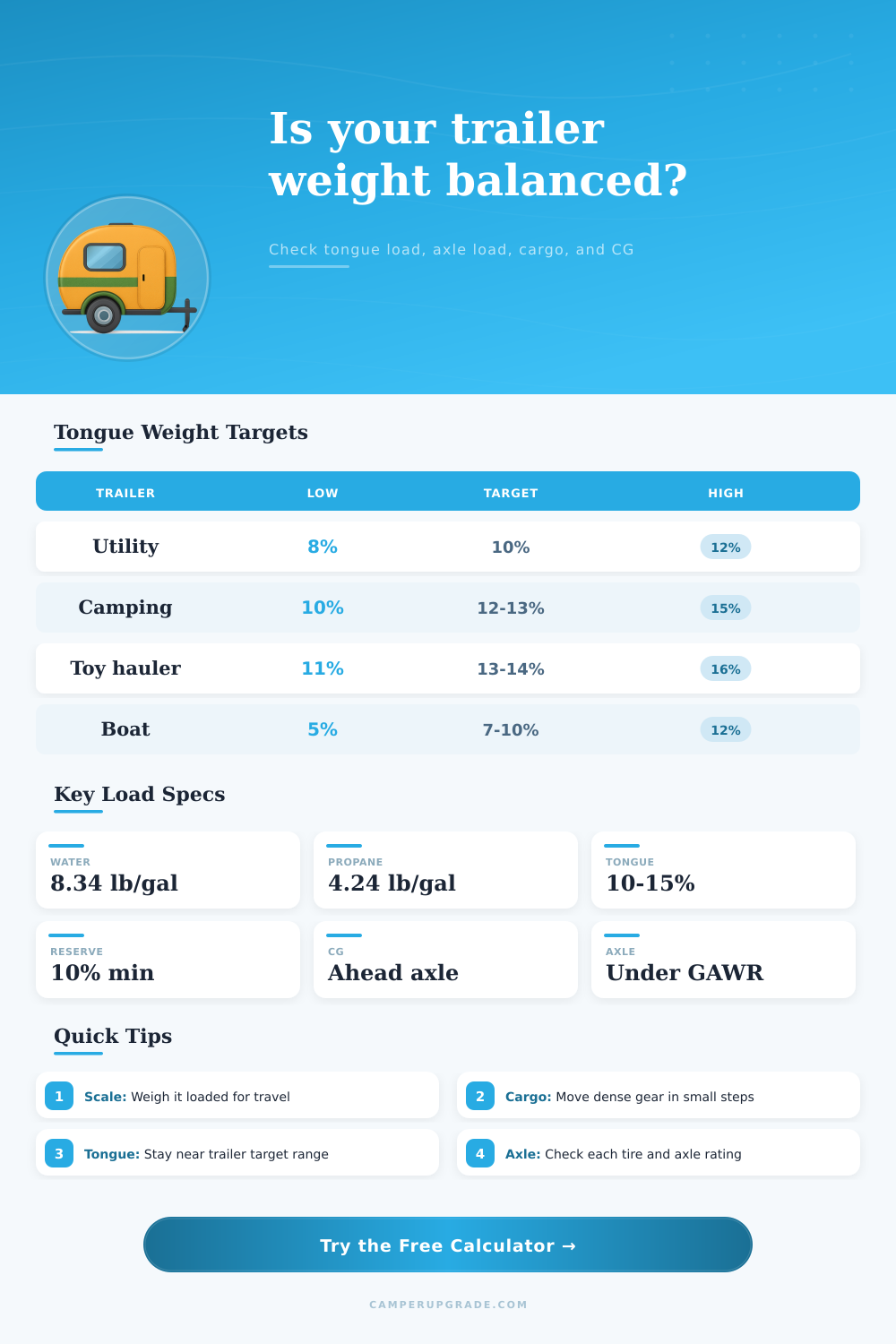
| Trailer type | Low | Target | High |
|---|---|---|---|
| Light utility trailer | 8% | 10% | 12% |
| Camping trailer | 10% | 12% to 13% | 15% |
| Toy hauler loaded rearward | 11% | 13% to 14% | 16% |
| Small boat trailer | 5% | 7% to 10% | 12% |
| Cargo move | Example | Tongue effect | Use when |
|---|---|---|---|
| Rear to front | 100 lb, 8 ft | Raises tongue | Sway or low tongue |
| Front to rear | 100 lb, 8 ft | Lowers tongue | Receiver is near limit |
| Near axle | 100 lb, 1 ft | Small change | Good place for dense gear |
| Far rear rack | Bikes or box | Strong drop | Recheck tongue weight |
| Rating check | Compare | Preferred margin | Watch item |
|---|---|---|---|
| GVWR | Total trailer | 10% cushion | Water and food |
| GAWR | Axle load | Under placard | Tires and bearings |
| Receiver | Tongue load | Under label | WD vs weight-carry |
| Tow vehicle payload | Tongue plus people | Door sticker | Passengers and gear |
| Scale pass | What to measure | What it proves | Note |
|---|---|---|---|
| Trailer only | Axles on scale | Actual axle load | Loaded as traveled |
| Tongue scale | Coupler load | Tongue percent | Level trailer |
| Truck plus trailer | Combined weight | Gross combination | Use real passengers |
| WD adjusted | All vehicle axles | Hitch setup effect | Follow hitch manual |
This calculator estimates static bumper-pull trailer reactions from weights and distances. Confirm final loads with a certified scale and the ratings printed on your trailer, tires, hitch, and tow vehicle.
Weight distribution on a trailer are important because the weight distribution on a trailer will determine in what way the trailer will behave when traveling behind a tow vehicle. Many people dont notice the effect of bad weight distribution until the trailer begins to sway or the hitch begins to feel light when the person is braking. Furthermore, if the trailer driver notices these issue, the driver must pull the trailer over to rearrange the cargo within a parking lot.
It is better for the trailer to be managed prior to departure from the trailer parking area when it is still possible to move the cargo prior to hitching the trailer to the towing truck. Weight on a trailer is not located in a single spot on the trailer. Instead, the weight is distributed between the tongue weight that is placed on the coupler that connects the trailer to the tow vehicle, the weight that is placed on the trailer axle group, and the overall center of gravity of the trailer.
How to Balance Trailer Weight for Safe Towing
Each time an object is move on the trailer a few feet to another spot on the trailer, each of these weights will change and the trailer may begin to behave differently behind the tow vehicle. A trailer weight calculator can help the trailer owner to manage these weight distribution change because the trailer calculator can perform the calculation necessary with the trailer dimensions and the current position of each piece of cargo. The specific inputs into the trailer weight calculator are important because each of these variables relate to the tongue weight of the trailer.
For instance, the base weight of the trailer and the center of gravity of the trailer will factor into the calculations that is made by the calculator. Additionally, the placement of cargo that is placed in the front of the trailer, the middle of the trailer, or the rear of the trailer will impact the tongue weight of the trailer. Furthermore, the movement of cargo from one spot to another will impact the tongue percentage of the trailer.
Finally, fluids that are placed into the trailer will add to the overall weight of the trailer; water weighs more than eight pounds per gallon and propane weigh approximately four pounds per gallon. For instance, if an owner places a water tank in the trailer that is positioned behind the trailer axle, the center of gravity of the trailer will shift in a way that the tongue weight increase due to the additional weight of the water tank. The tongue weight of the trailer must remain within certain target because the tongue weight determines the stability of the trailer.
If the tongue weight is too low, the trailer may begin to sway when encountering another truck, water, or even when the trailer encounters another gust of wind. If the tongue weight is too high, the tow vehicle may lose its ability to turn the trailer, and the rear tire of the tow vehicle may begin to approach their payload limit. Each type of trailer has a certain range of tongue weights that the trailer and trailer driver consider comfortable.
A reference table of these numbers can be provided to the trailer driver. The goal is not to have the tongue weight fall to an exact number; rather, it is more important for the trailer and tow vehicle to remain stable. The load of the trailer can change; the trailer owner might want to add a generator, add a box of tools, or even add a cooler with food.
These changes can be tested into the trailer weight calculator prior to adding the item to the trailer. Each time the individual enter the specifications of the item that is to be added to the trailer, the calculator will calculate the impact that the item will have upon the tongue weight, axle load, and hitch load of the trailer. If the tongue weight, axle load, or hitch load approaches a limit that is published for the trailer or tow vehicle, the item may be better moved to another spot or may be better left behind the trailer altogether.
This method of calculating the tongue and axle loads is better than attempting to calculate these number in one’s head while standing in the driveway of the trailer. The axle rating for the trailer are just as important as the tongue weight ratings. For instance, trailers that have only a single axle may have a Gross Axle Weight Rating (GAWR) that is very close to the empty weight of the trailer.
When water, propane, and the cargo are added to the trailer, there is a rapid decrease in the number of pounds of weight that can remain on the axle. The axle load can be viewed on the trailer weight calculator next to the axle load ratings for the trailer. If the axle is carrying too much weight, it may lead to cupped tire or even hot drive hubs over time.
The position of the center of gravity of the trailer impacts the way in which the trailer will remain stable on the trailer. If the center of gravity is positioned in front of the trailer axle, the trailer will remain in a straight line behind the tow vehicle. However, if the center of gravity is positioned behind the trailer axle, any gust of wind or turning of the trailer may cause the trailer to begin to move in a pendulum motion.
A trailer weight calculator will report whether the center of gravity is in the correct position in relation to the axle of the trailer. The load that is placed on the hitch that connects the trailer to the tow vehicle has a limit to that load. For instance, the rating for the receiver tongue that is published on the hitch or on a door sticker on the trailer may be lower than the Gross Vehicle Weight Rating (GVWR) of the trailer.
If the tongue weight of the trailer is calculated to be higher than the hitch load ratings, the hitch hardware may be at risk of breaking or otherwise failing to handle the calculated tongue weight. The weight calculator software can make such a calculation to ensure that the trailer owner does not have to manually calculate the tongue weight of the trailer or to manually check the hitch hardware for the limits of the hitch. Many trailer owners make mistake when loading the trailer.
For instance, many people tend to load the trailer with the heaviest items first. Furthermore, people may not consider the distance of these items from the trailer coupler. Instead, many people may believe that items placed near the trailer axle have no effect upon the balance of the trailer.
Additionally, many people may not consider the weight of the water and propane tanks once they are filled with their necessary liquid. For instance, a forty gallon water tank will add over three hundred pounds to the trailer. Furthermore, the location of this water tank may have an impact upon the balance of the trailer.
It is also common for trailer owners to weigh their trailer on a public scale prior to embarking upon a long trip. While the trailer weight calculator will provide a number for the trailer owner to use to plan the load of the trailer, the actual scale will provide the actual weight of the trailer and its load. By comparing the number provided by the trailer weight calculator to the number provided by the scale, the trailer owner can determine whether there placement of items on the trailer was correct.
Many trailer owners who are familiar with the item that they will transport will weigh the trailer prior to the start of the season, and again after they have changed the gear or trailer altogether. Even small move of cargo on the trailer can have an impact upon the tongue weight. For instance, if a box of some dense items is moved two or three feet along the trailer, the tongue weight may increase or decrease thirty or forty pounds without the addition of any additional cargo.
Moving the box in the opposite direction will have the opposite effect upon the tongue weight of the trailer. Furthermore, because the trailer weight calculator provides instantaneous calculations of the tongue weight, axle load, and hitch load, the trailer owner can adjust the load until the tongue percentage, axle load, and hitch load are within the correct margin. The goal for each trailer owner is to have their trailer behave in the most ordinary way while running on the highway.
One way to achieve this goal is to ensure that the trailer remains within the limit published for each type of rating. Furthermore, it is a goal for the trailer and tow vehicle to leave extra room for any additional item that may be needed while transporting the trailer, such as a cooler or a case of water. By meeting these goals, the trailer owner will have an ordinary drive with their vehicle and trailer.