Trailer Towing Capacity Calculator
Estimate practical trailer towing capacity from tow rating, GCWR, GVWR, payload, passengers, cargo, hitch rating, trailer load, tongue weight, and a chosen reserve margin.
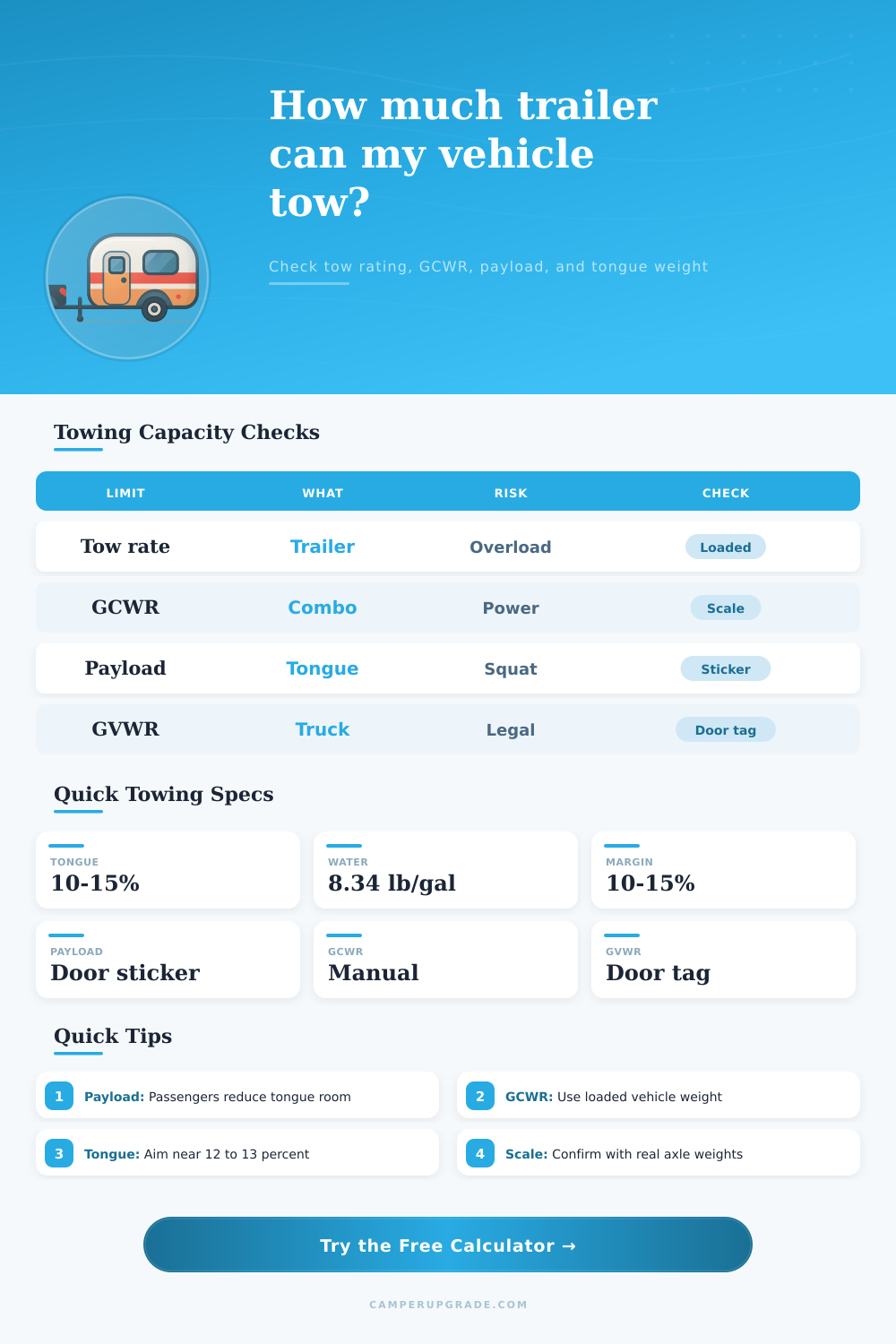
| Rating | What it limits | Common source | Planning note |
|---|---|---|---|
| Tow rating | Loaded trailer | Owner manual or towing guide | Often assumes a lightly loaded vehicle. |
| GCWR | Vehicle plus trailer | Towing guide | Subtract loaded vehicle weight to find remaining trailer room. |
| Payload | Cabin, cargo, hitch, tongue | Door sticker | Often becomes the real limit before the tow rating. |
| Vehicle GVWR | Loaded tow vehicle | Door certification label | Tongue weight counts on the vehicle. |
| Receiver rating | Tongue load | Receiver label | Check weight-carrying and weight-distribution numbers. |
| Vehicle type | Typical tow range | Payload pinch | Best trailer fit |
|---|---|---|---|
| Crossover SUV | 1500-3500 lb | Passengers and cargo | Teardrop or small utility trailer. |
| Midsize SUV | 3500-6000 lb | Receiver tongue rating | Popup, hybrid, compact camper. |
| Half-ton pickup | 7000-12000 lb | Door-sticker payload | Travel trailer if tongue weight is watched. |
| Full-size SUV | 6500-9000 lb | Cabin occupants | Family trailer with careful payload math. |
| HD pickup | 12000 lb plus | Trailer GVWR or receiver | Large travel trailer or heavy utility trailer. |
| Tongue share | Typical meaning | Capacity effect | Action |
|---|---|---|---|
| Under 10% | Light tongue | Uses less payload but may sway | Move dense cargo forward and reweigh. |
| 10-12% | Lower normal band | Helpful for payload-limited vehicles | Confirm stable handling. |
| 12-13.5% | Common target | Balanced for many campers | Check receiver and rear axle margin. |
| 13.5-15% | Heavy tongue | Payload may become limiting | Use weight distribution if allowed. |
| Over 15% | Very heavy front load | Receiver or payload can fail first | Shift cargo only within trailer-maker guidance. |
| Payload item | Typical weight | Counts against | Why it matters |
|---|---|---|---|
| Two adults | 300-400 lb | Payload and GVWR | Reduces tongue weight room directly. |
| Two kids and seats | 120-220 lb | Payload and GVWR | Family trips often run payload-tight. |
| Bed or cargo area gear | 150-500 lb | Payload and rear axle | Heavy cargo behind the axle magnifies squat. |
| Weight-distribution hitch | 70-120 lb | Payload | Often forgotten because it is not inside the trailer. |
| Loaded tongue weight | 10-15% | Payload and receiver | The main reason tow rating is not the only limit. |
Towing a trailer is more then just pulling a weight behind the towing vehicle; the trailer impact the way the tow vehicle sits on its springs. The trailer also add to the total weight the truck must tow in its bed and its cabin. While many may look at the tow rating advertised on the truck window sticker, there is another component to the total weight of the trailer and truck combination: the total weight that is already sitting on the truck before the trailer is attach to the truck.
The calculator on this page will mathematically determine the total weight of the trailer and truck based off the information you enter into the calculator. The tow rating, the Gross Combined Weight Rating (GCWR), the payload that is printed on the door sticker of the truck, and the tongue weight the trailer will add to the hitch when fully load are the four component the truck trailer calculator will consider. Because each of these ratings may not agree with the weight of the trailer, the calculator will determine which of the ratings will become the binding limit for the truck and trailer setup.
How to Calculate Truck and Trailer Weight Limits
The goal is not the largest trailer possible; rather, the goal is to determine the first limit that the trailer and truck will reach. When calculating the total weight the trailer can carry, one of the most surprising component is the payload. Payload is the total weight the truck can carry; this includes passengers, fuel, and the weight of any cargo that is carried in the truck.
A truck may have a high tow rating but a low payload rating. This is likely due to the options that is installed in the truck. The payload weight includes the weight of the passengers, the weight of the fuel in the tank, the cooler the passengers may be carrying, the hitch being used, and any other items that are in the truck but not in the trailer.
The tongue weight is the total weight of the trailer that is placed on the hitch of the towing truck. The tongue weight is typically between ten and fifteen percent of the total loaded weight of the trailer. Because the tongue weight is considered payload, an excessively heavy trailer may impact the truck in two ways.
First, the truck may squat under the trailers weight. Additionally, the trailer may cause the truck to steer in an odd manner when the truck is moving. The Gross Combined Weight Rating (GCWR) is the total weight of the loaded truck and trailer combination.
The higher the load that is already in the truck (and trailer) the less weight that will remain under the GCWR. The truck trailer weight and the tow rating are compared with the GCWR and the amount of the GCWR that remains after the truck is loaded with its passengers and cargo. This allows trailer owners to not exceed the weight limit that the manufacturer rated the trucks powertrain and brake system.
The percentage of tongue weight impact the handling of the trailer and truck combination. Additionally, the percentage of tongue weight also impacts the payload of the truck. A tongue weight that is too light may cause the trailer to sway in the wind or on straightaways when large vehicles pass them at high speed.
A tongue weight that is too heavy will reduce the payload of the truck and may even overload the rear axle of the towing truck. The tables provided on this page explain the different component of trailer and truck weights. The tow rating will limit the total weight of the trailer alone.
The payload will limit the total weight of what is on the truck; this includes the tongue weight. The Gross Combined Weight Rating will limit the total weight of the truck and trailer combination. The receiver will limit the total weight that is placed on the hitch of the truck.
The rear axle limit will limit the total weight of the trailer that is placed on the rear axle of the towing truck. These limits dont consider the additional weight of accessories. Thus, the only way to change these limits is to change the weight of the items that are placed in the truck and trailer.
One method of determining the total weight of the trailer and truck is to weigh the loaded truck and trailer. The empty weight of the truck can be subtracted from the total loaded weight to find the actual payload of the trailer and truck combination. By determining the loaded weight of the trailer, the total weight of the trailer can be compared to the remaining weight each component of the trailer and truck.
Weights that are within ten or fifteen percent of the limit of the component allow for extra weight to be added to the trailer; however, this margin provides space for the trailer to make stops for fuel and to move the items in the truck. While the goal is not to use the maximum weight limits of the truck, it is important for trailer owners to understand where the margin for the different components is. By understanding the weight limits of each component, trailer owners will have an understanding of how to keep the truck and trailer within that limit.
By leaving the trailer alone at a lower percentage of the maximum weight for the trailer, the trailer will tow more comfortable. Additionally, there will be less fuel consumption for the tow truck and trailer combination; the truck will have a better braking system when descending downhill slopes. By understanding each of these limits and which are the most important to the trailer and truck owner, the owner can make an informed decision about the number of trailer they can tow behind their truck.