Trailer Tongue Weight Target Calculator
Estimate loaded trailer tongue weight from gross trailer weight, current scale reading, axle-to-ball distance, cargo moments, target percent, hitch rating, and tow vehicle payload margin.
🚙Loaded Trailer Presets
⚙Trailer Weight, Geometry, and Cargo Inputs
📊Tongue Weight Spec Grid
📋Towing Reference Tables
| Trailer type | Common target | Why it matters | Planning note |
|---|---|---|---|
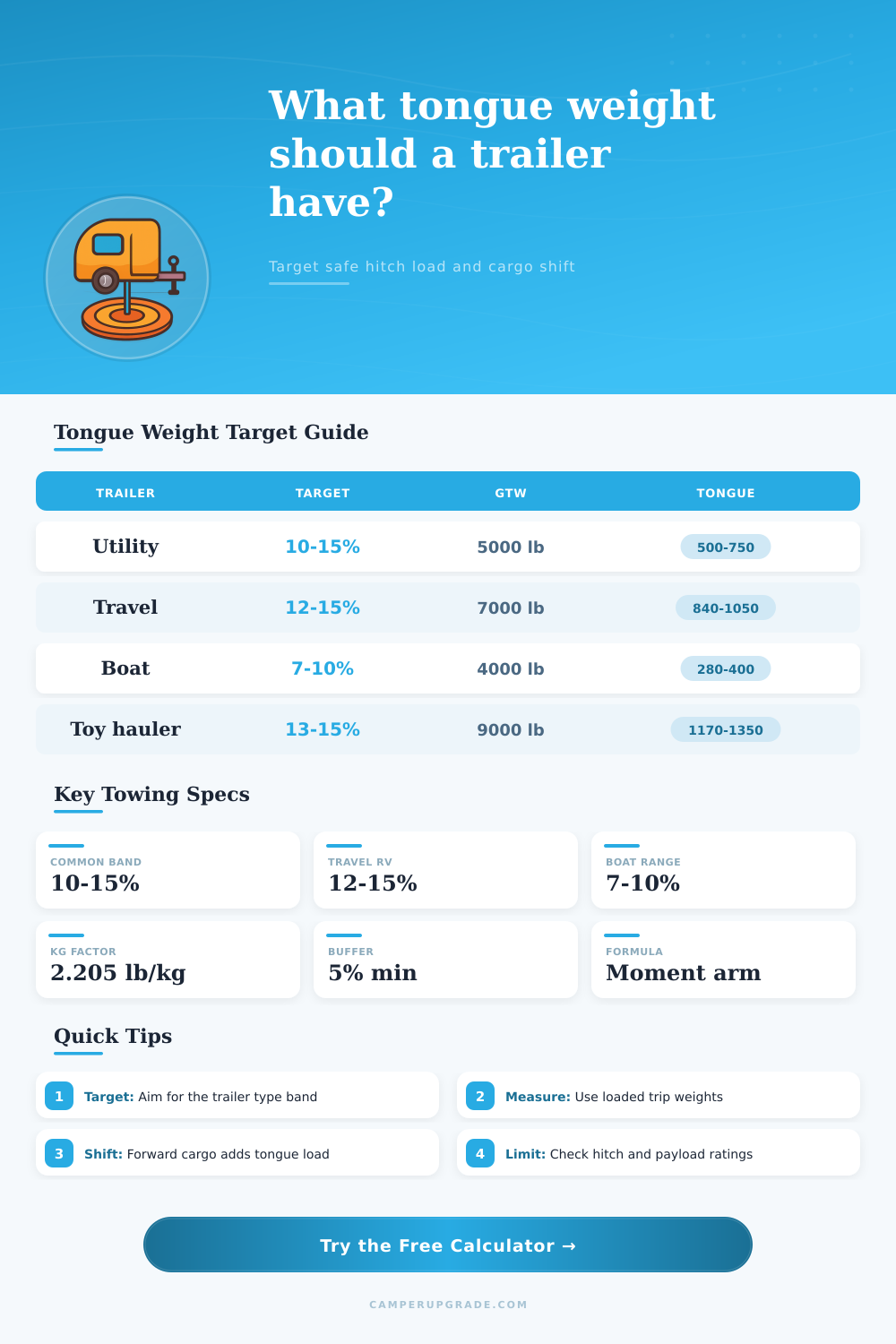
| Utility or cargo trailer | 10% to 15% | Reduces sway while avoiding overload | Keep dense cargo slightly forward of axle. |
| Travel trailer RV | 12% to 15% | Long body and high side area benefit from margin | Check with propane, battery, water, and trip cargo loaded. |
| Boat trailer | 7% to 10% | Engines often sit aft and hull supports carry differently | Adjust winch stop or axle position only within trailer limits. |
| Toy hauler | 13% to 15% | Rear garage cargo can unload the hitch | Measure loaded both with and without toys aboard. |
| Car hauler | 10% to 15% | Vehicle position strongly changes tongue load | Small fore-aft moves can make large changes. |
| Gross trailer weight | 10% | 12.5% | 15% |
|---|---|---|---|
| 2,000 lb / 907 kg | 200 lb | 250 lb | 300 lb |
| 3,500 lb / 1,588 kg | 350 lb | 438 lb | 525 lb |
| 5,000 lb / 2,268 kg | 500 lb | 625 lb | 750 lb |
| 7,000 lb / 3,175 kg | 700 lb | 875 lb | 1,050 lb |
| 10,000 lb / 4,536 kg | 1,000 lb | 1,250 lb | 1,500 lb |
| Cargo action | Moment sign | Tongue weight effect | Formula |
|---|---|---|---|
| Add cargo ahead of axle | Positive | Increases hitch load | TW change = W x D / L |
| Add cargo behind axle | Negative | Decreases hitch load | TW change = -W x D / L |
| Remove front cargo | Negative | Reduces hitch load | TW change = -W x D / L |
| Remove rear cargo | Positive | Raises hitch load | TW change = W x D / L |
| Move cargo forward | Positive | Adds tongue weight by distance moved | TW change = W x move / L |
| Measured condition | What to enter | Best source | Calculator use |
|---|---|---|---|
| Trailer gross weight | Loaded trailer weight | Commercial scale | Sets target tongue pounds. |
| Tongue scale reading | Current measured tongue weight | Tongue scale or scale method | Starting hitch load before changes. |
| Axle group center | Ball to axle distance | Tape measure | Moment arm denominator. |
| Water tank change | Net tank weight and position | Gallons x 8.34 lb | Models trip load changes. |
| Receiver limit | Tongue rating | Hitch label/manual | Capacity margin check. |
💡Tongue Weight Planning Tips
Tongue weights is the amount of downwards pressure that a trailer exert on the hitch of a towing vehicle. Maintaining the correct tongue weight are important for towing because the correct tongue weight ensure that the trailer remain stable while being towed. If the tongue weight is set to be too low, the trailer may begin to wander and sway behind the towing vehicle.
If the tongue weight is too high, the tow vehicle’s front end may be too light, which can make it difficult for a driver of the tow vehicle to steer and brake the vehicle. The target tongue weight for most trailers are between ten and fifteen percent of the total loaded weight of that trailer. Travel trailers typicaly have a tongue weight at the higher end of this range because travel trailers has long bodies with large side areas that provide areas for weight distribution that can make trailer travel trailers more sensitive to balance shifts.
How to Check and Adjust Trailer Tongue Weight
Boat trailers requires a tongue weight that is within the seven to ten percent range because the engine and hull of the boat are located towards the rear of the trailer. Additionally, trailers such as toy haulers or car trailers also typicaly require the tongue weight to be at the higher end of the range because the cargo that is loaded onto these trailers can significant reduce the tongue weight if it is placed in the rear of the trailer. In order to determine the tongue weight of a trailer, you must measure the tongue weight when the trailer is load with its total amount of cargo.
A measurement of tongue weight when the trailer is not loaded with any of its cargo will not provide an accurate measurement of the tongue weight of the trailer. The trailer tongue weight calculator included with this article will allow you to calculate the tongue weight of your trailer based off the loaded gross weight of the trailer, the current tongue weight of the trailer, and the distance from the hitch ball to the center of the trailer axle. Additionally, the trailer tongue weight calculator will display for you how the tongue weight will change if you move the cargo of the trailer, allowing you to adjust the placement of the trailers cargo to reach the target tongue weight.
The primary means of adjusting the tongue weight of a trailer is by moving the cargo of that trailer. If you move the trailers cargo to an area in the trailer ahead of the trailers axle, the tongue weight will increase. If you move the trailers cargo to an area behind the trailers axle, the tongue weight will decrease.
The change in tongue weight will be proportional to the distance moved by the cargo. Because moving a heavy object a small distance can change the tongue weight of a trailer, it is important to make sure that the placement of heavy objects are considered before the trailer is loaded with cargo. Of course, there are also weight limits that both the trailer and tow vehicle can endure.
For instance, there are limits to the amount of weight that the hitch of the tow vehicle, the ball mount, and the tow vehicle payload can endure. These limits are indicated on stickers on the tow vehicle and trailer. The trailer tongue weight calculator allows you to enter a safety buffer for each of these components.
Any tongue weight that is projected to reach the limits of these components will be flagged by the tongue weight calculator. Thus, while the tongue weight calculator helps to ensure that the tongue weight does not approach these limits, it does not replace the need to examine the stickers that is located on the tow vehicle and trailer. The weight of the water and fuel that is contained in the trailer can also impact the tongue weight of the trailer while the trailer is in motion on the road.
If the fresh water tank for the trailer is positioned in front of the trailer axle, the fresh water will add to the tongue weight of the trailer when the fresh water tank is filled with water. If the fresh water tank for the trailer is located behind the trailer axle, filling the fresh water tank will reduce the tongue weight of the trailer. Both of these variable can be entered into the tongue weight calculator for trailers that have fresh water tanks so that the tongue weight calculator can project the difference in tongue weight that will result from the fresh water tank becoming filled or partially emptied of water.
Many people makes the mistake of assuming that the tongue weight of their trailer is a constant number. However, the tongue weight is a variable number that can change based upon the changes of the trailers cargo. A trailer that may have the correct tongue weight with one type of load may have an incorrect tongue weight if, for instance, a generator is added to the trailer or if a spare tire is moved to the trailers rear.
It is important, therefore, to use a trailer tongue weight scale to ensure that the tongue weight remains within the proper range after making major changes to the trailers cargo. The tongue weight of a trailer should of been adjusted to ensure that the trailer tracks proper behind the tow vehicle while towing, yet in a manner that the steering of the tow vehicle is not vague or difficult. Thus, the correct tongue weight is that specific amount of downward pressure that ensure that the trailer, its cargo, and tow vehicle all functions properly together.