Trailer Tongue Length Calculator
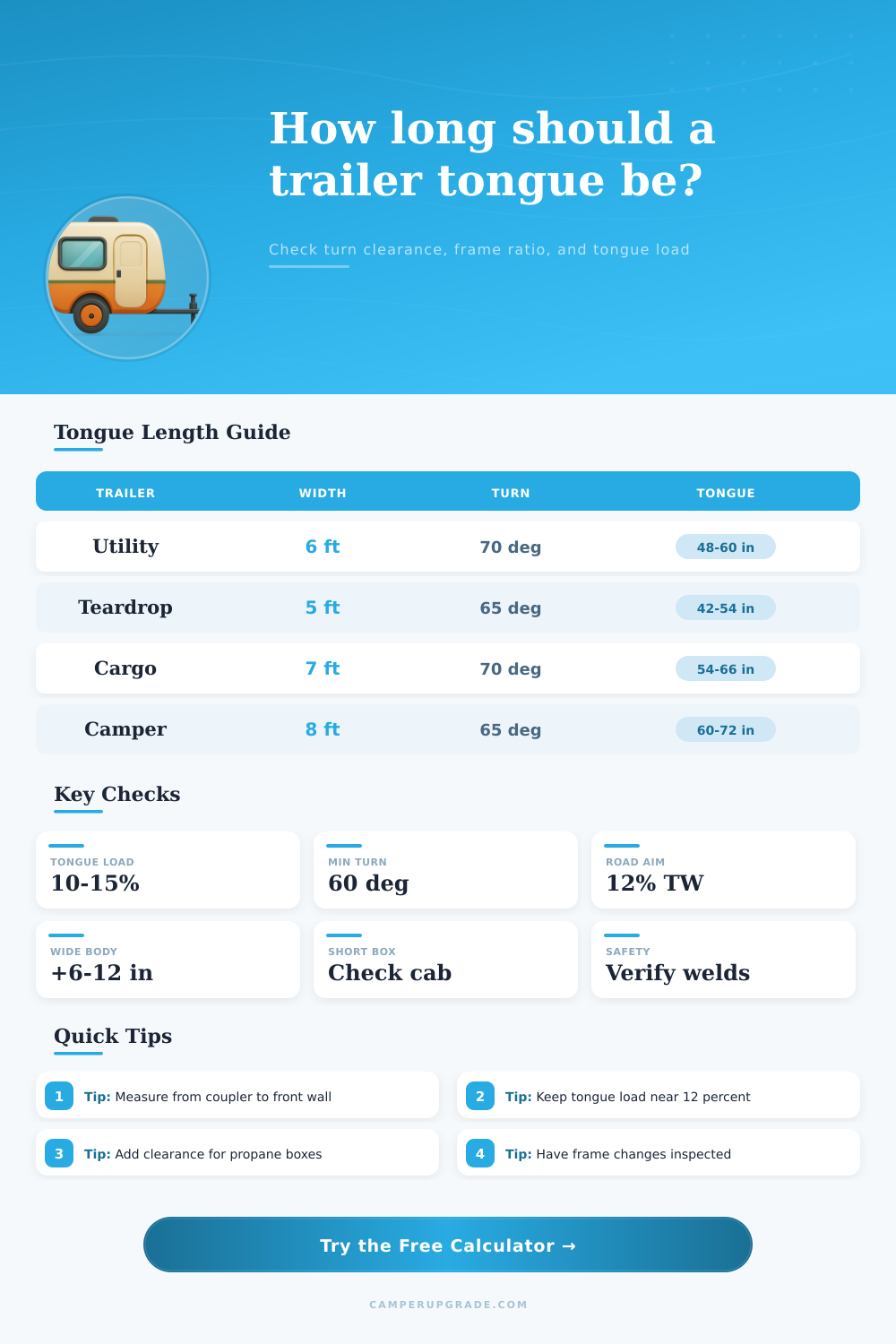
Estimate a practical coupler-to-front-wall tongue length from trailer size, desired jackknife angle, tow-vehicle clearance, tongue load, and frame style before you cut steel or move a coupler.
| Trailer body | Typical tongue | Use case | Watch point |
|---|---|---|---|
| 8 to 10 ft | 42 to 54 in | Teardrop, small utility | Short SUV hatch swing |
| 10 to 12 ft | 48 to 60 in | Utility, pop-up camper | Propane tray or jack |
| 12 to 14 ft | 54 to 66 in | Cargo or ATV trailer | Wide box front corners |
| 14 to 18 ft | 60 to 78 in | Flatbed, camper frame | Frame rail overlap |
| Width | 60 deg turn | 70 deg turn | 75 deg turn |
|---|---|---|---|
| 5 ft body | 37 in | 43 in | 47 in |
| 6 ft body | 43 in | 51 in | 56 in |
| 7 ft body | 49 in | 58 in | 64 in |
| 8 ft body | 55 in | 66 in | 73 in |
| Tongue load | Result | Handling clue | Adjustment |
|---|---|---|---|
| Under 8% | Too light | Sway risk rises | Move cargo forward |
| 10 to 12% | Good | Stable for many campers | Verify ratings |
| 12 to 15% | Strong | Often best for travel | Check payload |
| Over 15% | Heavy | Rear sag and overload risk | Shift load rearward |
| Frame style | Planning ratio | Rail overlap | Common note |
|---|---|---|---|
| A-frame | 38% body length | 1.5x tongue | Best for campers |
| Straight drawbar | 33% body length | 2.0x tongue | Light utility only |
| Extended off-road | 45% body length | 1.7x tongue | Better articulation |
| Boat trailer | 42% body length | Varies by hull | Ramp reach matters |
The length of the trailer tongues is another important measurement for trailers. The length of the trailer tongue impact the behavior of the trailer when turning, as well as when driving on a highway. The distance between the trailer coupler and the front wall of the trailer impact how much space the trailer have when jackniffing the trailer.
Additionally, the distance between those two component can also impact the way the trailer weight is distributed over each of the trailers axles. If the trailer tongue is too short, the trailer will not have enough clearance to jackknife the trailer. In contrast, if the trailer tongue is too long, the trailer may feel as though the trailer is steering the tow vehicle.
How to Choose the Right Trailer Tongue Length
Most trailers with body lengths between 15 and 40 feet will have trailer tongue lengths between one-third and one-half of the total body length of the trailer. Such a length for the trailer tongue is required to ensure that the trailer coupler is far enough from the trailer body to prevent the trailer from contacting the tow vehicle, as well as to ensure that the trailer tongue will have enough weight pressing down upon the hitch ball to prevent the trailer from deviating from a straight line while the trailer is in motion. To calculate the length of the tongue that should be incorporated into the trailer, specific measurements for the trailer must be provided into the calculator.
One of the measurements that is important is the width of the trailer. If the trailer is wider than others, it will make the trailer more likely to contact another object when turning. Additionally, the angle at which the trailer will turn is another measurement that must be provided to the calculator.
This angle will allow the calculator to determine the amount of space that the trailer need to turn within another area, such as a campground. Additionally, another important measurement for the trailer is the tow vehicle overhang. The overhang will determine how close the trailer body must stay to the tow vehicles bumper or tailgate.
Additionally, any projections for accessories for the trailer can also be included in these specifications. For instance, any batteries or propane tanks may extend out in front of the trailer, and they must not be within the path of the trailer body. The percentage for the tongue load is another important specification for the trailer.
For the trailer to be stable, the tongue load should be between 10 and 15%. If the tongue load percentage is too low, the trailer will tend to sway. Additionally, if the tongue load percentage is too high, the front wheels of the tow vehicle will become lifted from the ground.
The tongue load percentage will be used to calculate the trailer tongue length, and it is another specification that can be used to determine whether the trailers load is too heavy or too light. Additionally, the style of the trailer frame will impact the length of the trailer tongue. A trailer with an A-frame style frame will be able to distribute the trailers load over two rails, and thus is often used in the construction of trailers for campers.
Straight drawbar trailers will be lighter than trailers with A-frame trailers, but will require more length to provide enough bending strength to accommodate the load. Off-road trailers may have an extended tongue to allow for articulation between the trailer and the load over rough ground, but the extended tongue will contribute to the length of the trailer. The trailer tongue length calculator will adjust the trailer tongue length according to the trailer frame style that is selected.
Trailer tongue length calculations must be performed from the correct location on the trailer. If the length is measured from the wrong location, the length of the trailer tongue will be incorrect. Many individuals will make the mistake of measuring from the front of the trailer coupler instead of from the center of the hitch ball.
Additionally, if the trailer has a spare tire that extends past the front wall of the trailer, the length of that spare tire should be included in the trailer tongue length specification. Additionally, the safety buffer can be included in the trailer tongue length calculation. The safety buffer allows for allowance of the tow vehicles hitch and frame flex to ensure that the trailer will not dent the tow vehicles bumper or scrape its propane tank.
Trailer stability is achieved with the proper trailer tongue length, but other factors can contribute to instability. For instance, if the cargo that is loaded into the trailer is stacked too high, the trailer will tend to sway. Additionally, if the trailer axles are too far forward from the trailer coupler, the trailer can also exhibit swaying problems.
While the trailer tongue length calculator can calculate the ideal distance between the trailer coupler and the front wall of the trailer, there is no specification for where to place the trailer axles. Thus, an additional look at the trailer will be necesary to ensure that the trailer will remain stable while in use. Some trailer designs create other constraints upon tongue length.
For instance, short box trucks and SUVs may have a larger overhang from the rear of the trailer to the back of the tow vehicle. This distance is referred to as the rear overhang of the tow vehicle. The rear overhang includes the spare tire for the trailer and the tailgate of the tow vehicle.
The trailer tongue length calculation must take into account the rear overhang of the tow vehicle that will be used to tow the trailer. This allowance for length will ensure that the trailers corners do not contact the tow vehicle. Additionally, trailers that are used to tow boats has different requirements for tongue length calculations.
Boat trailers are required to have enough length for the trailer coupler to remain in contact with the tow vehicles hitch ball while the trailer is on a launch ramp and tilted to the side. The tables that are provided on the calculator may show the typical lengths of trailer tongue for trailers of specific lengths and for certain turn angles. These tables will allow an individual to ensure that the length that was calculated for the trailer is within a normal range.
If the trailer tongue length that is calculated is outside of the normal ranges, the specifications for the trailer will need to be double-checked. Additionally, since any alterations to the trailer frame are permanent once they are implemented into the trailer frame, the trailer tongue length calculator should of been used as a planning tool prior to beginning to cut the steel for the trailer frame.