Trailer Ramp Angle Calculator
Estimate ramp angle, grade, horizontal run, belly clearance, ramp load margin, and a better ramp length for campers, utility trailers, toy haulers, mowers, ATVs, UTVs, and low-clearance gear.
| Deck height | 6 ft ramp | 8 ft ramp | 10 ft ramp | 12 ft ramp |
|---|---|---|---|---|
| 18 in effective rise | 14.5 deg | 10.8 deg | 8.6 deg | 7.2 deg |
| 24 in effective rise | 19.5 deg | 14.5 deg | 11.5 deg | 9.6 deg |
| 30 in effective rise | 24.6 deg | 18.2 deg | 14.5 deg | 12.0 deg |
| 36 in effective rise | 30.0 deg | 22.0 deg | 17.5 deg | 14.5 deg |
| Loading job | Comfortable angle | Watch first | Typical ramp choice |
|---|---|---|---|
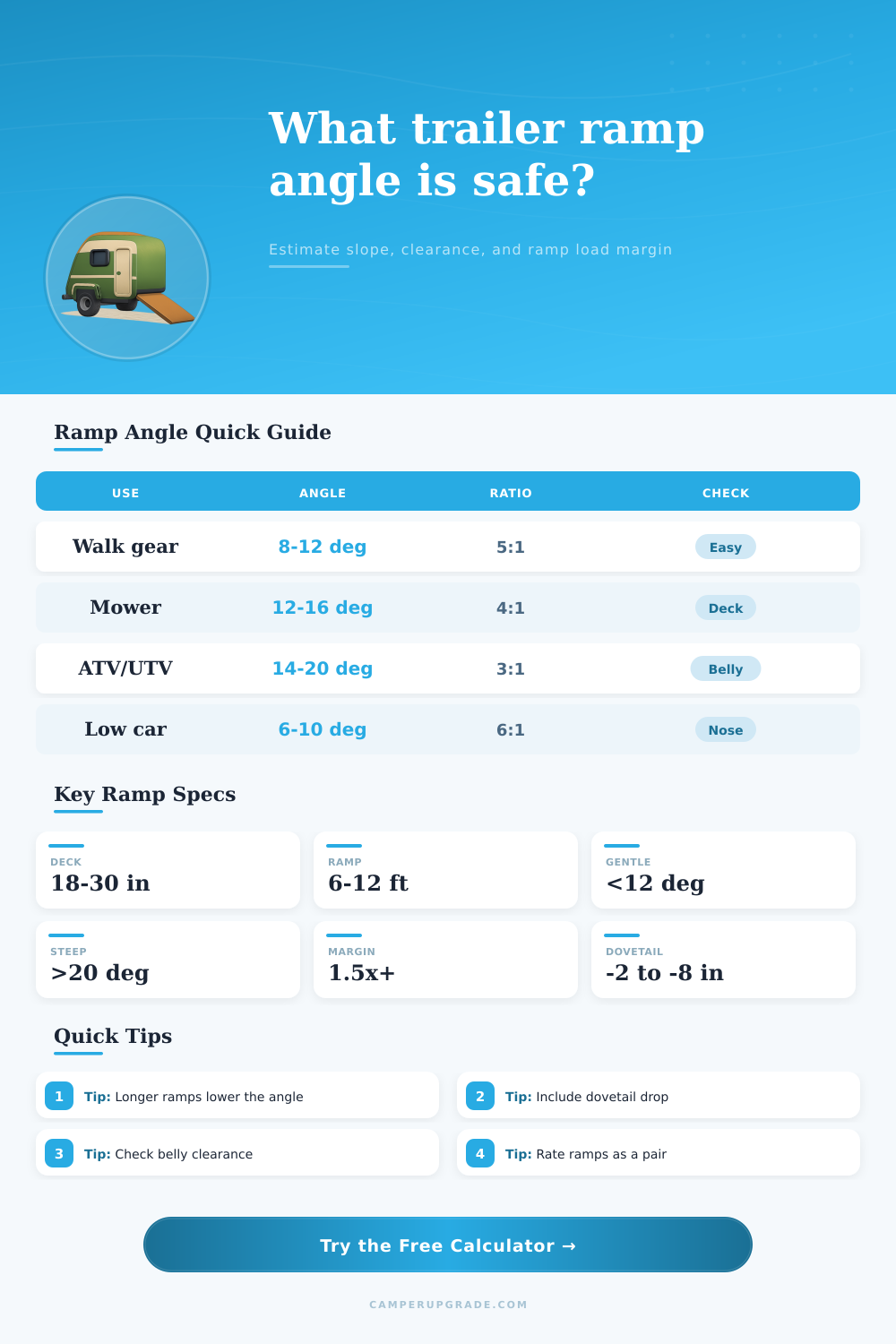
| Hand truck, cooler, generator | 8 to 12 deg | Foot traction and control | Long gate or portable ramp |
| Riding mower or garden tractor | 10 to 16 deg | Deck shell and rear hitch | 8 to 10 ft for 20 to 28 in decks |
| ATV or UTV | 14 to 20 deg | Belly skid and breakover | 7 to 10 ft with cleated traction |
| Low car or trike | 6 to 10 deg | Nose, exhaust, and rocker panels | 12 ft plus extensions if needed |
| Ramp surface | Strength note | Traction note | Best use |
|---|---|---|---|
| Aluminum serrated pair | Light for rating | Good dry bite, check mud | ATV, mower, light gear |
| Steel mesh gate | Heavy but durable | Good all-around grip | Utility trailers and tractors |
| Wood plank with cleats | Depends on span and lumber | Cleats help tires, wet wood slips | Occasional low-speed loading |
| Hydraulic ramp door | Use door rating label | Angle may be long and gentle | Toy haulers and cargo campers |
| Target angle | Rise 18 in | Rise 24 in | Rise 30 in | Use case |
|---|---|---|---|---|
| 8 deg | 10.8 ft | 14.4 ft | 18.0 ft | Very low clearance |
| 10 deg | 8.6 ft | 11.5 ft | 14.4 ft | Gentle walk-up |
| 12 deg | 7.2 ft | 9.6 ft | 12.1 ft | Mower-friendly |
| 15 deg | 5.8 ft | 7.7 ft | 9.7 ft | ATV and UTV range |
A trailer ramp angle calculator allow you to determine the ramp angle so you dont scrape your equipment while loading it onto a trailer. Many people will attempt to load there equipment without calculating the ramp angle. However, loading equipment without calculating the ramp angle can ultimataly lead to damage both the equipment and the trailer.
The ramp angle measurement depend on several variables that you must consider for safe loading of equipment. The first variable that you must consider is the trailer deck height. This is the distance from the ground to where the trailer ramp will be attach to the trailer.
How to Calculate Trailer Ramp Angle and Keep Your Equipment Safe
This measurement is essential as it will change the ramp angle. If the trailer deck height change, the ramp angle will change as well. The trailer ramp angle calculator consider both the trailer deck height and the length of the ramp to calculate the ramp angle.
The best way to determine this variable is to measure the deck height of your trailer. Different trailer will have different measurements for deck height. The second variable that will ultimataly change the ramp angle is the dovetail drop.
Many trailers will have a dovetail drop, which is a lowered section at the rear of the trailer. This will ultimately make the ramp less steeper. Additionally, the ground elevation where the ramp foot will be placed will ultimately play a role in the ramp angle.
If the ramp foot is placed into a dip in the ground, this will ultimately increase the ramp angle due to the increase in the trailer deck height. If the ramp foot is placed onto a curb or another raised portion of the ground, this will also increase the trailer ramp angle due to the increase in the trailers deck height. The third variable is the ground clearance of the equipment you are loading onto the trailer.
Ground clearance is the distance between the equipment and the ground. You will need to determine the ground clearance of your equipment. This will help you to determine whether or not your equipment will scrape the trailer ramp.
The trailer ramp angle calculator will allow you to input the ground clearance of your equipment. This will help with the comparison between the ground clearance of your equipment and the ramp angle. The fourth variable to consider when calculating the trailer ramp angle is the load rating of the ramps.
The load rating is the maximum amount of weight that the ramps can hold. You must consider a safety factor when determining the load rating of the ramps. A safety factor of 1.5x is normally use because this will account for the bounce of the wheels as they are loaded onto the trailer ramp.
Use a higher safety factor for wet trailer ramps or if you are loading the trailers equipment alone. Finally, the material of the ramps will ultimately play a role in the loading of your equipment. The different material options for trailers include aluminum ramps, wood ramps, and steel mesh ramps.
Aluminum ramps offer good traction, but they can become slippery when wet. Wooden ramps can provide good traction with cleats on the ramps; however, if the ramps get damp, they will not offer the same traction. Steel mesh ramps will ultimately be the most durable but will ultimately be the more heavist of the ramp options.
The trailer ramp angle calculator will not determine the material of the ramps, but it will allow you to determine if the ramp angle is steep enough to make the material of the ramps an issue for your equipment traction. Common mistakes for individuals using trailer ramp angle calculators include not measuring the dimensions correctly. For instance, measuring the height of the trailer gate instead of the height of the trailers deck.
Another mistake is to forget the elevation of the ground where the ramp foot is located. If you make these mistakes with determining the dimensions, the ramp angle will ultimately be calculate incorrectly. The incorrect calculation can ultimately result in your equipment scraping the trailer.
The reference tables included with the trailer ramp angle calculator will ultimately help you determine how different dimension of the trailer and the ramp will impact the ramp angle. These tables will allow you to compare the different types of ramps out there before purchasing your own set of ramps. Use this trailer ramp angle calculator to help you avoid the guesswork in loading your trailer.
This trailer ramp angle calculator will provide you with the mathematical data to make your decisions regarding the ramp and the ground clearance of your equipment.