Trailer Overhang Percentage Calculator
Estimate rear overhang percent, turning tail swing, load center effect, and axle load shift for utility, camper, cargo, boat, and toy-hauler trailers.
Dimensions convert in place when units change.
Measure the usable body or deck, not the tongue.
For tandem axles, measure to the midpoint between axles.
Distance from axle group center to the rear edge.
Distance from front of body to hitch ball center.
Center of the item or cargo group being added.
Used for axle and hitch reaction estimates.
Loaded or estimated trailer weight before this added load.
Use your builder, chassis, or local rule when known.
A larger angle estimates a tighter turn or sharper backing move.
Compare against tail swing near posts, walls, and campsite edges.
Overhang And Balance Results
8-14%
Compact campers and teardrops often land here when the axle is set rearward.
10-18%
Utility, cargo, and toy trailers commonly use this working range.
18-22%
Longer rear deck space increases tail swing and should be checked carefully.
22%+
High rear overhang needs closer review of structure, clearance, and load placement.
| Trailer Type | Typical Rear Overhang | Good Measuring Practice | Watch Point |
|---|---|---|---|
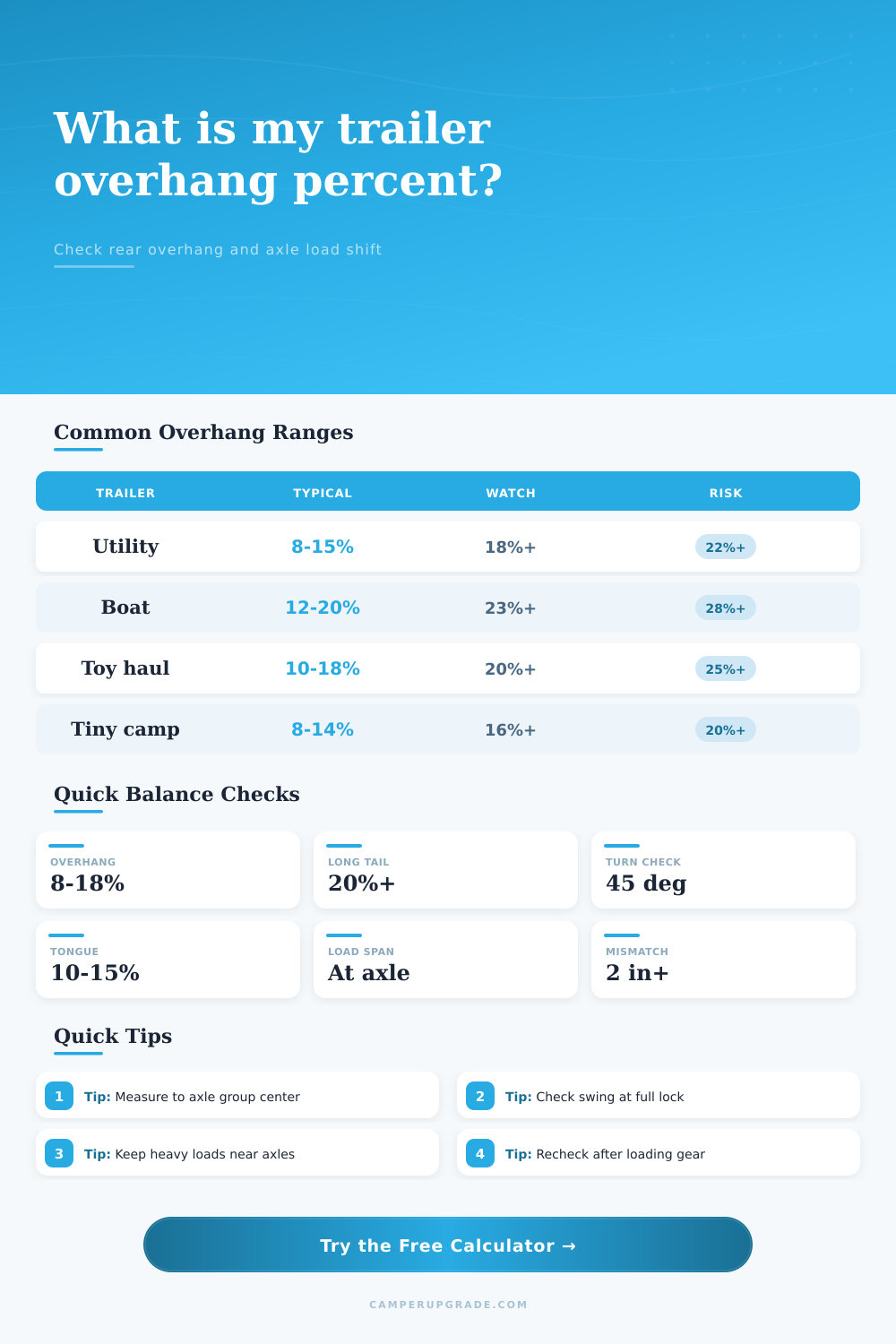
| Small camper or teardrop | 8% to 14% of body length | Measure to the rear body edge, bumper included only if it carries structure. | Rear kitchen boxes can move the load center behind the axle. |
| Open utility trailer | 10% to 18% of deck length | Use the deck front as zero and the axle group midpoint as the support point. | Ramp gates add rear mass and may increase tail swing needs. |
| Boat trailer | 12% to 20% of supported hull length | Use the rear-most supported transom or roller location for the rear reference. | Engine weight can create a rear-biased load center. |
| Toy hauler or cargo conversion | 10% to 18% of body length | Check both empty and loaded with the carried item in travel position. | Rear garage cargo can reduce tongue reaction quickly. |
| Rear Overhang | 30 Deg Turn Swing | 45 Deg Turn Swing | 60 Deg Turn Swing |
|---|---|---|---|
| 2 ft | 1.0 ft | 1.4 ft | 1.7 ft |
| 3 ft | 1.5 ft | 2.1 ft | 2.6 ft |
| 4 ft | 2.0 ft | 2.8 ft | 3.5 ft |
| 5 ft | 2.5 ft | 3.5 ft | 4.3 ft |
| 6 ft | 3.0 ft | 4.2 ft | 5.2 ft |
| Load Center Position | Hitch Reaction | Axle Reaction | Balance Meaning |
|---|---|---|---|
| Ahead of axle group | Increases | Less than full added load | Usually supports tongue weight but still check rating limits. |
| At axle group center | Little change | About full added load | Often stable for dense gear when axle capacity allows it. |
| Behind axle group | Decreases | More than full added load | Can lighten the hitch and increase sway risk. |
| Far behind axle group | May become negative | Load is amplified at axle | Reposition cargo or review the chassis layout. |
| Measurement | Reference Point | Common Error | Calculator Use |
|---|---|---|---|
| Trailer length | Front of body to rear edge | Including the tongue in body length | Forms the overhang percentage denominator. |
| Axle group center | Midpoint of all axle contact lines | Measuring to the front axle only | Sets the lever arm for load shift. |
| Rear overhang | Axle group center to rear edge | Measuring from the rear tire edge | Drives percent and tail swing results. |
| Load center | Center of added item or cargo group | Using the front edge of a load | Estimates hitch and axle reaction changes. |
We’ve all done it: you back up a trailer in a narrow driveway and, as you turn around, the back end swings out and hits a fence post. If you’ve ever towed, it’s one of those rites of passage. The problem isn’t necessarily our inability to drive well.
The problem is often the geometry, namely, the ratio of your trailer’s rear overhang to its total body length. That ratio will tell you how much space the tail require to clear corners. It will also show how weight is loaded on the trailer. It shows if the weight are placed forward or backward from the axles.
Why Trailer Overhang Matters for Safe Towing
Wrong? The trailer feel heavy and slow. Right? The trailer feels like an extension of the truck.
With those dimensions plugged in, the calculator will do the math. No need to guess at load shift and lever arm stuff. It takes meat and potatoes and turns it into a percentage for you. Which percentage lets you know how your particular rig stacks up to the norm.
First you enter total length of body or deck you can use. Pay close attention here. Don’t count the tongue in that number. The tongue is part of the steering mechanism and is not part of the load platform.
Next, you indicate the location of the axle group. For single axle rigs this isn’t an issue but if your rig has tandem axles mark out the middle between them. That’s your fulcrum. That central point act as the fulcrum for your entire load.
From there back to the rear edge is what we call overhang. Divide the overhang by the total length and that will give you the percentage. This is your starting place for safety and handling concerns.
Weight tends to be farther forward when the percentage is lower. This results in greater downward force on the hitch. This stabilizes the tow vehicle, but it also results in less cargo carrying capacity behind the axle.
The higher the overhang percent, the bigger boat and/or equipment deck in back. There is more room for stuff. But it increases the risk of the tail swinging out and reduces tongue weight.
But there are two big issues with high overhangs. Number one: when turning, the tail swings out wildly. You don’t even need much of an angle to gain several feet of clearance required.
Number two: the farther the weight moves past the axles, the less tongue weight there will be. If your tongue weight get too light, your trailer is now prone to sway. The trailer will fishtail because there is no firm pull from the tow vehicle.
The chart on the page spells it out nicely. It illustrates where each type of trailer has its sweet spot. The structure hangs over.
Utility and cargo trailers are better off with an overhang between 10% and 18%. Why? This is because it is still manageable for the vehicle’s center of gravity. And secondly, because that leaves some usable area behind the axles.
Toy haulers and boats tend to sway more sometimes, up to 20%, because they are stiff and long loads. Still, there’s a ceiling. Past 22%, you’re entering a dangerous zone that requires careful thought when loading. You can’t simply stack whatever wherever you want. Heavier items must be placed near the axle group on purpose.
The calculator shows you how much weight is shifting from the hitch to the axles, whether or not what you have is lightening the hitch too much. The other thing to consider is the estimated tail swing based off their tool based on the angle of the turn. Maybe you have tight driveways or parking spaces where that four foot overhang suddenly becomes a six-foot requirement laterally to complete the turn in safety. And most folks just don’t think about it. They only measure the straight-line distance without considering the turn.
The tool factors in the math of it all, so you can understand what you’re up against before scraping your paint job off the asphalt. It’ll let you know if you should of shift some weight to the front near the axle. Or maybe pull some gear forward. A little goes a long way toward improving the ride.
Overall, this is a well-balanced trailer that parks easily and rides quietly down the road. Tracks true with no constant corrections. Doesn’t resist the direction it’s being steered.
You should definitely check your overhang percentage. This is not only because you’ll tear up fences, but because it will ensure the physics work for you rather than against you. Measure it carefully, put the numbers into the formula, and believe the math. Every trip will be easier when you’re hauling a balanced load.