Trailer Length For Wheelbase Calculator
Compare wheelbase, trailer length, rear overhang, hitch setup, tongue weight, and sway conditions before choosing a towing combination.
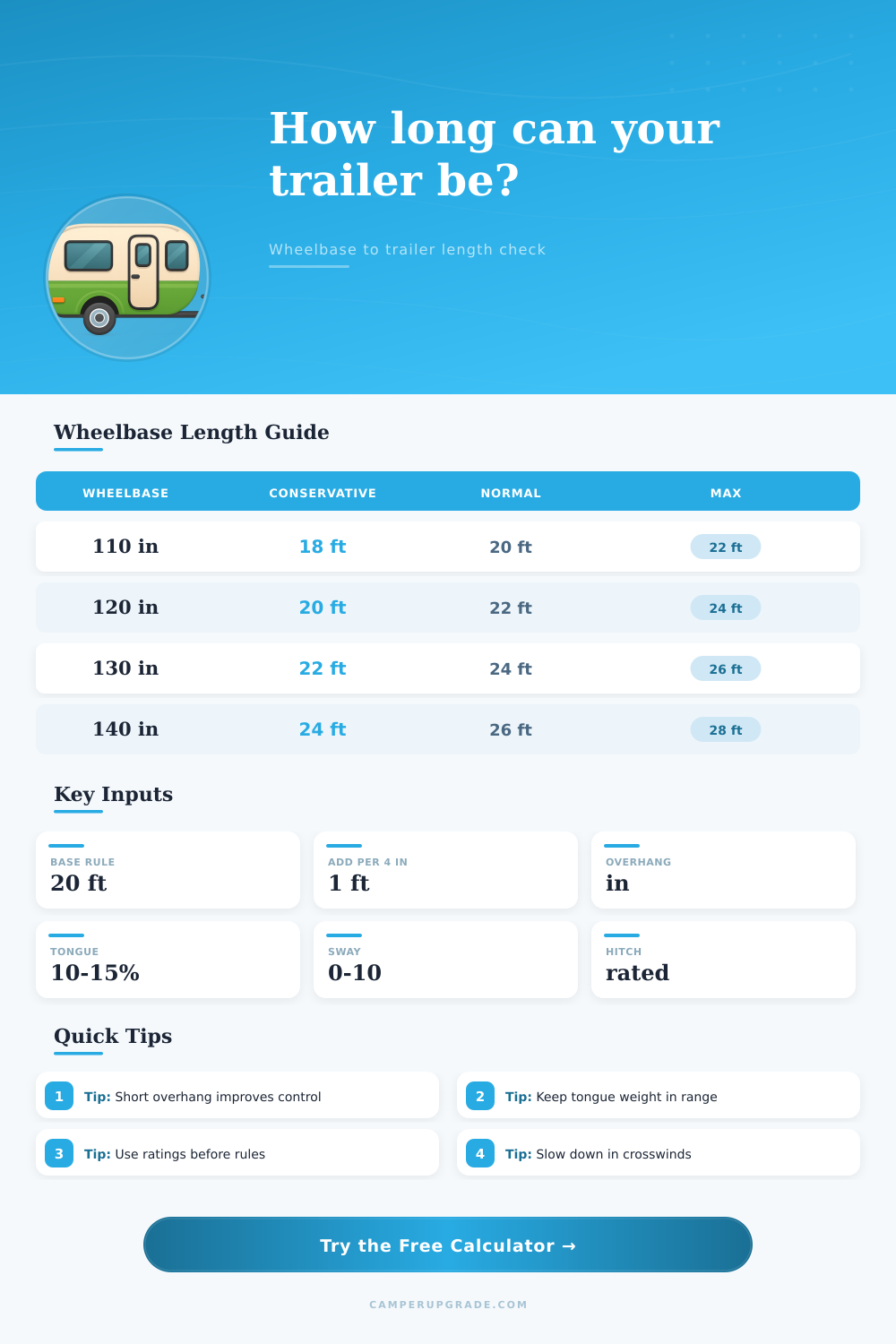
| Wheelbase | Conservative Length | Typical Upper Length | High Attention Zone |
|---|---|---|---|
| 100-109 in | 16-18 ft | 19-20 ft | Over 20 ft |
| 110-119 in | 18-20 ft | 21-22 ft | Over 22 ft |
| 120-129 in | 20-22 ft | 23-24 ft | Over 24 ft |
| 130-139 in | 22-24 ft | 25-26 ft | Over 26 ft |
| 140-149 in | 24-26 ft | 27-28 ft | Over 28 ft |
| 150-159 in | 26-28 ft | 29-30 ft | Over 30 ft |
| 160-169 in | 28-30 ft | 31-32 ft | Over 32 ft |
Based on the common 110-inch wheelbase for 20 feet of trailer, plus about 1 foot for every added 4 inches of wheelbase.
| Rear Overhang Ratio | Example | Handling Effect | Calculator Modifier |
|---|---|---|---|
| Under 28% | 40 in on 145 in | Short lever | No penalty |
| 28-33% | 46 in on 145 in | Normal pickup range | Small caution |
| 34-39% | 54 in on 145 in | More yaw leverage | Moderate penalty |
| 40% or more | 60 in on 145 in | Strong lever | Large penalty |
| Hitch Setup | Best Use | Length Help | Notes |
|---|---|---|---|
| Basic ball mount | Short, light trailers | None | Least sway resistance |
| Friction sway control | Moderate lengths | Small | Helps damping |
| Weight distribution | Tongue-heavy travel trailers | Moderate | Restores axle balance |
| Integrated sway WDH | Longer bumper pulls | Strong | Best common RV setup |
| Fifth-wheel/gooseneck | Bed-mounted tow point | Strong | Different geometry |
| Loaded Tongue % | Condition | Likely Feel | Action |
|---|---|---|---|
| Under 10% | Light tongue | Sway prone | Move load forward |
| 10-12% | Lower target | Often stable | Verify scale weight |
| 12-15% | Strong target | Planted feel | Check payload |
| Over 15% | Heavy tongue | Payload strain | Confirm axle ratings |
When towing a trailer behind a truck, there are many factor to consider. While it is essential to consider the horsepower a truck can provide or the load rating for trailer receivers, the length of the trailer relative to the wheelbase of the towing truck is what will have the most significant bearing on your towing performance. The wheelbase of a truck are the distance from the center of the front axle to the center of the rear axle of the truck.
The longer the wheelbase, the more stabley the truck will be when towing and the further it will be able to handle a trailer of increased length. The rear overhang of a truck is the distance from the rear axle of the truck to its hitch ball. This overhang, like a lever, will amplify the movement of the trailer back into the truck if it is too long relative to the trucks wheelbase.
Why Trailer Length Matters When Towing
Measuring the rear overhang and hitch extensions will reveal how far the trailer’s pivot point is from the rear tire of the towing truck. The tongue weight of the trailer will also have a bearing on how the trailer will follow the towing truck. Tongue weight should of be between ten and fifteen percent of the loaded weight of the trailer.
If the tongue weight is less than ten percent, the trailer may feel light and unstable in side wind. If the tongue weight is more than fifteen percent on a conventional bumper pull hitch, the trailer will overload the rear axle or tow vehicle’s receiver. The hitch used to tow the trailer will also change the truck and trailer’s dynamic.
A basic ball mount will provide the least amount of resistance to trailer sway. Using a weight distribution hitch will dampen the trailer’s movement and allow for better control of trailers of increased length. Fifth-wheel and gooseneck trailers allow the trailer’s pivot point to be moved into the towing truck’s bed.
By moving the trailer’s point of pivot into the towing vehicle, a fifth-wheel hitch or a gooseneck hitch allows for towing of trailers of increased length on the same wheelbase as the truck. The route to be towed and how you will load the trailer will also impact trailer stability. A trailer may be stable on a highway but challenging on a mountain grade or in crosswinds.
Loading the trailer with cargo in the rear will shift the trailer’s center of gravity. The shift in trailer’s center of gravity will create a longer lever for the hitch to manage. Using the sway factor input on the trailer towing calculator can take into account such variables.
Another consideration when towing is the tow ratings of the truck. The tow rating will specify the maximum load the truck can tow. However, the trailer length considerations will dictate the towing truck’s behavior when towing the trailer.
While the tow ratings will tell you what the truck can tow, the length of the trailer will show you how it will behave while towing the trailer. Both specification should be checked before towing. When measuring the trailer, use the length of the trailer’s body instead of the distance from the bumper of the trailer to the bumper of the truck.
The length measurement of the trailer body is the one the trailer tow calculator will use to determine the trailer’s maximum tow length. The spare tire and ladder on the trailer dont impact the trailer’s distribution of its mass. Including such measurements will throw off the trailer tow calculator’s tow length estimation.
The tables that shows the various lengths of trailer relative to the length of the truck’s wheelbase will provide a general idea of where your truck and trailer sit in respect to towing. Based off the values entered into the towing trailer calculator, there will be an adjusted maximum trailer length that the truck can tow and a ratio score for the trailer and truck’s tow capacity. The verdict will tell you if your truck and trailer have a comfortable margin for tow, a borderline tow, or if the tow is beyond the capability of your truck and trailer combination.
If your trailer and truck have a comfortable margin for tow, they will have allowances for unexpected tow challenges. If the calculator shows that your truck and trailer are on the edge of the tow capacity, you may have to adjust the length of the trailer or the hitch used to tow the trailer.