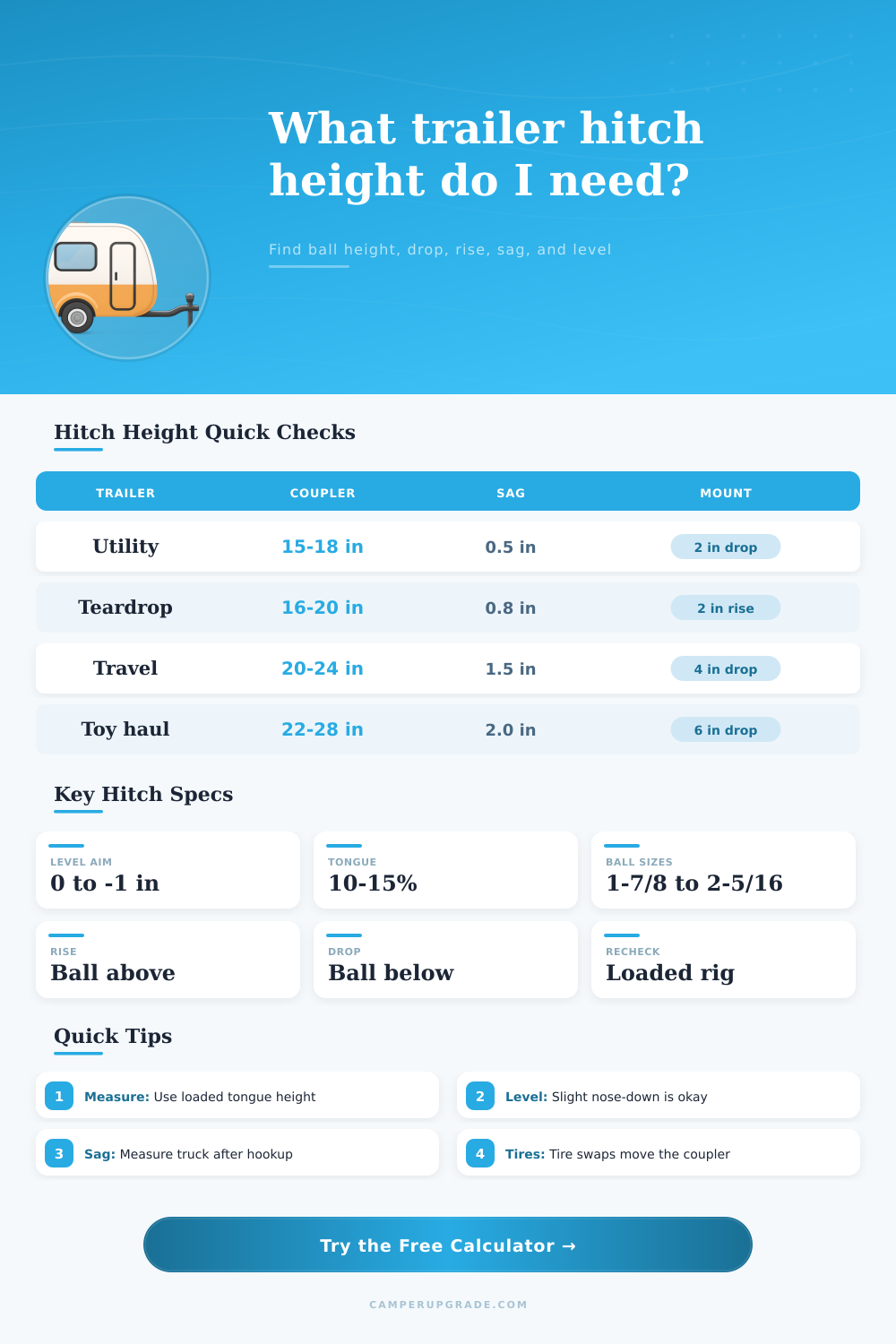
Trailer Hitch Height Calculator
Estimate the ball mount drop or rise needed to tow a camper, utility trailer, boat trailer, or toy hauler level after receiver height, coupler height, frame angle, tire size, load sag, and preferred nose attitude are included.
| Trailer style | Typical level coupler | Common receiver | Likely mount |
|---|---|---|---|
| Small utility trailer | 15-18 in | 17-20 in | 0-3 in drop |
| Teardrop camper | 16-20 in | 15-22 in | 2 in rise to 4 in drop |
| Pop-up camper | 17-21 in | 18-22 in | 0-4 in drop |
| Travel trailer | 20-24 in | 18-25 in | 2-6 in drop or adjustable |
| Lifted/off-road trailer | 22-30 in | 18-30 in | Adjustable rise/drop mount |
| Drop or rise need | Mount label | Use case | Check before towing |
|---|---|---|---|
| -6 to -4 in | 4-6 in drop | Tall receiver with normal camper | Tailgate and jack clearance |
| -3 to -1 in | 2-3 in drop | Most SUVs and half-ton trucks | Ball platform rating |
| -0.5 to +0.5 in | Level mount | Receiver and coupler already close | Loaded sag after hookup |
| +1 to +3 in | 2-3 in rise | Low receiver or taller trailer tires | Safety chain angle |
| +4 in or more | Adjustable rise | Lifted trailer or low vehicle | Shank, pin, and coupler ratings |
| Measurement | Where to measure | Use in formula | Common mistake |
|---|---|---|---|
| Receiver height | Ground to inside top of receiver | Loaded receiver baseline | Measuring to bumper trim |
| Coupler height | Ground to top inside coupler socket | Target ball height | Measuring to coupler outside top |
| Trailer frame angle | Frame rail angle while parked | Level-height correction | Using driveway slope as trailer angle |
| Tire diameter | Old and current trailer tire diameter | Half diameter change | Ignoring larger tire swaps |
| Vehicle sag | Receiver drop after trailer is on ball | Drop/rise after load | Sizing from unloaded truck only |
| Loaded stance | Result clue | Handling risk | Correction path |
|---|---|---|---|
| Nose-high trailer | Rear axle carries less share | Sway and light tongue feel | More drop or load forward |
| Level trailer | Frame rail parallel to ground | Best baseline | Confirm tongue percentage |
| Slight nose-down | Front of trailer 0-1 in lower | Usually acceptable | Check ground clearance |
| Excess nose-down | Coupler much lower than level | Front axle overload on tandems | Less drop or adjust shank |
| Truck sagging hard | Receiver drops over 2 in | Headlight aim and steering loss | Redistribute load or use WDH |
In order to ensure that a trailer sit level behind a truck, an individual must calculate the hitch height that is necessary to achieve that goal. A trailer may not sit level due to the fact that the rear of the trucks may drop under the load of the tongue weight of the trailer. Additionally, the trailer itself may not sit level due to the trailer frame itself sitting at an angle.
Additionally, it is possible that the trailer itself dropped in relation to the coupler due to the fact that new tire on the trailer have changed the height of the coupler. Each of these factor must be considered in order to determine if a drop hitch, rise shank, or adjustable mount is necessary for the trailer. One of the main measurements that are required of an individual is the measurement of the receiver height.
How to Measure Hitch Height to Keep Your Trailer Level
An individual measures the receiver height from the ground to the inside of the receiver tube of the trailer prior to attaching the trailer to the truck. However, the height of the receiver can change once the trailer is loaded and its tongue weight settles upon the hitch of the trailer. Thus, it is necessary to account for the sagging of the truck due to the tongue weight of the trailer.
The next of the important measurements is the height of the coupler on the trailer. This measurement is important for determining if the trailer will sit level when towed by the truck. However, this measurement can only be taken when the trailer is level.
Many individual make the mistake of taking this measurement while the trailer is resting upon a tongue jack, additionally another mistake is to take this measurement while the trailer is resting in an angled position. If the trailer is not level, the coupler height will not accurately reflect the true height of the coupler when the trailer is in use. Thus, it is necessary for an individual to know the distance from the coupler to the trailer axle, as well as the attitude of the trailer when towed (whether it is nose-high or nose-low) to determine the coupler height that is required to ensure that the trailer will remain level.
Another factor that can play into the height of the trailer is the diameter of the trailer’s tires. If an individual changes the trailer’s original tires for new tires, the new tires may impact the height of the trailer. If the trailer’s tires are taller then the original tires of the trailer, then the coupler of the trailer will rise.
The coupler will rise by half the difference in the diameter of the tires. For example, if the trailer’s new tires are larger in diameter than the original tires of the trailer, then the coupler will rise in height. Thus, it is important to include the tire diameter in a trailer hitch height calculator prior to purchasing hitch hardware for the trailer.
Another factor that an individual can consider is the attitude of the trailer. Ideally, the trailer should have a level trailer frame. However, some individuals may prefer to have the trailer with a slight attitude that is nose-down.
A trailer that is nose-down will help to counteract trailer sway when passing other large vehicles on the highway. Thus, it is important for an individual to establish a preferred trailer attitude prior to calculating the height of the trailer ball. Tongue weight is another measurement that is important in determining the stability and sagging of both the trailer and the truck.
For trailers that are pulled by a bumper, the tongue weight should be between 10% and 15% of the loaded weight of the trailer. If the tongue weight is less than 10% of the loaded weight of the trailer, the trailer may appear to be unstable when being towed by the truck. If the tongue weight is more than 15% of the loaded weight of the trailer, the trailer will cause the rear of the truck to sag.
Additionally, if the trailer causes the rear of the truck to sag excessively, the trucks headlights may aim too high at the highway. Thus, it is important to consider the tongue weight of the trailer prior to purchasing hitch hardware. Not all trailers will have the same requirements for hitch drop.
For instance, small trailers that are used for utility purposes may not require any drop hitch hardware. In contrast, trailers used for camping purposes may require a hitch drop of between 2 and 6 inch. Additionally, trailers that are used for camping with sleeping accommodations may require even more drop hitch hardware due to the weight that the trailer must support.
In addition to the measurements that have been discussed, an individual may want to consider other factors that may impact the trailer and truck rig. For instance, factors like the wind, the crown of the road, and the shifting weight of the trailer can all impact the rig in operation. Additionally, the weight of the fuel that is within the truck can impact the way the truck sits.
Thus, it may be beneficial to re-adjust the trailer hitch hardware after traveling a long distance or after changing the weight of the trailer or its tires. In addition to the other factors, it is also important to ensure that there is enough clearance for the trailer’s coupler to properly function. For instance, it is necessary for the trailer’s coupler to allow for the coupler latch to open and close, for the safety chains to allow for the trailer to be secured to the hitch, and for the trailer’s tailgate or spare tire to not hit the trailer itself while making turns.
Another consideration for hitch hardware is the size of the trailer ball. For trailers that are used for hauling light goods and equipment, a one-and-seven-eighths-inch ball may be appropriate. For trailers that are smaller in size and for camping trailers or boats, an individual may use a two-inch ball.
For trailers that are more heavily loaded, a two-and-five-sixteenths-inch ball will be required to ensure that the trailer will not fall off of the truck. Ultimately, all of these measurements must be taken into consideration in order to create a trailer and truck rig that is both stable and allows for the truck’s headlights to be aimed correctly. Each of these factor will ensure that the hitch hardware that is purchased for the trailer will remain within its rated limits.
When all of the factors are considered and accounted for, the trailer will remain level and the truck will remain stable in relation to the trailer when traveling at highway speeds. Its actualy a lot of work, but you should of done it early.