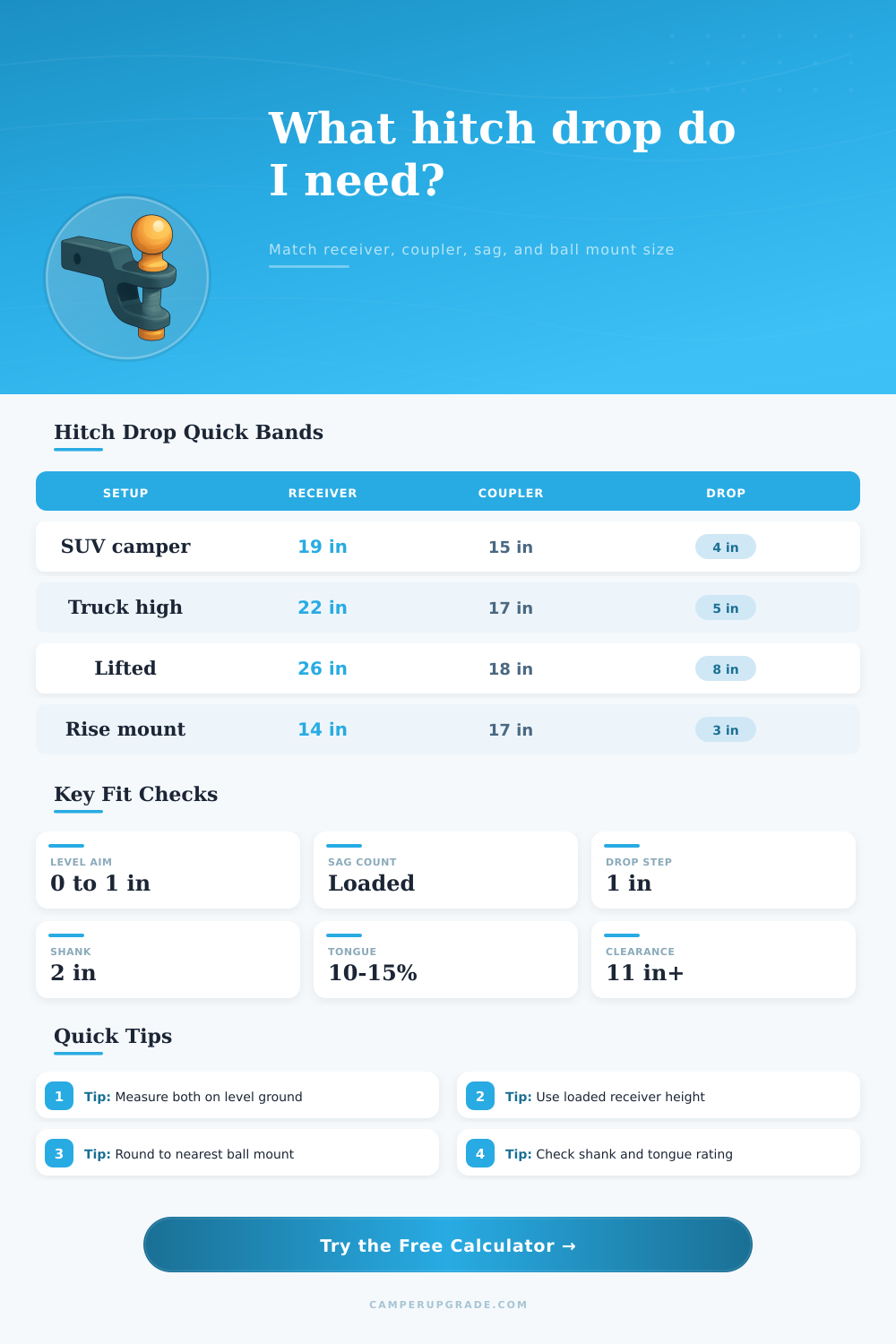
Trailer Hitch Drop Calculator
Find the ball mount drop or rise needed to level a trailer by comparing loaded receiver height, level coupler height, ball height, suspension sag, tongue weight, and ground clearance.
| Loaded receiver vs coupler | Mount direction | Typical mount label | Fit note |
|---|---|---|---|
| Receiver 1-2 in higher | Drop | 1-2 in drop | Often seen on crossovers and small campers. |
| Receiver 3-4 in higher | Drop | 3-4 in drop | Common half-ton truck and travel trailer pairing. |
| Receiver 5-6 in higher | Drop | 5-6 in drop | Check driveway clearance at the bottom of the shank. |
| Receiver 7-10 in higher | Drop | Adjustable drop | Lifted trucks usually need a rated adjustable mount. |
| Receiver lower than coupler | Rise | 2-6 in rise | Confirm the mount is approved for rise orientation. |
| Trailer type | Typical coupler height | Typical receiver height | Usual ball mount |
|---|---|---|---|
| Small utility trailer | 13-16 in | 16-20 in | 2-4 in drop |
| Pop-up camper | 14-17 in | 17-21 in | 2-5 in drop |
| Travel trailer | 17-21 in | 19-24 in | 2-6 in drop |
| Boat trailer | 16-20 in | 18-23 in | 2-5 in drop |
| Off-road teardrop | 19-23 in | 18-26 in | rise to 6 in drop |
| Tongue weight | Soft SUV sag | Half-ton sag | HD truck sag |
|---|---|---|---|
| 250 lb | 0.8-1.3 in | 0.4-0.7 in | 0.2-0.4 in |
| 500 lb | 1.6-2.6 in | 0.8-1.4 in | 0.4-0.8 in |
| 750 lb | 2.4-3.8 in | 1.2-2.0 in | 0.6-1.2 in |
| 1000 lb | 3.2-5.0 in | 1.6-2.7 in | 0.8-1.6 in |
| With WDH | Measure actual | Usually less | Usually less |
| Receiver shank | Typical use | Common tongue range | Drop caution |
|---|---|---|---|
| 1.25 in | Light cargo and small utility | 100-350 lb | Avoid long deep-drop mounts unless rated. |
| 2 in | Most campers, boats, utility | 350-1000 lb | Check both receiver and ball mount labels. |
| 2.5 in | Heavy travel trailers | 800-1800 lb | Reducer sleeves can lower the practical rating. |
| 3 in | Commercial HD towing | 1200 lb and up | Use matched hardware and pin diameter. |
| Adjustable mount | Multiple trailers | Model specific | Confirm the rating at the selected drop hole. |
When a trailer is hooked up to a tow vehicle, the rear end of the tow vehicle will compress and the front end will rise. The towing of a trailer impacts the way that the trailer travels, as well as the function of the trailer brakes. Therefore, the trailer must be equipped with the correct ball mount drop or rise to allow for the trailer to move in a straight line while maintaining even trailer brakes.
Incorrect ball mount heights may cause the trailer to scrape against curb, or may cause the trailer to sag either below or above the tow vehicle. Thus, measuring the ball mount height is a necessary step prior to towing the trailer. You must measure ball mount height by taking two specific measurements of the tow vehicle and trailer while on level ground.
How to Measure Ball Mount Height for Safe Towing
The first measurement is the height of the inside top of the tow vehicle’s receiver while it is loaded with fuel, passengers, and any other cargo. The second measurement is the height of the bottom of the trailer coupler while the trailer is on level ground. The difference between these two measurements is the raw ball mount height; however, this measurement isnt the measurement that is used for trailer towing.
The reason that this value is not used instead is due to the fact that the tow vehicle’s suspension will sag as a result of the trailer’s tongue weight resting upon the tow vehicle, and the ball itself is positioned a few inch above the ball mount platform. Calculators are available that will calculate the drop or rise that is required for the tow vehicle’s ball mount. These calculators require the entry of several specific inputs to calculate the drop or rise for the ball mount.
These parameters include the height of the receiver while the trailer is unloaded, the height of the trailer coupler while on level ground, the offset of the trailer ball, and the amount of suspension sag of the tow vehicle. The calculator will subtract the height of the suspension sag and the height of the ball from the raw height of the receiver, and will then compare that result to the height of the trailer coupler. Based off this comparison, the calculator will provide the reader with the drop or rise that is required for the ball mount.
Ball mounts are typically available only in one-inch increments, so the calculator will indicate the ball mount that should be purchased. Additionally, the calculator will indicate whether or not the selected ball mount will allow the trailer to remain within the desired tolerance. The suspension sag value that the calculator requires is another critical variable in the ball mount selection process.
The value of the suspension sag changes based upon the load that the tow vehicle is carrying. For instance, heavy-duty trucks typically has stiffer leaf springs than light-duty SUVs. Additionally, the value may change based upon the load that the tow vehicle is carrying; a heavy-duty truck may have a different amount of suspension sag than a light-duty SUV.
The load that is to be towed by that tow vehicle may estimate the amount of suspension sag; the amount of sag that is entered into the calculator may be the estimated amount of sag created by the tongue weight of the trailer that is to be towed. Additionally, the sag value may be calculated using the tongue weight of the trailer and the spring rate of the tow vehicle’s suspension system. Additionally, it is necessary to ensure that there is enough clearance between the trailer and the tow vehicle.
A deep drop in the ball mount may result in the trailer becoming hung too low from the tow vehicle, and a low ball mount may cause the trailer to interact with steep driveways. Therefore, the calculator will ask for the clearance of the tow vehicle and trailer from the ground. As with the height measurements, it is necessary to ensure that the trailer does not scrape against the ground.
Additionally, it is critical to note that the ball mount does not merely rise or lower the trailer; instead, the ball mount allows the trailer to remain in balance when the tow vehicle turns or pitches. Beyond the drop that is calculated for the ball mount is the size of the tow vehicle’s receiver and the rating for that ball mount. For example, people typically use 1.25-inch receivers for light utility trailers; they are not typically rated for the same load or drop depth as 2-inch or 2.5-inch receivers.
Thus, deep drop angles for a 1.25-inch receiver may be problematic; the shank of the ball mount may not be able to support the load. Similarly, if the tongue weight of the trailer is too great for the ball mount or the tow vehicle’s receiver, it can cause damage to the tow vehicle. This is especially true of tow vehicles that encounter washboard roads or make emergency stops.
Lastly, the type of trailer that is to be towed may also impact the ball mount height. For example, small utility trailers may require ball mount drops of between 2 inches and 4 inches. In contrast, trailers and tow vehicles with a half-ton capacity may require ball mount drops between 3 inches and 6 inches to maintain proper clearance and balance.
Additionally, if the tow vehicle is a lifted truck, the drop for the trailer may require the purchase of an adjustable ball mount to allow the trailer to drop to the ground and remain level when traveling at even modest speeds. Furthermore, trailers that carry boats may require ball mount rises; the bunk of the trailer that is used to carry the boat may sit lower than the rest of the trailer. The opposite may be true of trailers that are used to carry horses; the trailers for horses may have tall frames to allow the horses to step onto the trailer, indicating that the trailer must rise in comparison to the tow vehicle.
Purchase of trailer ball mounts may be avoided altogether by using the ball mount that was used with the trailer prior to purchase. However, the ball mount that is used on the trailer with another tow vehicle may not account for the different heights of the tow vehicle’s receiver, or the spring rates of the tow vehicle’s suspension system. Additionally, even the introduction of a half-inch into the equation can create issues in the distribution of tongue weight between the trailer and the tow vehicle; this may impact the braking distance of the trailer, as well as the sway of the trailer.
If the trailer has a weight-distribution hitch mounted to tow the trailer, the ball mount height calculations will be different from those that are used without a weight-distribution hitch. The weight-distribution hitch will help to even out the tongue weight of the trailer, and will reduce the amount of suspension sag that the trailer places upon the tow vehicle. For these reasons, the amount of suspension sag that is entered into the calculator is the sag created by the tow vehicle with the weight-distribution hitch mounted; the calculator will not account for the type of hitch that is mounted to the tow vehicle.
Beyond the calculation of the drop for the trailer, the decision of what type of ball mount should be purchased is another decision to make. Ball mounts come in two types: fixed and adjustable ball mounts. Fixed ball mounts are lighter in weight and cost less money than adjustable ball mounts.
However, fixed ball mounts allow only for one height of ball mount. Adjustable ball mounts allow the height of the trailer to be adjusted, which is beneficial if the tow vehicle is to tow more than one type of trailer; however, adjustable ball mounts are heavier and contain more moving parts in comparison to the fixed ball mount. The ball mount height calculator allows individuals to determine the drop for the ball mount, allowing them to decide between these two types of ball mounts.
After making a decision of which ball mount will be purchased, it is still necessary to take one last physical measurement of the height of the trailer. Once the trailer is coupled to the tow vehicle, the height from the ground to the bottom of the trailers coupler may be measured, as well as the height from the ground to the top of the ball mount. These two measurements may be used to determine if the ball mount calculations are within the desired tolerance; if they are within tolerance, the trailer is ready to be driven.
However, if the difference between these two heights is not within the selected tolerance, it is possible that the amount of suspension sag has changed; this could be the result of different tire pressure on the tow vehicle, or different weights are placed into the tow vehicle. In this situation, the new numbers for the height of the trailer may be entered into the calculator, which will provide a new height for the ball mount. By following this procedure, the owner of the tow vehicle will ensure that the trailer will evenly distribute its load between its axles, that the trailer brakes will be even in their operation, and that the tow vehicle will remain level when towing its trailer.