Trailer Dovetail Angle Calculator
Estimate dovetail angle, ramp approach angle, hinge transition, rear clearance, and loading suitability from deck height, dovetail drop, tail length, ramp length, and vehicle geometry.
| Dovetail length | 6 in drop | 8 in drop | 10 in drop |
|---|---|---|---|
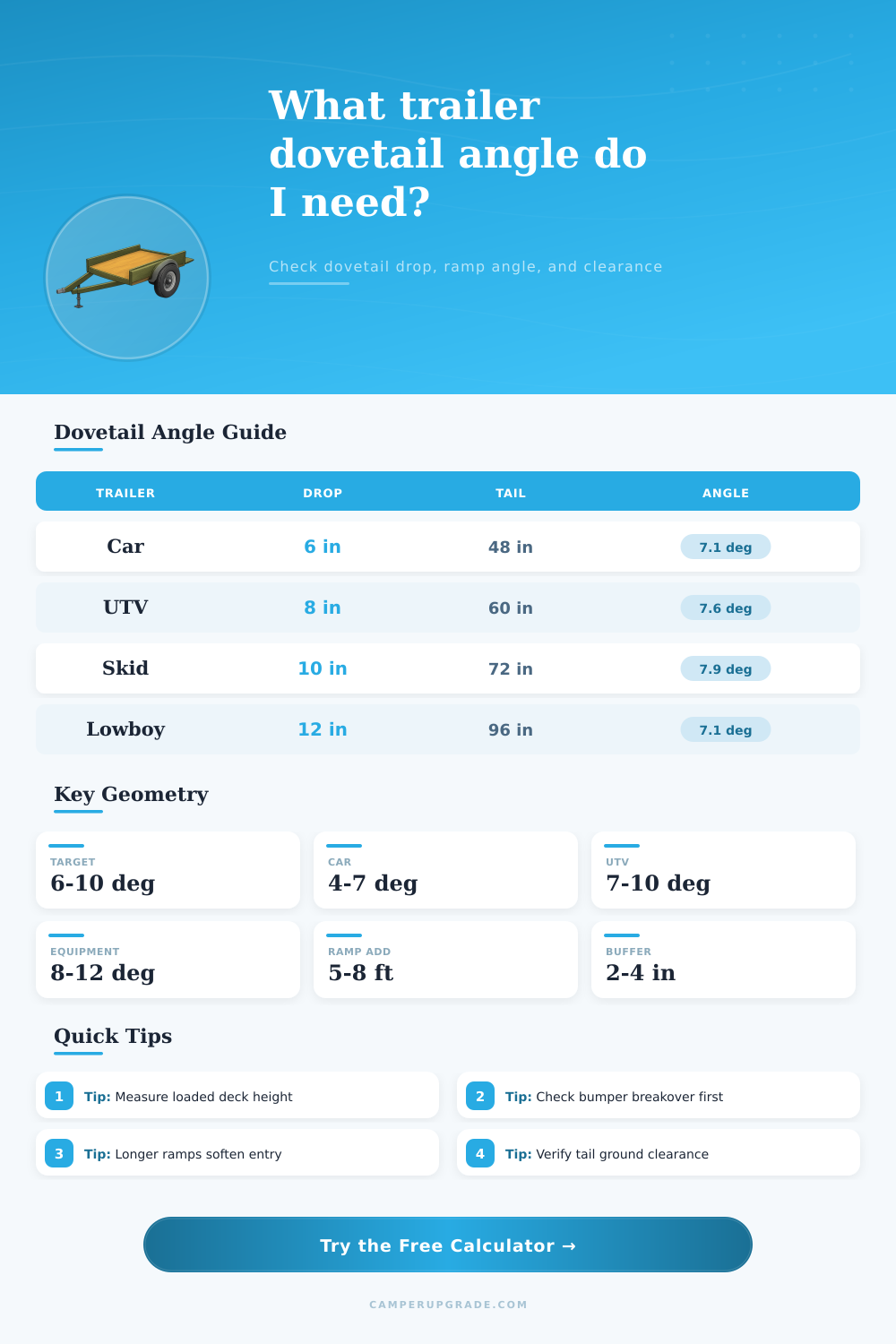
| 36 in tail | 9.5° | 12.5° | 15.5° |
| 48 in tail | 7.1° | 9.5° | 11.8° |
| 60 in tail | 5.7° | 7.6° | 9.5° |
| 72 in tail | 4.8° | 6.3° | 7.9° |
| 96 in tail | 3.6° | 4.8° | 5.9° |
| Ramp length | 14 in tail | 18 in tail | 22 in tail |
|---|---|---|---|
| 48 in ramp | 16.3° | 20.6° | 24.6° |
| 60 in ramp | 13.1° | 16.7° | 20.1° |
| 72 in ramp | 11.0° | 14.0° | 17.0° |
| 84 in ramp | 9.5° | 12.1° | 14.7° |
| 96 in ramp | 8.3° | 10.6° | 12.9° |
| Load type | Good approach | Watch zone | Common fix |
|---|---|---|---|
| Low car | 4-7° | 8° plus | Add ramp length or boards. |
| UTV or mower | 7-10° | 12° plus | Lengthen ramp or reduce tail height. |
| Skid steer | 8-12° | 14° plus | Use longer equipment ramps. |
| Camper rear | 6-10° | 12° plus | Check departure clearance. |
| Pallet jack | 3-5° | 6° plus | Use a liftgate or shallow ramp. |
| Deck style | Typical drop | Tail length | Planning note |
|---|---|---|---|
| Car hauler | 4-8 in | 4-6 ft | Keep breakover soft for low bumpers. |
| Utility trailer | 6-10 in | 3-5 ft | Balance ramp weight and tail clearance. |
| Equipment trailer | 8-12 in | 5-8 ft | Track machines tolerate more angle. |
| Gooseneck deckover | 10-16 in | 6-10 ft | Long tails soften high deck height. |
| Enclosed trailer | 0-4 in | Door ramp | Ramp hinge lip often controls entry. |
A dovetail is the tapered portion of a trailer’s rear. The dovetail is formed such that it lowers the height of the trailers entrance so that the trailers vehicles can roll up onto the trailer. The angle of the dovetail will impact the steepness of the approach for vehicles driving onto the trailer, and it will also impact the amount of lift that the trailers loaded vehicle experience as their wheels move from the trailers ramps onto the trailers main deck.
To calculate the angle of the dovetail, four different measurement must first be entered into the trailer ramp calculator that determines the dovetail angle. Each of these measurement is the height of the trailers main deck after it is loaded with its typical cargo, the vertical drop that occurs at the tail of the trailer, the length of the dovetail itself, and the length of the ramps. Based off these four measurement, the calculator will output the angle of the dovetail, the angle of the ramps, and the combined approach angle for the trailer.
Measure Trailer Height and Calculate Ramp and Dovetail Angles
The combined approach angle will allow the trailer owner to ensure that the calculated value are within the parameters for the specific make and model of the vehicle that they intend to move onto the trailer. The accuracy of the measurement that are entered into the ramp calculator is crucial to ensuring the validity of the angles that are calculated. The height of the trailer change when the trailer is loaded with its cargo.
For instance, trailers has certain heights for their main decks when they are not loaded with any cargo. However, when loaded with too much weight, the trailers will experience a squat in their suspensions which causes the height of the trailers main deck to decrease. Additionally, the trailer will also experience change to the height at which it clears the ground when loaded.
These change can be accounted for in the calculator to ensure that the angles that are calculated are again reflective of the loaded trailer. Vehicle make, model, and geometry will also impact the impact of the dovetail. For instance, trailers may have different height for their splitters, and some models have long wheelbases while other brands have short wheelbases.
Additionally, the measurement of the trailers wheelbase and its rear overhang will help to determine whether the trailers rear will drag over the deck or whether it will rock upwards onto the trailer. The breakover margin account for the difference in height between the lowest point of the trailer and the rise that is created by the dovetail. The breakover margin will be zero or a negative number if the angles and make of the trailer will result in a collision between that trailer and the trailers cargo.
Reference tables are provided for the different parameter of the trailer and its cargo, and they exist in a different format than that which is provided by the calculator. For instance, the tables can include information about how the angle of the dovetail changes if the vertical drop of the trailer change. Shorter dovetails will have steeper angles than longer dovetails for the same vertical drop.
Additionally, the tables allow the trailer owner to compare the length of the ramps to the height of the tail of the trailer. For instance, a sixty inch ramp on an eighteen inch tail create an angle of seventeen degree, while an eighty-four inch ramp on the same eighteen inch tail only creates an angle of twelve degree. When building trailers, most builder will select an angle range rather than a specific angle.
For instance, different type of equipment will have different requirement for the combined approach angle of the trailer. Cars will require an angle between four and seven degree to prevent the cars splitter from colliding with the trailers main deck. Models like UTVs and mowers will have angles between seven and ten degree.
For equipment like skid steers and compact tractors, the combined approach angle can be between eight and twelve degree since those brand have frames that is built for rough ground. When using the calculator, the user may select the target band for the combined approach angle. If the calculated angle is too steep, lengthening the ramps, reducing the vertical tail drop, or placing a transition board at the hinge of the trailer can help to make the angle within the target range.
Additionally, other variable can act upon the result of the calculations. For instance, the tire pressure and how the load is distributed will change how much the trailer squats when loaded. The type of ground upon which the trailers ramps are placed may also change the angle of the ramps.
For instance, a ramp may sit flat upon concrete but rock on gravel or a crowned driveway. The hinge of a trailer may also be higher than the tail of the trailer which can be accounted for with the hinge-lip field provided in the calculator. The angle of the ramps will be steeper if the ramp foot is above the tail of the trailer so that entering this measurement will result in accurate calculation of ramp angle.
Mistake can be made when measuring a trailer when the trailer is empty. For instance, the height of the trailers main deck is higher when the trailer is empty than when it is loaded. Another mistake that is commonly made is treating the dovetail and ramp angle as separate angles when they interact with each other.
For instance, a gentle angle of the dovetail can result in a very steep ramp angle which could result in a combined approach angle that is too steep for the make and model of the trailers cargo. The fact that the calculator calculates the combined approach angle is for just this reason to allow the trailer owner to understand the interaction between each of these angle. Finally, the rear overhang of the trailers cargo is another variable that may impact the movement of the cargo.
For instance, trailers with cargo that has long rear overhangs may have a sudden drop in height once the front portion of the cargo clears the dovetail. The tail-margin measurement will allow the trailer owner to determine the amount of clearance between the tail of the trailer and the rear of the cargo. The trailer owner can lengthen the run of the trailer or reduce the vertical tail drop to account for any too-small margin.
Finally, after the trailer has been built and the ramps have been placed on the trailer, the trailer should be physically rolled to the loading area. At this time, the loaded height of the trailer should be measured one more time. The trailer and its cargo should be moved at a walking speed to ensure that all angle are within the target range before any loading begins.
You should of checked these measurements twice. It is better to be safe than sorry when you are moving heavy loads.