Trail Run Gear List Weight Calculator
Build a trail-run gear list that separates worn kit, carried equipment, water, fuel, safety items, refill strategy, and the load you will still have near the finish.
1.Trail run presets
2.Run profile
3.Hydration and fuel
4.Carried gear list
5.Worn kit context
Calculator note: the carried load is what your vest, belt, or pack holds. Worn kit is tracked separately so shoe and clothing weight do not inflate the pack number.
Your trail run gear weight estimate
6.Current list snapshot
7.Trail run gear weight references
| Gear item | Light range | Typical range | When it matters most |
|---|---|---|---|
| Running vest or belt | 4-8 oz | 8-16 oz | Every run where carried load bounces |
| Soft flask, empty | 1.2-1.8 oz | 1.5-2.5 oz | Water capacity planning |
| Rain or wind shell | 3-6 oz | 6-10 oz | Exposed ridges, rain, long descents |
| Compact insulation layer | 5-9 oz | 8-14 oz | Cold starts, high points, injury stops |
| Headlamp with battery | 1.5-3 oz | 3-6 oz | Dawn, dusk, overnight, backup light rules |
| First aid and emergency kit | 2-4 oz | 4-8 oz | Remote routes and solo runs |
| Phone, map, tracker | 5-8 oz | 7-12 oz | Navigation, check-ins, photos, emergency calls |
| Trail running poles | 8-11 oz | 11-18 oz | Long climbs, rough descents, run-hike days |
| Hydration or fuel item | Conversion used | Planning range | Calculator treatment |
|---|---|---|---|
| Water | 1 liter = 2.20 lb = 35.27 oz | 0.4-1.0 L per hour is common | Counts as consumable start weight |
| Gels and chews | Usually 80-120 calories per oz | 150-300 calories per hour | Food weight depends on density input |
| Bars or dense snacks | Often 100-140 calories per oz | Useful for longer relaxed outings | Higher density lowers weight |
| Drink mix and electrolytes | Entered directly by weight | Small but easy to forget | Added to start and finish reserve |
| Emergency calories | Entered as calories, converted by density | 100-400 calories for remote routes | Kept in finish load by default |
| Start load as body weight | Zone | What it usually feels like | Adjustment idea |
|---|---|---|---|
| Under 2% | Light | Minimal bounce, close to normal running | Good for short familiar loops |
| 2% to 4% | Balanced | Normal vest load for longer trail runs | Check pocket balance and flask position |
| 4% to 7% | Heavy | Noticeable on climbs and technical descents | Review water carry, layers, poles, and food |
| Over 7% | Very heavy | Fastpack or remote safety load territory | Consider refills, cache, shorter route, or bigger pack |
| Run scenario | Typical packed items | Common start load | Main weight driver |
|---|---|---|---|
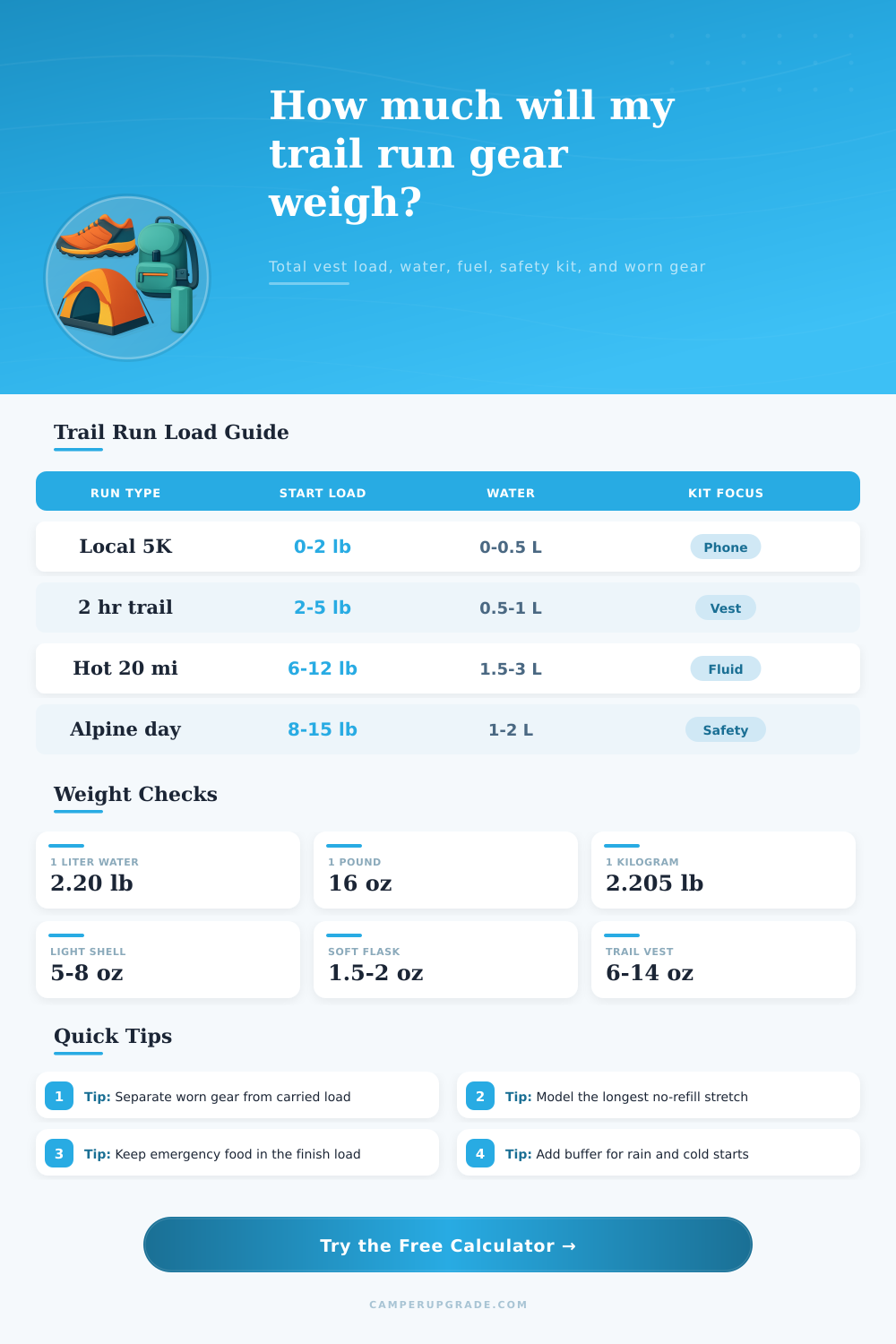
| Neighborhood trail loop, under 1 hour | Phone, key, small bottle if hot | 0-2 lb / 0-0.9 kg | Water choice |
| Training run, 1.5-3 hours | Vest, 1-2 flasks, snacks, phone, shell | 2-6 lb / 0.9-2.7 kg | Fluids and snacks |
| Hot exposed ridge, 3-5 hours | Extra water, electrolytes, sun items, safety kit | 6-12 lb / 2.7-5.4 kg | Water volume |
| Remote mountain day | Shell, insulation, filter, headlamp, emergency kit | 7-14 lb / 3.2-6.4 kg | Safety margin |
| Fastpack run-hike | Larger pack, layers, filter, food, compact shelter items | 10-20 lb / 4.5-9.1 kg | Overnight or survival items |
8.Trail gear list tips
Running fast carrying weight. That’s trail running. It’ll change your shoulder position and shorten your climbing stride. By mile twelve, if your pack is too heavy it might make you think you don’t want to run anymore.
Until the big day when it all becomes clear and now most folks overestimate what they needed. That’s easy to fix with a little calculator. But it’s no random input. Fuel and water is based off time and distance, the baseline parameters. Your load will peak on your longest unfueled stretch; that’s what matters most. Weather and terrain tweak your safety margin. You’ll need more water running up a hot ridge then you would in a cool loop of equal length. The refill strategy field force you to choose: carry it all at once or plan to stop along the way. That’s what makes you feel overloaded or steady.
How to Pack the Right Amount for Your Run
There’s a reason the calculator split up the carried gear from the worn gear. Your shoes and clothes create extra work, sure, but it doesn’t slap you in the rib cage. Separating those category keeps pack weight from being increased by stuff you’re wearing. It also displays finish load… I.e., the weight you carry around all day. This is important as many runners obsess over start weight without considering what’s left toward end of the day.
The reference tables also help without having to remember them. These are normal weight ranges for the flask, shell, and first aid kit. Know what’s normal and know if yours is lighter or heavier. Then there’s the load zone table that turns carried weight into body weight as a percentage. Less than two percent feel pretty normal while running. 4 to 7 percent makes technical terrain feel different. More than seven percent tends toward being more like fastpacking rather than just a training run.
This includes a 10 percent planning buffer for any little things that slip your mind. A bigger buffer is needed if you are going to take some new routes, start from scratch in the mornings, or expect rain. The cost of being underprepared is higher then the cost of carrying a little extra weight. All of this factor into the calculator and lets you test out scenarios before packing
What’s valuable comes into view when you change a single variable. Reduce the water amount by half a liter and see how that changes finish load. Replace heaviest shell with lightest shell and see if it keeps you within your comfort zone. Those little tests will show you those tradeoffs more quickly than trying stuff out on the trail. It doesn’t substitute for experience; it just speeds up the learning curve between trips. Then it’s up to you to figure out what feels right wearing the thing. The numbers takes the guesswork out of the math.