Trail Loop vs Out and Back Time Calculator
Compare a loop route against an out-and-back route using distance, climb, descent, footing, retrace speed, navigation drag, breaks, and daylight margin.
1.Route presets
2.Timing inputs
3.Loop route
4.Out-and-back route
Model note: Loop time is modeled as one continuous route. Out-and-back time is modeled as an outbound leg plus a return leg where gain and loss swap, then the return leg gets a retrace or fatigue multiplier.
Loop vs out-and-back estimate
5.Route comparison specs
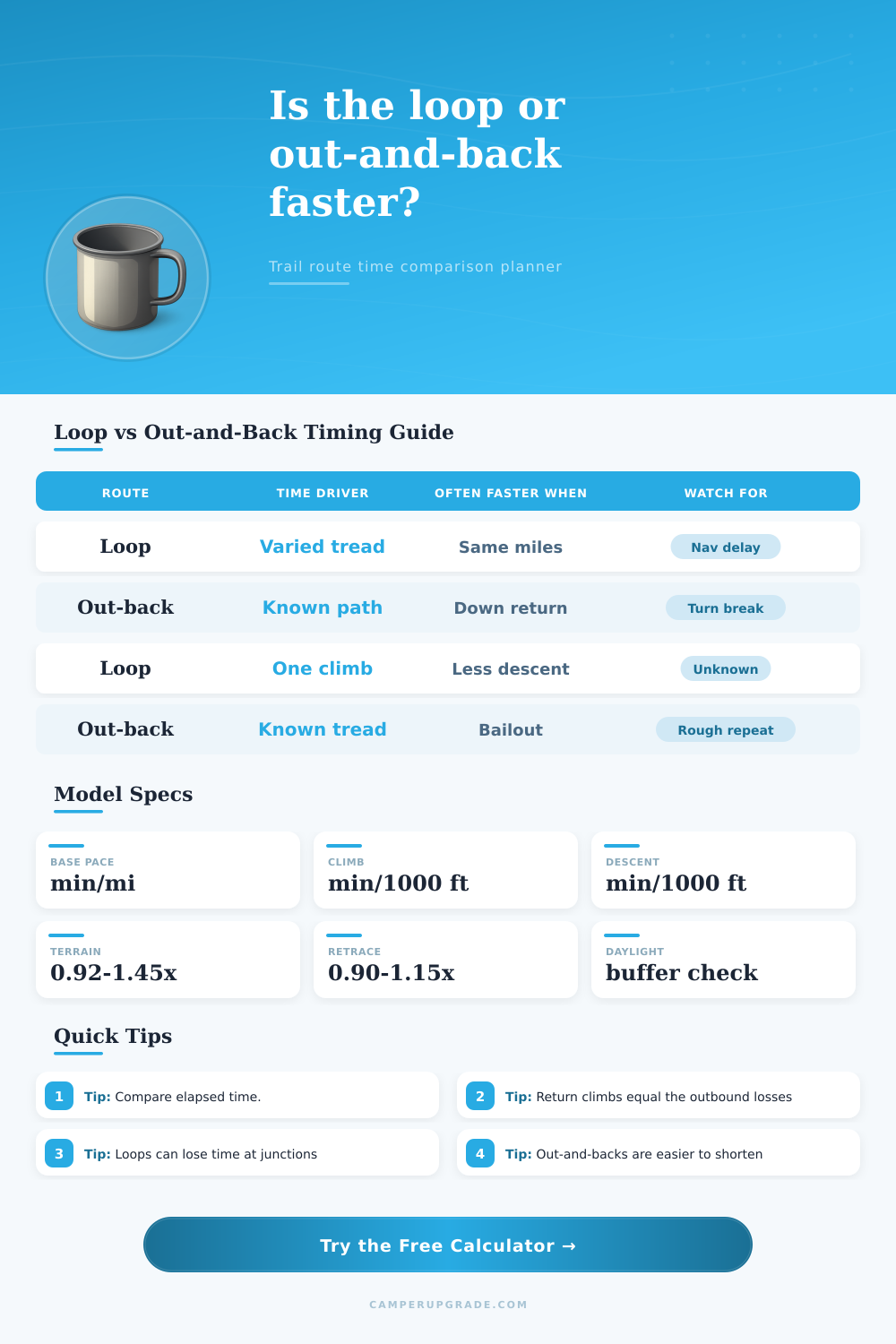
6.When each route type wins
| Planning question | Loop usually helps when | Out-and-back usually helps when | Calculator input to tune |
|---|---|---|---|
| Total time | The loop is not much longer and avoids repeating steep loose descent. | The return is familiar, downhill, and has fewer junction decisions. | Distance, descent control, retrace effect |
| Navigation risk | The loop is signed, obvious, and has a clear map line. | The route is new, visibility is poor, or the group may turn around early. | Loop navigation drag, daylight buffer |
| Group pacing | The loop keeps morale high with changing scenery and fewer repeated climbs. | The group benefits from a known turnaround and simple bailout plan. | Group delay, turnaround stop |
| Terrain uncertainty | The loop avoids a known muddy, snowy, crowded, or technical return corridor. | The alternate loop has unknown footing, faint trail, or too many junctions. | Loop footing, return footing |
7.Planning tips
At the trail head, you’re facing two routes, one retracing already-trodden terrain, one circling back to explore something new. At first glance, it’s often hard to tell which will be faster. On paper, maybe one look shorter than the other, and perhaps this one provide a cleaner ending.
But how do the terrain, hills, breaks, and the trip back all add up once you start moving? Most folks do not account for elevation gain/loss. You may have had a gentle climb on the way out, but it become a steep return when the route reverses. Every loss becomes a gain. Turning around adds time in both directions. You has to reverse every foot of climbing, and every drop becomes an uphill climb.
Loop or Out-and-Back: Which Is Faster?
Enter your leg gains/losses into the calculator above and it will figure out the math for you, eliminating the guessing game of how these swaps impact total effort. Navigation and terrain drag also matter. Even a loop with multiple junction can lose minutes (or more). This happens at every decision point where group stops to consult maps or wait for stragglers to catch up. An out-and-back on familiar tread tends to go faster on the return since you know what’s underfoot. That’s why the tool has inputs for navigation complexity and footing quality. These multipliers help make it a reflection of actual trail you’ll be walking rather than just a rough estimate.
Plans also tend to change when there are breaks. That view point photo stop becomes fifteen minute layer up/down/layer up down/snack break. Breaks along an out-and-back often take less time then all those random stops interspersed throughout a whole loop. Therefore, adjusting the planned stops field is less about how route looks on paper and more about how your group is actualy moving.
The last caveat is daylight. If it ends within the buffer, there’s time for an unplanned detour or lingering traffic heading home. If it barely makes the deadline, it mean less time or starting earlier. Trail time does not align perfectly with the calendar. So you should of include a safety buffer.
In reality, it is a matter of deciding which trade-offs you want. Looping means you cannot backtrack but you get changing scenery, while out-and-back means extra miles and more difficult navigation. Out-and-back offers easier decisions and an easy bailout vs the return climb and repeated scenery. Depending on your conditions, one will finish first (or at least that’s what the calculator says), but ultimately it’s up to the team that stands at the trailhead.