Trail Calorie Per Mile Calculator
Estimate hiking calories per mile, total burn, fueling gap, and climb calorie share from body weight, pack weight, distance, elevation gain, terrain, pace, temperature, altitude, and planned calorie intake.
🏔Trail Presets
⚙Trail Energy Inputs
⚡Trail Energy Spec Grid
This calculator uses a planning estimate based on the ACSM walking equation, then adjusts for pack load, rough terrain, temperature stress, and altitude. Individual burn can vary with stride, fitness, poles, wind, trail surface, and descent style.
📊Reference Tables
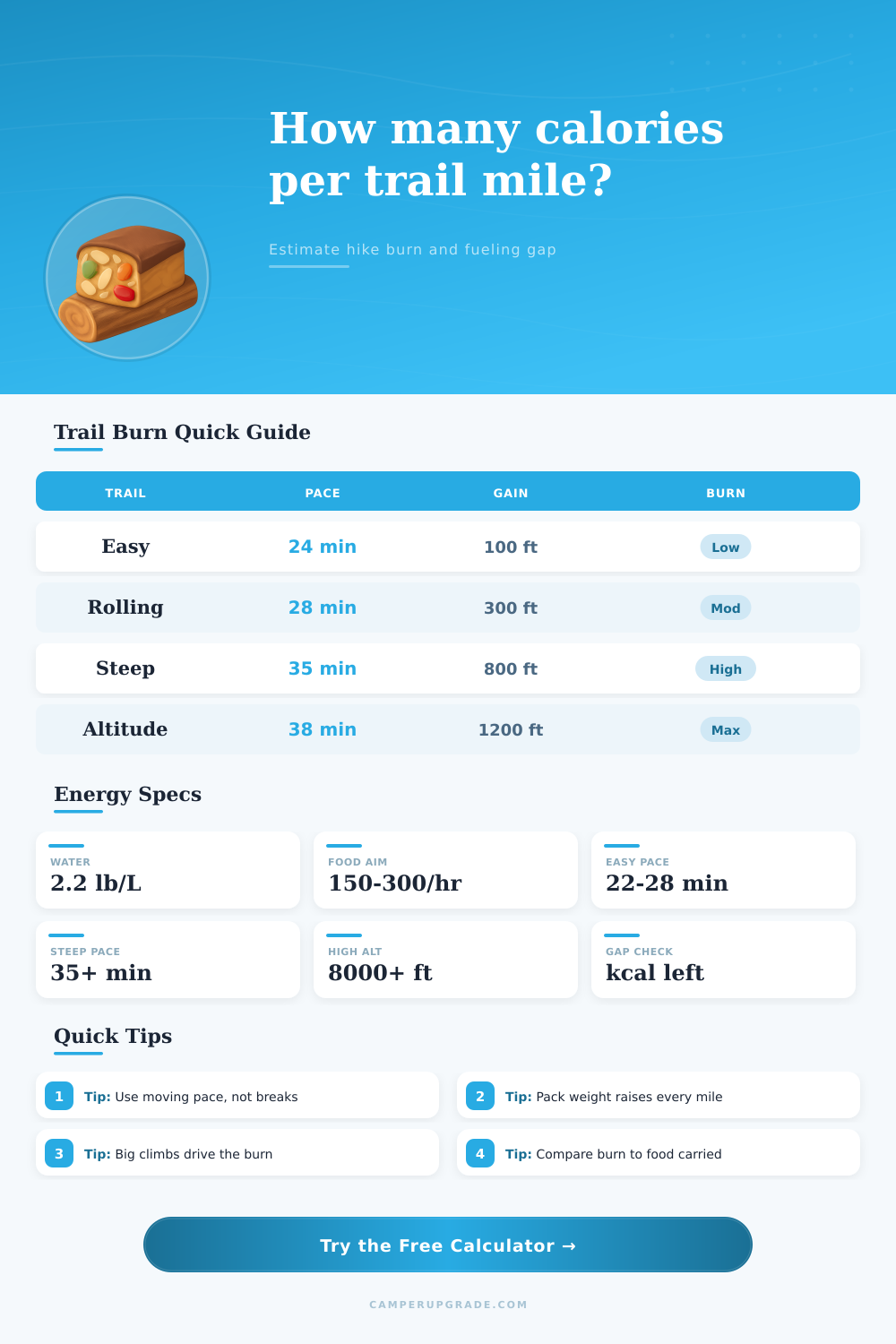
| Trail profile | Typical grade / gain | Terrain factor | Energy note |
|---|---|---|---|
| Smooth rail trail | 0-150 ft per mile | 0.95 to 1.00 | Most calories come from horizontal walking and pack load. |
| Rolling maintained trail | 150-350 ft per mile | 1.00 to 1.08 | Climbs become noticeable while pace can stay steady. |
| Steep summit trail | 500-900 ft per mile | 1.08 to 1.16 | Elevation gain can become a large share of total burn. |
| Loose sand, talus, snow | Variable | 1.16 to 1.35 | Footing raises cost even when the map distance looks short. |
| Pack load | Common trip use | Burn effect | Planning note |
|---|---|---|---|
| 0-8 lb / 0-4 kg | Short walk or trail run vest | Small increase over body-only walking | Distance and pace dominate the estimate. |
| 9-20 lb / 4-9 kg | Day hike with water, layers, food | Moderate increase every mile | Water weight changes quickly between sources. |
| 21-35 lb / 10-16 kg | Overnight or light multi-day pack | Large increase on climbs | Use current start weight for the hardest segment. |
| 36 lb+ / 16 kg+ | Winter, long food carry, group gear | High load cost and slower pace | Check feet, knees, and descent effort as well as calories. |
| Fueling plan | Kcal per hour | Best fit | Trail use |
|---|---|---|---|
| Light snack plan | 100-150 | Short, easy hikes | Works when normal meals bracket the route. |
| Steady hiking | 150-220 | Most half-day and full-day hikes | Simple snacks every 45 to 75 minutes help pacing. |
| Hard mountain day | 220-280 | Steep climbs and long efforts | Mix quick carbs with salty foods and fluids. |
| Long endurance day | 280-350 | Fastpacking or ultra-distance trail days | Practice intake before relying on it for a big objective. |
| Condition | Calculator adjustment | When it matters | Practical note |
|---|---|---|---|
| Cool to mild weather | 1.00x | About 45-75°F / 7-24°C | Use this as the baseline for most planning. |
| Hot trail | Up to about 1.08x | Above 75°F / 24°C | Heat can lower appetite even when calorie need rises. |
| Cold trail | Up to about 1.07x | Below 40°F / 4°C | Extra clothing, snow, and warm drinks may change the plan. |
| Higher altitude | About 1-12% added | Mostly above 5,000 ft / 1,500 m | Altitude factor is capped because acclimatization varies widely. |
💡Trail Calorie Tips
For medical nutrition advice, diabetes management, endurance racing, or altitude illness risk, use this as a planning estimate and follow guidance from a qualified clinician or coach.
A calorie calculator will helps you determine the amount of energy that you will use during your hike. The calorie calculator use specific inputs to calculate the energy that a person will burn during there hike, and it create specific outputs that show what the calculator’s calculation will be for you to compare to the amount of energy that you plan to consume during your hike. Because each hike are going to be different from the next, however, you will have to change the inputs that is used to calculate the energy that you will burn to ensure that you find an accurat estimate for the number of calories that you will burn on each specific hike.
The first input that you will have to provide to the calorie calculator is your body weight. Your body weight will help the calorie calculator to determine the amount of energy that you will use to move your body during your hike. The second input that you will have to provide to the calorie calculator is your pack weight.
How to Use a Hiking Calorie Calculator
Your pack weight will factor into the calculation of the energy that you will burn during your hike with each step that you take. The third input that you will have to provide to the calorie calculator is the distance that you will hike. This input will allow the calorie calculator to calculate the energy that you will burn as a result of the distance that you hike.
The fourth input that you will have to provide to the calorie calculator is an elevation gain that you will experience during your hike. The elevation gain is an important input for the calorie calculator because climbing hills burn more energy then walking on flat terrain. The fifth input that you will have to provide is the terrain factor.
This variable is used to calculate your energy burn as a result of the terrain that you hike on, rough terrain will burn more energy than smooth terrain. The sixth input that you will have to provide is your hiking pace. Your hiking pace will determine how long you will be burn energy during your hike.
The seventh input that you will have to provide is the temperature and the altitude of the hike. These variable are used to calculate how much stress is placed upon your body during your hike. Finally, the last input that you will have to provide is your planned intake for the hike.
This input allow the calorie calculator to determine how much energy you will consume during your hike. The calorie calculator will create several different output after you have entered your inputs. The first output will be the number of calories that you will burn per mile.
This output will determine how many calorie that you will burn on an average mile of your hike. The second output will be the total number of calories that you will burn during your hike. The total burn is an important calculation that will show you the total number of calories that you will use during your hike.
The third and final output of the calculator is the fueling gap. The fueling gap will show you the difference between the number of calories that you will burn during your hike and the number of calories that you will consume during your hike. If the fueling gap is a large number, that is a sign that you are not consuming enough food.
The fourth output of the calculator is the climb calorie share, which measure how many calories you burn while climbing. There are reference table included with the calculator. The first shows the different type of trails and their terrain factors.
The second reference table show the effect of different weight on energy burn. Another table display the fueling rates for different level of hiking effort. These reference tables assist with the selection of inputs for the calorie calculator.
The reference tables allow you to make sure that your input is realistic, and that you are within the bound of what is expected for a hiker. People often make mistake with energy burn estimates because they do not account for the terrain and their pack weight. A person might think that every mile will burn the same amount of calories, but that is not the case for every mile of hiking.
The calorie calculator will allow a person to avoid these mistake. However, it is still only an estimate. There are many variable to hiking that the calorie calculator will not account for.
The calorie calculator can be used to test out different hiking plans prior to begin a hike. By changing the weight that a person will be carrying, the distance that they will hike, or the altitude of the hike, that person can use the calorie calculator to determine whether or not their current fueling plan will be sufficient for the hike that they plan to take.