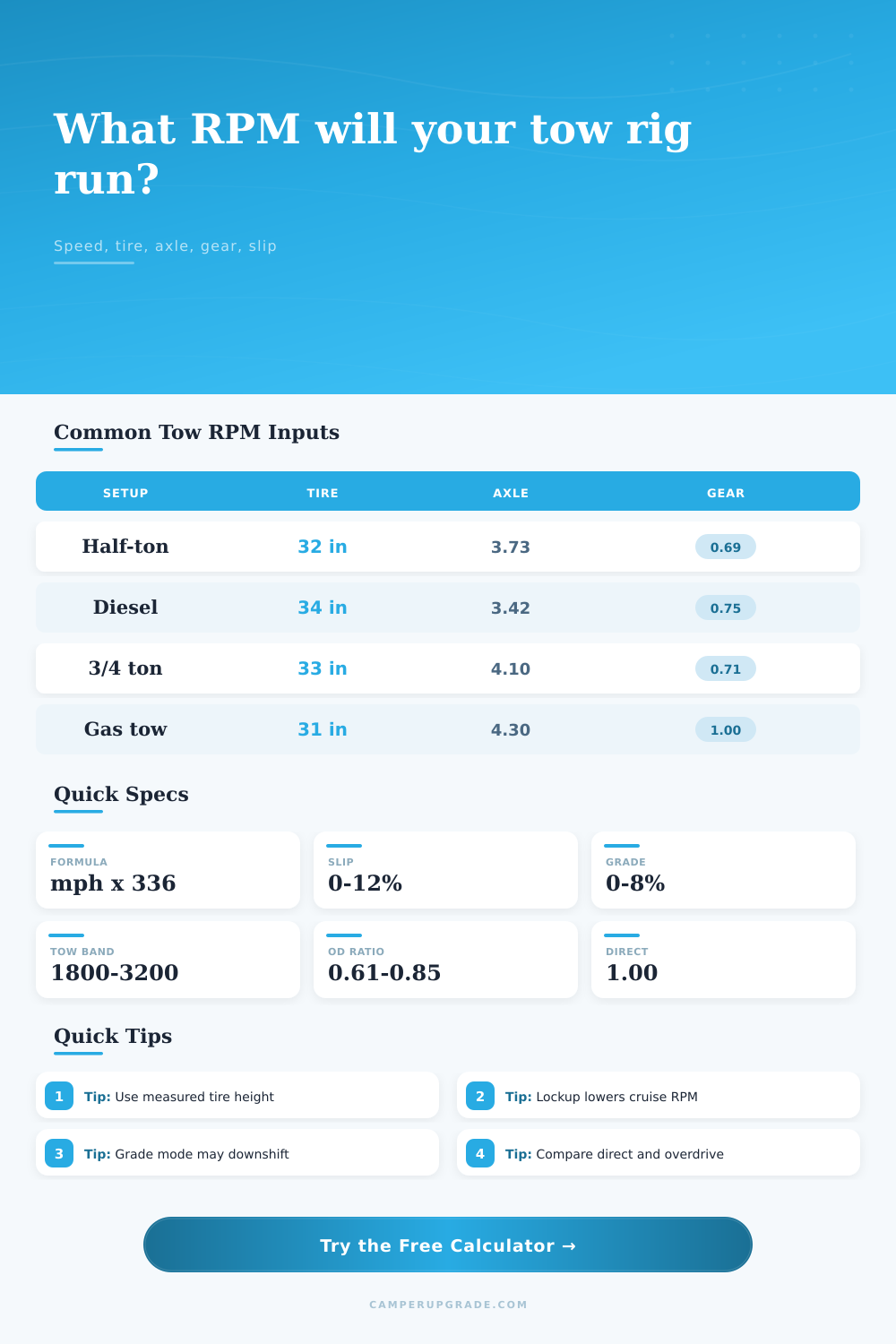
Towing Gear Ratio RPM Calculator
Estimate towing engine RPM from road speed, tire diameter, axle ratio, transmission gear ratio, overdrive selection, torque converter slip, grade mode, and your target RPM band.
Calculation Breakdown
Direct
0 rpmCalculate to compare 1.00 direct gear.
Current
0 rpmYour current entered gear and overdrive.
Next Lower
0 rpmSimulates one lower tow gear.
65 mph
0 rpmSame gearing at highway speed.
| Axle ratio | Typical tow use | RPM effect | Planning note |
|---|---|---|---|
| 3.08 to 3.23 | Light highway towing | Lowest RPM | May need more downshifts with campers or hills. |
| 3.42 to 3.55 | Balanced daily/tow setup | Moderate RPM | Common with half-ton trucks and light trailers. |
| 3.73 to 3.92 | Dedicated tow package range | Higher RPM | Often keeps engines closer to useful torque. |
| 4.10 to 4.30 | Gas heavy tow or smaller tires | High RPM | Good for grade control and loaded starts. |
| 4.56 and deeper | Large tires or heavy loads | Very high RPM | Common correction after moving to taller tires. |
| Gear ratio | Common label | Towing behavior | When to compare it |
|---|---|---|---|
| 2.10 to 1.52 | Lower gears | High RPM and strong engine braking | Slow climbs, descents, and heavy grades. |
| 1.28 to 1.15 | Upper tow gears | Moderate-high RPM | Useful when overdrive keeps hunting. |
| 1.00 | Direct drive | Stable converter load | Baseline for heat and grade comparisons. |
| 0.85 to 0.75 | Towing overdrive | Lower cruise RPM | Works best with lockup and light grades. |
| 0.69 to 0.61 | Deep overdrive | Lowest highway RPM | May lug or downshift with wind and hills. |
| Grade mode | Mode factor | Slip tendency | Calculator use |
|---|---|---|---|
| Flat highway cruise | 1.00 | Lowest slip when locked | Best for level-road RPM comparisons. |
| Rolling hills tow mode | 1.04 | Small rise | Allows mild tow/haul behavior and load. |
| Grade mode holding gear | 1.08 | Moderate rise | Models a held gear with converter load. |
| Steep climb or descent | 1.12 | Highest heat risk | Use for conservative mountain checks. |
| Manual gear hold | 1.02 | Depends on lockup | Good for driver-selected gear comparisons. |
| Engine/tow style | Common tow band | Below band can feel | Above band can mean |
|---|---|---|---|
| Turbo diesel cruise | 1,600 to 2,400 rpm | Lugging or downshift hunting | Extra noise or unnecessary gear hold |
| Modern gas V8/V6 | 2,000 to 3,500 rpm | Converter heat and soft response | Acceptable on grades if in range |
| Older gas truck | 2,200 to 3,800 rpm | Poor cooling or low torque reserve | May be normal on long climbs |
| Small SUV tow | 2,500 to 4,200 rpm | Frequent unlock and gear hunting | Watch temperature and rated limits |
| Engine braking | 3,000 to 5,000 rpm | Not enough holdback | Check redline and manual guidance |
On the highway you’re pushing your boat and your towing. The wind fights back and the trailer is heavy. Your engine strain for the right gear and transmission just can’t seem to locate it. You are going fast enough but slow enough to make the tow feel miserabley. That’s when towing math turns to physics. And many folks push that accelerator and pray for a different result.
Knowing how your tire size and axle ratio affect engine speed is a smarter way to do things. When you input your configuration into the calculator, it does all of the math for you. It’s based off the key variables and will give you an estimated RPM. But you have to know why the number matter.
How Tires and Gears Change Your Engine Speed
Let’s begin by looking at tires. Manufacturers list a diameter for their tire that is accurate when the tire is cold and unloaded. That isn’t how you drive across the country. You put three thousand pounds on the sidewalls of the tire which cause the tire to flatten out. It then rolls smaller than manufacturer says it should. Adjusting the loaded tire diameter change the effective gearing.
Most folks believe there is no way to change gear ratio. This is true at the axle level, but the tire is the final multiplier. An axle ratio is the torque multiplication factor. Generally speaking, the higher (ie: 4.10) the worse gas mileage but greater torque. The opposite are true with a lower axle ratio. Check the chart below for common ratios.
As an example… a low axle ratio in combination with a tall tire mean the engine has to turn less to go faster. Sounds good right? Wrong. If the engine drop out of its power band, it isn’t good. Every hill becomes a challenge to your forward momentum. Heat builds up causing the torque converter to unlock and the engine lug. You’re working harder then you need to be.
Things get more complicated with overdrive. Today’s transmissions has many gears that appear unnecessary. The calculator allows you to play out the shifts. You can compare direct drive versus several stages of overdrive. Direct drive make the tow stable. It cools the transmission and locks the converter in place. Overdrive lowers the RPMs for fuel economy. However, it compromises resilience. When you climb a grade and lower the RPM too far, the transmission hunts downshifting all day long. That hunting action generates more heat than constant higher RPMs. Running the motor higher may saves the transmission.
Slip is an invisible variable. A torque converter is basically a fluid coupling that lets engine turn at a higher RPM than the output of the transmission. Heat is created by the slip. You can enter in a percentage for this occurrence as well. A locked converter slips very little. An unlocked converter will slip quite a bit. On flat ground, slip is minimal. On a grade, slip increases with the load. Grade mode settings accounts for the real world load. It is not just the grade but also the steady load on the drivetrain.
On long trips, target RPM bands are critical. For diesel engines, they likes to operate at lower RPM for greater efficiency. For gas engines, they require higher revs for torque. To put it another way, if your cruise RPM is below the engine’s torque peak, then you’re leaving power on the table. If it’s too high, then you’re wasting fuel and wearing components. So what do we want? We want a middle ground. You want enough RPM to hold the grade without having to downshift. The RPM should be low enough to save fuel and reduce noise.
This requires trial and error, but there is a way to simulate the trial before heading out of the driveway, with a calculator. Physics is physics. How heavy is the trailer? That’s not changing. How long is the hill? That is not changing either. What are you doing with the tow vehicle? What do you make it do? Control the towing experience by understanding what happens when you combine transmission gearing with axle ratio and tire size. Turn it into a plan instead of a guessing game. Stop reacting to the hill and start anticipating it. Let the numbers speak. Read ‘em right, and they’ll tell the tale.
Now that you know where engine lives on the highway, the rest of the journey gets a lot easier. Leave the drama for the road.