Tow Rating Derating by Altitude Calculator
Estimate effective mountain tow rating from elevation, engine type, GCWR, payload, trailer weight, grade demand, speed, and cooling reserve.
🏔 Mountain tow presets
⚙ Tow vehicle and route inputs
Use the rating from the tow guide after drivetrain and hitch limits.
Enter the pass, campground approach, or sustained high plateau elevation.
Speed above 50 mph adds aero and cooling demand on long climbs.
📊 Comparison grid
🔧 Derate reference cards
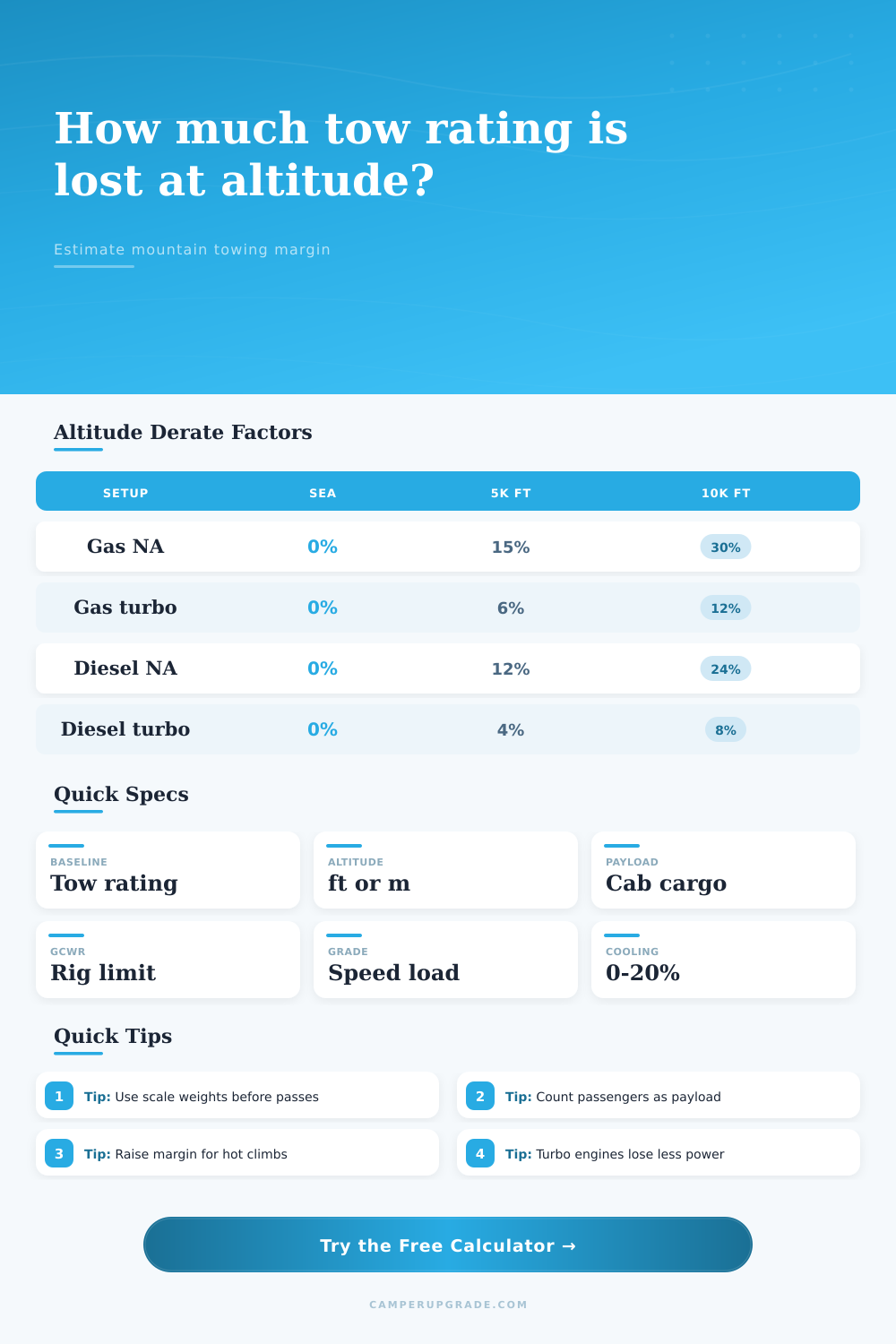
🗺 Altitude derate table
| Highest elevation | Gas NA | Gas turbo | Diesel turbo |
|---|---|---|---|
| 2,500 ft | 7.5% power derate | 3.0% power derate | 2.0% power derate |
| 5,000 ft | 15.0% power derate | 6.0% power derate | 4.0% power derate |
| 7,500 ft | 22.5% power derate | 9.0% power derate | 6.0% power derate |
| 10,000 ft | 30.0% power derate | 12.0% power derate | 8.0% power derate |
| 12,000 ft | 36.0% power derate | 14.4% power derate | 9.6% power derate |
⛓ Constraint table
| Constraint | What it checks | Typical input | Result impact |
|---|---|---|---|
| Base tow rating | Manufacturer trailer rating before altitude math | 5,000 to 14,000 lb | Upper limit for derate |
| GCWR | Loaded vehicle plus loaded trailer | 10,000 to 25,000 lb | Can cap trailer lower than tow rating |
| Payload | People, cargo, hitch gear, and tongue load | 900 to 3,500 lb | Often limits travel trailers first |
| Cooling margin | Reserve for heat, slow traffic, and long climbs | 5% to 20% | Reduces practical mountain limit |
⚡ Grade and speed factor table
| Road demand | Grade range | Speed note | Added derate |
|---|---|---|---|
| Rolling foothills | 2% to 4% | 45 to 60 mph | 0% to 3% |
| Mountain highway | 5% to 6% | 45 to 60 mph | 4% to 8% |
| Long pass climb | 7% to 8% | 35 to 55 mph | 9% to 13% |
| Steep slow ascent | 9% plus | 25 to 45 mph | 14% to 20% |
🚚 Mountain tow preset table
| Preset | Elevation | Engine | Trailer weight |
|---|---|---|---|
| Denver to Eisenhower | 11,158 ft | Gas turbo | 6,200 lb |
| Rocky half-ton camper | 9,500 ft | Gas NA | 5,800 lb |
| Sierra turbo diesel | 8,700 ft | Diesel turbo | 9,200 lb |
| Cascade van trailer | 4,300 ft | Gas turbo | 3,800 lb |
| Million Dollar Hwy | 11,000 ft | Gas NA | 4,900 lb |
💡 Calculation tips
Elevation is usualy treated as an afterthought in most towing guides. It is a small change for driving in mountains, something you can ignore unless you live or tow in hilly area. That’s wrong.
Every thousand feet you rise, the air thins and your engine must breathes harder. Your half-ton tow vehicle that pulls well at sea level may crawl up a steep pass. The problem isn’t so much gravity as it is physics of combustion.
Why Alt Matters When You Tow
When you plug in the elevation of your route and your engine type, the calculator do the math for you. No need to guess at how much power you’re realy losing. And effect of altitude on your particular engine make a big difference.
For instance, a naturally aspirated gas engine lose about 3% of its horsepower for each one-thousand-feet gain in altitude. Because forced-air diesels blow denser air into the cylinder, it doesn’t loses nearly as much power. This matters if you’re cruising at fifty-five miles per hour up a grade.
Your Gross Combined Weight Rating (GCWR) factors into equation, and that’s how much your trailer and vehicle can weighs combined at their maximum. A lot of people disregard the GCWR in favor off the trailer hitch limit. Since they believe the hitch capacity is all that matters, they’ll load up the cab with gear and people. Not so.
There are also limitations for drivetrain and suspension. Add a full tank of propane and a family of four to your loaded travel trailer and you may be over GCWR before hitting your first climb.
Payload is also important. Your vehicle have a payload limit. That includes everything from your passengers and their gear to the trailer’s tongue weight. If you do some math on your actual tow rating up high in air, that leftover space closes quicker than you might think.
This is how your trailer margin is calculated. You can use it to determine whether or not you has to take items out of truck prior to going mountain riding.
Numbers don’t tell the whole story about heat. Engine temperatures rise, and so do brakes on long hills. That’s where reserve inputs for cooling margins comes into play. You can add a ten percent reserve that may seem conservative during summer months, yet protects your transmission fluid from boiling up when climbing long hills.
The speed and grade factors focuses on how the engine is working to determine the derate amount. Greater than the grade, the greater required torque. This results in higher engine heat and increased cooling-system strain.
The preset settings includes popular trails such as the Million Dollar Highway or Eisenhower Tunnel. This lets you have an idea of how these setups works on challenging roads. But each run is different. Weather, your driving style, and tire pressure will all affect things differently.
A high-power setting might be too much on a wet road which decreases traction.
The brochure number isn’t your number. Your number is the reduced rating. Under ideal conditions. Sea level conditions. Temperatures are moderate. There are no passengers. And then you drive in the real world with winding roads and thin air. It is a number adjusted for cooling, grade, and altitude. It may not be what you’d like. But it’s the number that moves you along.
Get a scale ticket when possible. Theoretical weights is guesses. Put everything in the truck how you will haul it and weigh yourself out. You should of gotten one. See what happens. If it’s close, leave some weight off road. Two loads are better than none. Safety first.
There will always be another day on that mountain. You don’t want your tow vehicle to be “that one” where they had to give up because they pushed it too far. Let the numbers helps make the decision.
Respect the weight. Respect the air.