Top Rope Rope Length Needed Calculator
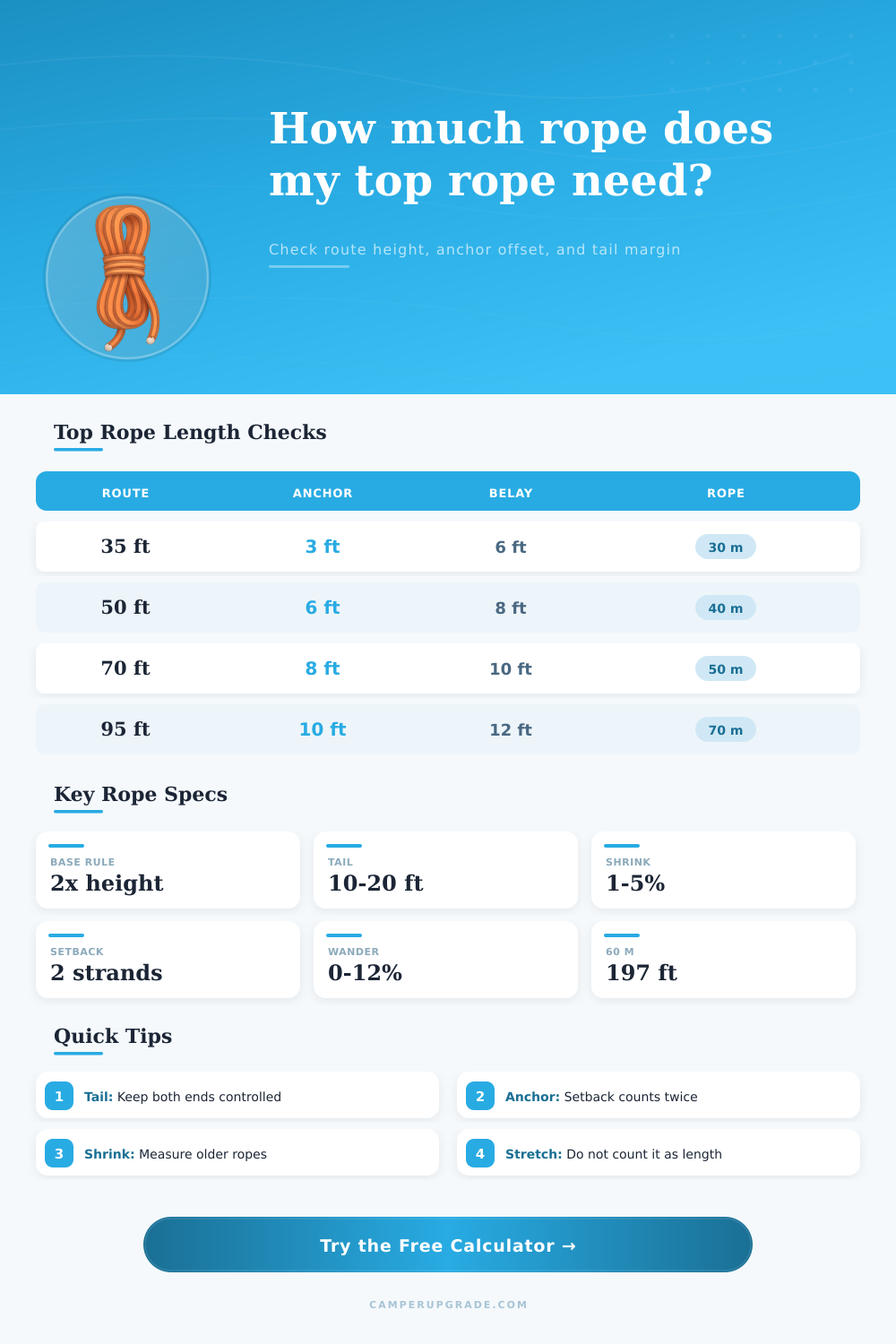
Estimate the rope length needed for a top rope from climb height, anchor setback, belayer stance, route wandering, knots, anchor rigging, shrinkage, reserve tail, and the rope you plan to carry.
🧗Top Rope Presets
⚙️Route, Anchor, and Rope Inputs
📊Top Rope Spec Grid
📋Top Rope Reference Tables
| Vertical Route Height | Clean Minimum Rule | With 15 ft Reserve | Common Rope Cue |
|---|---|---|---|
| 30 ft / 9 m | 60 ft / 18 m | 75 ft / 23 m | 30 m is usually enough |
| 40 ft / 12 m | 80 ft / 24 m | 95 ft / 29 m | 30 m can be tight with setbacks |
| 50 ft / 15 m | 100 ft / 30 m | 115 ft / 35 m | 40 m starts to make sense |
| 60 ft / 18 m | 120 ft / 37 m | 135 ft / 41 m | 50 m gives useful margin |
| 80 ft / 24 m | 160 ft / 49 m | 175 ft / 53 m | 60 m is common |
| 100 ft / 30 m | 200 ft / 61 m | 215 ft / 66 m | 70 m or longer |
| Anchor Situation | Added Path | Why It Matters | Calculator Input |
|---|---|---|---|
| Bolted anchor over edge | Low | Master point is close to the rope line. | 0 to 3 ft setback |
| Tree just back from lip | Moderate | Both strands travel from lip to anchor. | 4 to 8 ft setback |
| Large boulder anchor | High | Longer extension and handling tails are common. | 8 to 15 ft setback |
| Top-managed class rope | Variable | Extra knots and supervision tails consume length. | Training allowance |
| Belayer Position | Extra Demand | Common Use | Planning Note |
|---|---|---|---|
| At wall base | Lowest | Gym and clean crag base. | Still keep the brake side controlled. |
| 6 to 10 ft back | Small | Typical outdoor stance. | Horizontal distance changes the belay-side leg. |
| 10 to 20 ft back | Moderate | Uneven landings or group management. | Tail reserve becomes more important. |
| Sloped base | Variable | Talus, beach, snow, or ledge. | Use the ground slope allowance. |
| Nominal Rope | Feet | After 3% Shrink | Useful Top Rope Range |
|---|---|---|---|
| 30 m | 98 ft | 95 ft | Short walls and practice towers |
| 40 m | 131 ft | 127 ft | Clean routes around 45 to 55 ft |
| 50 m | 164 ft | 159 ft | Moderate crag routes |
| 60 m | 197 ft | 191 ft | Many outdoor top ropes |
| 70 m | 230 ft | 223 ft | Longer routes and setbacks |
| 80 m | 262 ft | 255 ft | Long routes with extra margin |
💡Top Rope Length Tips
When choosing a climbing rope, you must ensure that the rope is long enough to lower the climber to the ground. While the height of the climbing wall will play a significant role in the rope selection, several other factor will inevitably make the climbing rope shorter than the distance from the climber to the ground. Factors to consider when choosing a climbing rope include the position of the anchor, the position of the belayer, the length of the knots that will be used in the rope, and the amount of shrinkage that the climbing rope will experience.
A common mistake when choosing a climbing rope is to use the height of the climbing route as the determining factor for the length of the climbing rope. The length of the rope must be twice the height of the climbing route only if the anchor is set at the edge of the wall and the belayer stand at the base of the wall. If the anchor is set back from the wall, the climbing rope will need to extend to both strands of the rope.
How to Choose the Right Climbing Rope Length
If the belayer isnt standing at the base of the wall, the rope will have to travel diagonally to the belayer, thus using more rope than if the belayer was standing directly at the base of the wall. The geometry of the climbing route can also play a significant role in the length of the climbing rope necessary to complete a climb. If the route allows the climbing rope to move sideways from the wall or bulge away from the wall, the rope will follow the path of the route.
Any path that allows the rope to travel sideways or bulges away from the wall will use up more rope than a vertical path. If the ground is sloped or the belayer has to move around an obstacle on the ground, the rope will have to travel a longer distance. These factors may seem small when making the selection of a climbing rope, but they can ultimately add up and result in a rope that is too short for the climb.
Another factor to consider when choosing a climbing rope is the amount of shrinkage that the rope may experience. The climbing rope will shrink in length after the climber use the rope for long periods or when the rope gets washed. A climbing rope that measured 60 meter when new may be shorter after the season of use.
Another factor to consider is the stretch of the rope. Dont confuse climbing rope stretch with the usable length of the rope. Some dynamic stretch occur when the climber puts their weight on the climbing rope.
However, this stretch dissapears when the climber lowers their weight on the rope. Any mistake in thinking that the dynamic stretch of the climbing rope is the usable length of the rope will result in the rope being too short to lower the climber to the ground. Another factor to consider when choosing a climbing rope is the length that the knots will take up in the rope.
Any tie-in knot, stopper knot, or static extensions in the rigging will use up some of the length of the rope that can be used to lower the climber. Thus, the total length of the climbing rope will decrease as a result of these knots. It is possible that a climbing rope may seem long enough for the climb when you measure the rope.
However, once you tie the knots into the rope and set up the rigging for the climber, the rope will be too short for the climber to be lowered safely to the ground. Reference tables can ultimately help the rope selection process. These tables will show how the length of the rope will change with the addition of certain factors to the climbing route.
An example of these factors is the setback of the anchor and the position of the belayer. However, you should still take the measurements for these factors in any setup for the climb. The reference tables are a helpful tool to the climbing team, but the climbing team must still take the actual measurements of the climbing route.
When choosing a climbing rope, you have a decision to make as to how much margin you would like to provide for certain factors in the climb. If you choose a longer climbing rope, you will have more margin to accommodate for the setbacks of the anchor and the position of the belayer. Additionally, a longer rope will provide more margin in case the belayer changes there stance during the climb.
However, using a longer rope will make the pack heavier for the climber. Yet, a longer climbing rope will ensure that the climber does not come to a stop above the ground. In order to ensure that the climbing rope you are using will be able to safely lower the climber to the ground, you should develop a habit of measuring the climb.
Walk to the location of the anchor to measure the position of the anchor. Measure the position of the belayer and the distance of the route that the rope will have to travel. Once you have taken the measurements for the anchor, the belayer, and the route, compare those measurements with the length of the climbing rope you have selected.
By comparing these numbers, you can make a decision about whether or not the rope you are using will be long enough for the climb.