Tobler Hiking Speed Calculator
Estimate Tobler walking speed, travel time, slope penalty, and adjusted pace from grade, trail distance, terrain, path condition, pack weight, direction, and rests.
🗺Slope and Trail Presets
⚙Tobler Model Inputs
📊Model Spec Grid
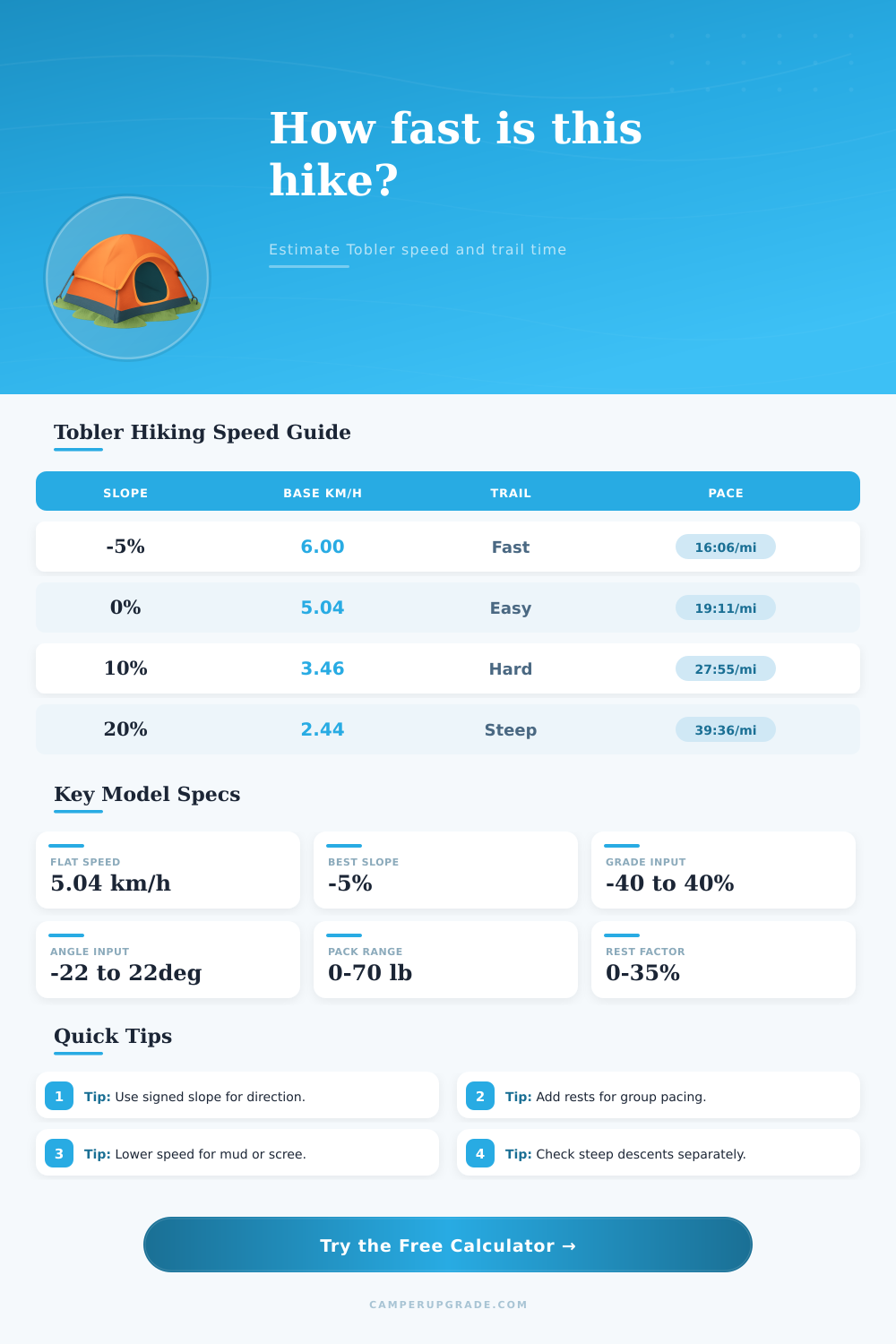
📐Tobler Slope Speed Table
| Signed slope | Slope angle | Tobler speed | Penalty or bonus vs flat |
|---|---|---|---|
| -15% downhill | -8.5° | 4.23 km/h / 2.63 mph | 16% slower than flat |
| -10% downhill | -5.7° | 5.04 km/h / 3.13 mph | About equal to flat |
| -5% downhill | -2.9° | 6.00 km/h / 3.73 mph | 19% faster than flat |
| 0% flat | 0.0° | 5.04 km/h / 3.13 mph | Baseline flat model |
| 5% uphill | 2.9° | 4.23 km/h / 2.63 mph | 16% slower than flat |
| 10% uphill | 5.7° | 3.46 km/h / 2.15 mph | 31% slower than flat |
| 15% uphill | 8.5° | 2.92 km/h / 1.81 mph | 42% slower than flat |
| 20% uphill | 11.3° | 2.44 km/h / 1.52 mph | 52% slower than flat |
🚶Terrain and Condition Modifiers
| Modifier type | Multiplier | Best use | Planning effect |
|---|---|---|---|
| Smooth trail | 1.08x terrain | Graded path, rail trail, smooth dirt. | Allows a small speed lift above the raw model. |
| Maintained trail | 1.00x terrain | Normal hiking singletrack. | Leaves Tobler speed unchanged before other inputs. |
| Rocky or rooted | 0.90x terrain | Uneven steps, rocks, roots, short ledges. | Reduces moving speed by about 10%. |
| Loose scree or sand | 0.80x terrain | Sliding footing, dry washes, unstable tread. | Turns moderate grades into slow travel segments. |
| Snow or icy tread | 0.74x condition | Compacted snow, ice patches, winter approaches. | Traction limits speed more than slope alone. |
🎒Pack Weight Adjustment Table
| Pack load | Model factor | Typical route | Use note |
|---|---|---|---|
| 0-10 lb / 0-4.5 kg | 1.00x | Short walk, water and shell only. | Light enough to ignore in most trail timing. |
| 15 lb / 6.8 kg | 0.98x | Day hike with food, layers, and water. | Small effect, but visible on long climbs. |
| 25 lb / 11.3 kg | 0.94x | Full day or light overnight kit. | Noticeable on sustained uphill grades. |
| 35 lb / 15.9 kg | 0.90x | Backpacking load with shelter and food. | Plan slower starts and more rest time. |
| 50 lb / 22.7 kg | 0.84x | Expedition, winter, or group gear carry. | Use conservative buffers and shorter segments. |
📝Preset Comparison Table
| Preset | Distance | Slope and surface | Modeled planning result |
|---|---|---|---|
| Flat rail trail | 5.0 mi | 0%, smooth, dry | About 1h 43m including rests and margin. |
| Gentle downhill | 4.0 mi | -5%, smooth, dry | Fast Tobler segment near the model optimum. |
| Steady uphill climb | 6.5 mi | 8%, maintained, normal | Moderate penalty with a 20 lb pack. |
| Rocky descent | 3.8 mi | -12%, rocky, wet | Downhill speed is capped by footing and caution. |
| Loaded backpacking | 9.2 mi | 6%, maintained, normal | Pack factor and rest factor dominate planning time. |
💡Calculation Tips
Run uphill and downhill segments separately when a route changes direction. Tobler treats a 10% uphill and a 10% downhill differently, with the best speed near a mild 5% downhill.
If your recent hikes are consistently slower than the result, reduce the terrain or group multiplier instead of changing the slope. That keeps the model transparent for future routes.
The Tobler function is a planning model, not a safety rule. Trail closures, weather, altitude, heat, navigation, creek crossings, snow travel, and individual fitness can change real travel time.
When planning a hike, it is important to be able to estimate how long it will take to complete that hike. It is difficult to find the time that it will take to complete an hike due to the various factor that may impact that time. One tool that can be used to estimate the time it may take to hike is the Tobler hiking speed calculator.
The Tobler hiking speed calculator is a tool that consider various variables about the hike to provide an estimate of the time required to hike those distance. The Tobler hiking speed calculator determines the hiking speed of an individual based off a mathematical curve. The mathematical curve indicates that the speed at which an individual can hike is highest on gentle downhill slope.
How to Use the Tobler Hiking Speed Calculator
The use of gravity makes walking on a downhill slope more easy than other types of walks, and individuals can travel at a faster rate on those type of slopes. An individual’s speed on a downhill slope, however, decreases the steeper of those slope are. Individual speed on hills may seem similar, but an uphill slope will slow an individual more then a downhill slope will speed an individual.
The Tobler hiking speed calculator allows for individual segment of a hike that include hills to be calculated separately. Thus, an individual will not mistake the time required for uphill hikes as the same as the downhill hiking time required for that same hike. The terrain that an individual is hiking upon and the weight of the individual’s hiking gear both impact the speed at which an individual can hike.
An individual who is planning there hike must consider these variables. If the terrain that an individual will hike on is maintained and flat, the individual will be able to maintain a higher hiking speed. If the terrain includes feature like roots, mud, or rocks, however, the individual’s hiking speed will be slower on those type of terrain.
The weight of the individual’s gear will also impact their hiking speed; heavier gear will make it more difficult for an individual to climb hills, and reduce their speed on flat terrain, as well. The Tobler hiking speed calculator allows the individual to enter these variable, so they dont have to memorize the various coefficient that impact hiking speed. The number of individual who will hike or the speed at which each individual takes rests will impact the total time that is required for the hike.
An individual will need to account for the time that they will spend resting throughout the hike. If an individual is planning to hike with other, a group multiplier will be required to ensure that the group does not move too quick for the other member of that group. A safety margin should also be included in the hike’s time calculation to provide extra time for unexpected weather change or navigational error on the hike.
In order to use the Tobler hiking speed calculator, an individual should first divide the long route that they plan to hike into several smaller segment. Each of those segment can be entered into the Tobler hiking speed calculator to determine the time that it will take to hike each of those segments. The times for each of those segment can be entered into the calculation to determine the total amount of time that will be required to hike the entire route.
This method is one way of calculating hiking time, and the route can also be checked for accuracy by comparing it to the reference table included with the Tobler hiking speed calculator. Although the Tobler hiking speed calculator can include many of the variables that may impact hiking speed, it does not account for all variable. Variables that the Tobler hiking speed calculator does not account for may include the potential impact of high altitude, high heat, and the fatigue of the hiker.
These variable should be accounted for in the safety margin for the hike. Any hike that estimate the time that is required for the hike with the Tobler hiking speed calculator is best if the time calculated is not too close to the individual’s limit. Thus, if the time determined by the Tobler hiking speed calculator is close to an individual’s limit for hiking time, the individual should of begin hiking earlier or reduce the length of their hiking day.
The Tobler hiking speed calculator is a helpful tool that allows an individual to turn guess into decision regarding their hike. It’s a moddern way to plan, but you’re still responsible for your own safety. Most people find it actualy quite useful for their trips.