Tide Interval Calculator
Estimate high and low tide timing intervals, next event times, and daily drift for trip planning.
🌊Scenario Presets
⚙Timing Inputs
📊Tide Planning Benchmarks
📘Reference Tables
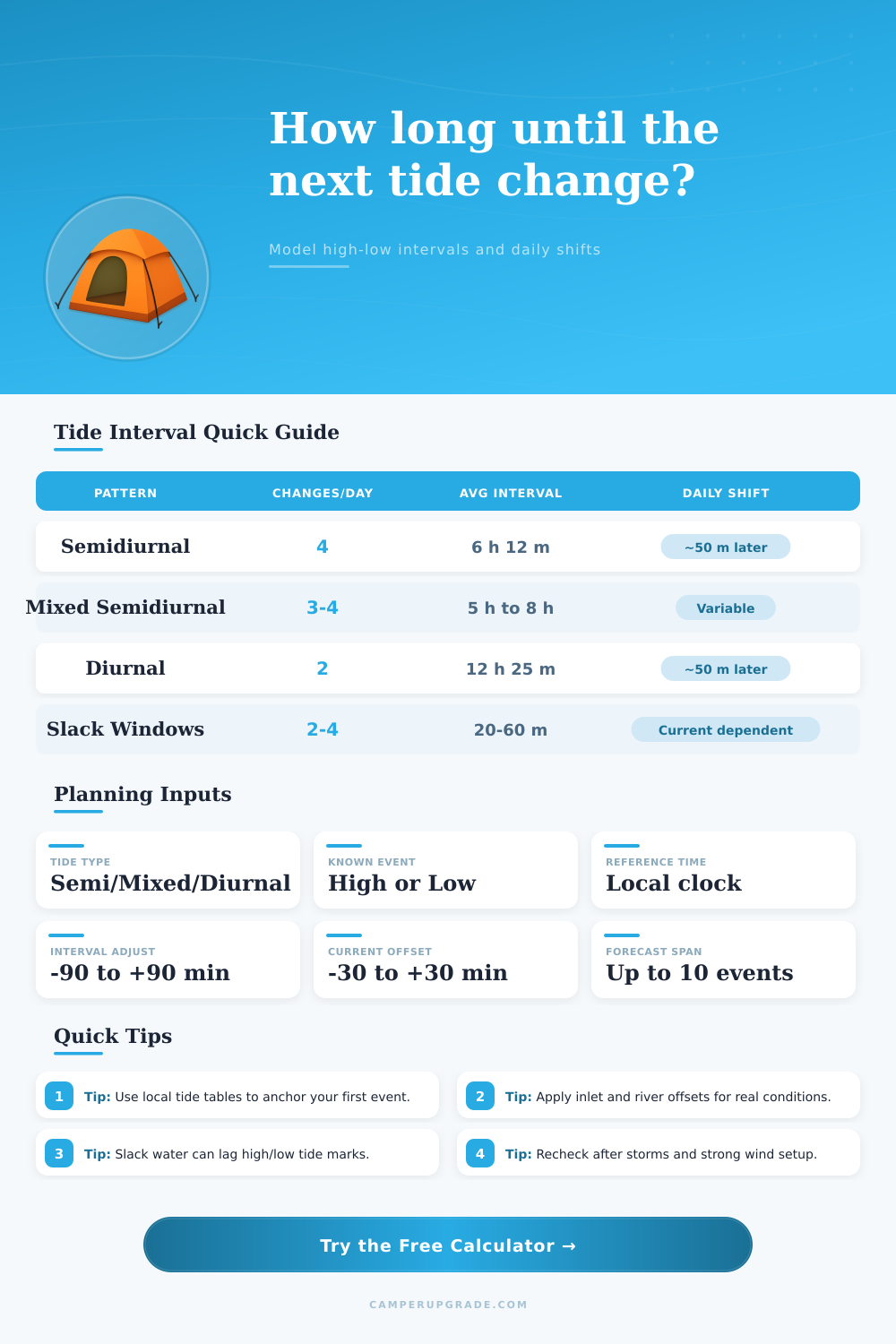
| Tide Pattern | Typical Sequence | Nominal Interval | Planning Note |
|---|---|---|---|
| Semidiurnal | H-L-H-L | 6 h 12 m | Most consistent alternation |
| Mixed Semidiurnal | H-L-H-L | 5 h to 8 h | Unequal highs and lows |
| Diurnal | H-L | 12 h 25 m | One high and one low each day |
| Current-Dominated Inlet | Slack-H/L shift | Site specific | Current turns may lag tide marks |
| Daily Shift | 1 Day Drift | 3 Day Drift | 7 Day Drift |
|---|---|---|---|
| 40 min/day | +0:40 | +2:00 | +4:40 |
| 50 min/day | +0:50 | +2:30 | +5:50 |
| 60 min/day | +1:00 | +3:00 | +7:00 |
| Variable mixed | +/-0:30 | +/-1:30 | +/-3:30 |
The gravity of the moon causes tides chiefly. It and the sun draws the water direct to itself and away of the Ground. That then attracts the Ground self away of the water at the contrary side.
Because of that high tides appear simultaneously at two sides of the Ground. The Ground twists through two tidal swellings during every lun-day. Coast regions so experience two high and two low tides each 24 hours and 50 minutes.
How the Moon and Sun Make Tides
High tides usually come in 12 hours and 25 minutes of interval. Between high and low tide passes 6 hours and 12 minutes. In some places tidal flows happen almost all 6 hours.
Tidal cycles can be complicated. The strongest is M2, with period of 12.4206 hours. Double that give 24.8412 hours so 24 hours and 50.47 minutes.
One full tidal cycle ends after 24 hours and 50.4 minutes, because the moon moves around the Ground. Rotation of the Ground and orbit of the moon goes in same direction. So that the Ground repeatedly reach the moon requires one extra 50 minutes.
Hence you have two high and two low tides each 24 hours and 50 minutes.
Exist different tidal kinds. Spring tides bring water higher than average. They cause also low levels lower than average, strong flows and shorter loosening of water.
Neap tides give gentle provisions. Between spring and neap pass around seven days. Incoming tide is interval of low until high.
Outgoing tide lasts of high until low. The height-difference between them is the tidal scope.
Common establishment is other name for tidal interval. You also call it vulgar establishment. It differes to the corrected establishment that averages all high-aquatic intervals.
The corrected establishment usually is 10 until 15 minutes shorter than common. Lunitidal interval is difference between first high tide after moonrise and the moonrise self. Some navigators use lunitidal interval for point high and low waters.
Tidal clock would can dividiĝi in two 6-horajn periods for average times in twice-diurnal areas as Atlantic Ocean.