Thru Hike Finish Date Calculator
Estimate a finish date from trail miles, start date, miles already completed, hiking pace, zero days, nero days, terrain difficulty, seasonal buffer, and deadline pressure.
🧭Thru Hike Presets
📅Trail, Pace, And Calendar Inputs
Use your trail start date, or today's date when updating mid-hike.
Optional, but useful for snow windows, flights, permits, or work return dates.
Enter official trail miles or the route length you actually plan to walk.
For a new thru hike, leave this at zero. For a reforecast, enter progress so far.
This is average miles on days you hike, before zero and nero adjustments.
A ramp prevents early pace optimism from making the finish date too aggressive.
A zero day is a full non-hiking day for rest, weather, town, illness, or logistics.
A nero day counts as partial hiking. The calculator applies the mileage share below.
Example: 45% means a 15 mile hiking day becomes 6.8 miles on a nero day.
Use for mail drops, permit errands, family visits, gear swaps, or travel around closures.
Terrain modifies the practical miles per hiking day.
The buffer appears in the finish forecast and deadline check.
This adjusts how much hidden downtime to expect beyond explicit zeros.
Optional. Use for mid-hike pace notes; it does not change remaining mileage.
Formula core: effective daily miles combine hiking days, zero days, nero days, ramp loss, terrain adjustment, rest rhythm, town days, and seasonal buffer before converting remaining miles into a calendar date.
Thru Hike Finish Forecast
⚙Finish Date Model Spec Grid
🥾Major Trail Finish Date Benchmarks
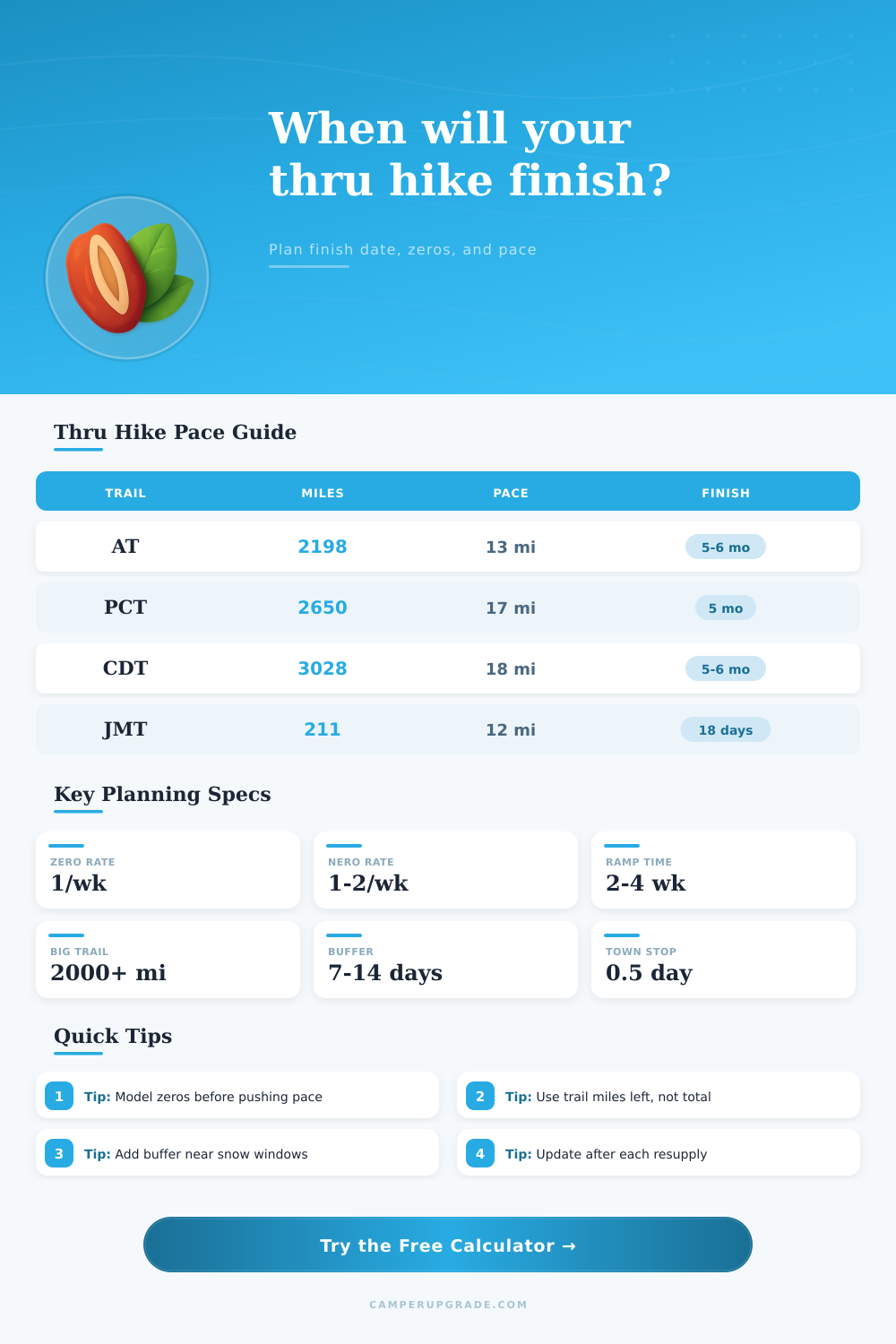
| Trail or route | Approx miles | Common calendar range | Typical planning pressure |
|---|---|---|---|
| Appalachian Trail | About 2198 miles | 5 to 7 months | Big elevation swings and frequent town access. |
| Pacific Crest Trail | About 2650 miles | 4.5 to 6 months | Desert heat, Sierra snow, and northern weather window. |
| Continental Divide Trail | About 3028 miles | 5 to 6.5 months | Route choices, altitude, weather, and longer carries. |
| John Muir Trail | About 211 miles | 2 to 4 weeks | High passes, permit dates, and food carry weight. |
| Colorado Trail | About 486 miles | 4 to 7 weeks | Altitude, storms, and resupply spacing. |
⏱Zero And Nero Planning Table
| Rest pattern | Zero days per 30 | Nero days per 30 | Calendar effect |
|---|---|---|---|
| Fast or deadline-driven | 0 to 2 | 2 to 4 | Strong pace, low recovery margin. |
| Balanced thru hike | 3 to 5 | 4 to 7 | Common mix of rest, chores, and social time. |
| Town-friendly pace | 5 to 8 | 6 to 10 | More resupply flexibility and slower finish date. |
| Recovery or injury cautious | 7 to 10 | 6 to 12 | Protects the body but stretches the season. |
| Remote high-route travel | 2 to 4 | 1 to 3 | Fewer towns, but more weather and terrain delay. |
🏔Terrain Adjustment Reference
| Terrain setting | Calculator factor | When it fits | Finish date effect |
|---|---|---|---|
| Smooth tread | 1.08x | Canal paths, mild grades, or easy tread. | Raises practical hiking-day miles. |
| Rolling trail | 1.00x | Normal trail grade with regular climbs. | Uses entered hiking-day mileage. |
| Mountain trail | 0.92x | Long climbs, frequent descents, and elevation load. | Adds calendar days through slower progress. |
| Technical high route | 0.82x | Rock, passes, talus, snow, or difficult navigation. | Can move finish by weeks on long trails. |
| Desert or muddy travel | 0.86x to 0.88x | Water carries, heat, wet tread, or blowdowns. | Reduces pace and increases buffer need. |
📊Example Finish Date Scenarios
| Scenario | Miles left | Hiking-day pace | Approx calendar outcome |
|---|---|---|---|
| AT new start, balanced | 2198 miles | 15 miles | About 5.5 to 6.5 months. |
| PCT new start, steady | 2650 miles | 20 miles | About 4.5 to 5.5 months. |
| CDT high-route style | 3028 miles | 21 miles | About 5.5 to 6.5 months. |
| Mid-hike reforecast | 850 miles | 18 miles | About 7 to 9 weeks. |
| Short trail fastpack | 270 miles | 24 miles | About 12 to 16 days. |
📝Deadline Buffer Guide
| Buffer result | What it means | Possible adjustment | Trail planning note |
|---|---|---|---|
| 21 days or more | Comfortable deadline cushion. | Keep normal zeros. | Good for flexible finish logistics. |
| 8 to 20 days | Useful but not huge cushion. | Review weather and resupply gaps. | Watch long town stays. |
| 0 to 7 days | Tight finish window. | Cut zeros or lift hiking-day mileage. | Small delays can erase the margin. |
| Past deadline | Forecast misses target. | Rebuild the plan now. | Deadline pressure needs a real pace change. |
| No deadline | Open-ended finish forecast. | Use projected date for travel planning. | Recalculate after resupply blocks. |
✅Thru Hike Finish Date Tips
This calculator is a planning estimate. Weather, trail closures, health, snow, fire, route alternates, permits, and transport logistics can change the finish date.
The idea of planning a thru hike finish date seems easy enough until you begin to add in variables. Choose your start day, guess at your miles per day and add in zero days for weather windows and time in towns. Then consider that your legs might hike slower in week one than they do in week three of the trip. Suddenly, it’s not about how far you can hike on a good day. It’s about adding up how long it takes when you factor in rest, logistics, and terrain. How many calendar days will it actualy take? That’s what the calculator above does.
By factoring in a ramp period of time for early season conditioning, a buffer for your season (whether it’s heat, snow, permits), zero days, and rest days, it convert your desired pace on a hiking day into a pace on the calendar. So when the calculator spits out a finish date, it already takes into account the knowledge that you aren’t going to go full-tilt-boogie each and every day you’re hiking. Rest patterns are the most underappreciated time shapers for hikers. Even if your “aggressive” plan looks good on paper it can end up finishing late (if zero days accumulate faster than expected or if town stops stretches beyond the half-day allowance built into the model). Conversely, even a slower daily pace and fewer zero days may yield an earlier finish then a faster pace that forces multiple recoveries. The calculator shows these tradeoffs without forcing you to do the math.
How to Plan Your Hiking Finish Date
But few of us realize how much season and terrain influence things. Rolling terrain might appear similar to something as mild as a mountain trail but can slow you down enough to add several weeks over two thousand miles. And a high route with a snow window may require adding buffer days not apparent in your initial route sketch. Adjustments such as these is easily forgotten about until it’s too late and you’re behind schedule.
But it’s not just about doing it one time, it’s about doing it multiple times. Replenishing that first resupply? Update the number of miles covered. Tweak your recent mileage pace. Refresh your finish date. Same thing if you’re midway through the hike and discover you’re getting more neros than expected, or perhaps weather is making you take an additional rest day. Every new calculation provides a better understanding of whether you’re on track for your target or need to make an adjustment before the window closes.
That’s not something that a calculator can pick up on, the human element of the decision. Will you arrive a week late? Sure. Is it worth coming home with your body intact? That’s your call. How many town stop are going to be worth the hit to your calendar? How much extra breathing room do you want in your buffer? Those are all decisions for you to make. What these numbers will do is help show what each one might cost you in terms of time.